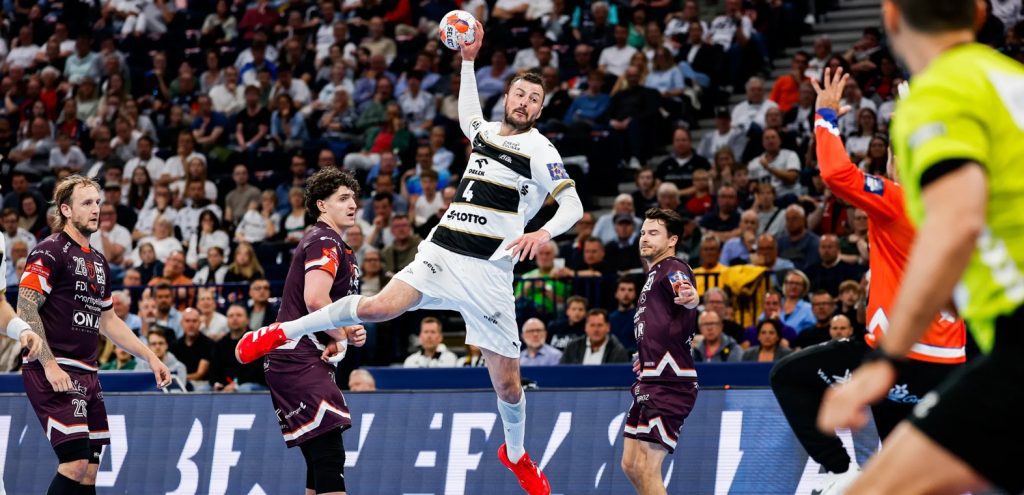
The new season of the EHF European League Men kicks off on October 14, featuring 32 teams from 17 countries and a final stage scheduled in Hamburg on May 30 and 31, 2026. As the second-most important competition in continental handball, it shares the calendar with the EHF Champions League, but not its philosophy. Both tournaments are part of a dual strategy by the European Handball Federation -EHF- to combine elite spectacle with grassroots development, each with its own economic and communication approach.
The Champions League represents the highest competitive and media level in European handball. It features national champions and runners-up, with a permanent Final Four in Cologne (Germany) and significant investment in television production. The European League, meanwhile, works as an expansion platform: it opens space for emerging clubs, prioritizes geographical diversity and gives visibility to markets where handball is still growing. The EHF uses both leagues to sustain the same ecosystem, but with different goals — global profitability in one, sustainable growth in the other.
Two tournaments, two market approaches
The financial gap between the two competitions is evident. The Champions League distributes around 750,000 euros in prize money during its final stage, with 300,000 going to the champion and proportional amounts to the remaining finalists. Clubs also receive bonuses for victories, participation fees and broadcasting rights, turning the tournament into a stable source of income and visibility. The European League, by contrast, offers smaller and less transparent financial rewards but provides a different kind of return: media exposure and institutional strengthening. For many clubs, it’s a medium-term investment rather than an immediate profit.
The EHF’s media strategies also differ depending on the tournament. The Champions League relies on an international network of broadcasters and exceeded one billion combined impressions across television and digital platforms in the 2021/22 season. Its audiovisual coverage includes unified graphics, multilingual commentary and the “Match of the Week” for its top games. The European League, on the other hand, has focused on the EHFTV platform and a digital model designed for accessibility. High-definition broadcasts, English-language production and strong social media presence are key elements of a strategy aimed at younger audiences and local markets.
The EHF and its dual growth model
Since the 2023/24 season, the EHF has separated club rankings between the Champions League and the European League, allowing each competition to evolve under its own parameters. The decision reflects a strategic goal: preventing the performance of major clubs from distorting the evaluation of developing leagues. This approach allows two complementary products to coexist. The Champions League consolidates sporting excellence and commercial return, while the European League broadens the reach of European handball into new countries and among new sponsors.
The federation has strengthened its commitment to technology and professional broadcasting. Its final tournaments now feature 1080p production quality and cinematic-style cameras, with up to 21 camera units offering a more immersive experience. The EHF has also introduced the Youth Club Trophy, a continental youth club competition that will share the same venue as the senior Final Four in Cologne from 2025 onward. In addition, it has published the “European Handball 2024” report, containing data on audiences, innovation and governance transparency. These steps outline a future based on digital growth and talent development.
Impact on smaller clubs
The European League has become a gateway to the continental stage for smaller-budget clubs. It offers international experience, media exposure and the ability to attract sponsors. However, it also demands a significant financial effort: long-distance travel, larger squads and logistical challenges that are not always offset by direct income. Even so, the competition has become a driver of professionalization. It pushes local structures to improve management and communication and strengthens the identity of clubs that, though far from the elite, aim to establish themselves within European handball.
With the European League underway and the Champions League well established, the EHF maintains two parallel paths of growth: one focused on sporting excellence, the other on sustainable expansion. The model shows that a single sport can multiply its reach when it diversifies its market, media and institutional strategies.
 Last related articles