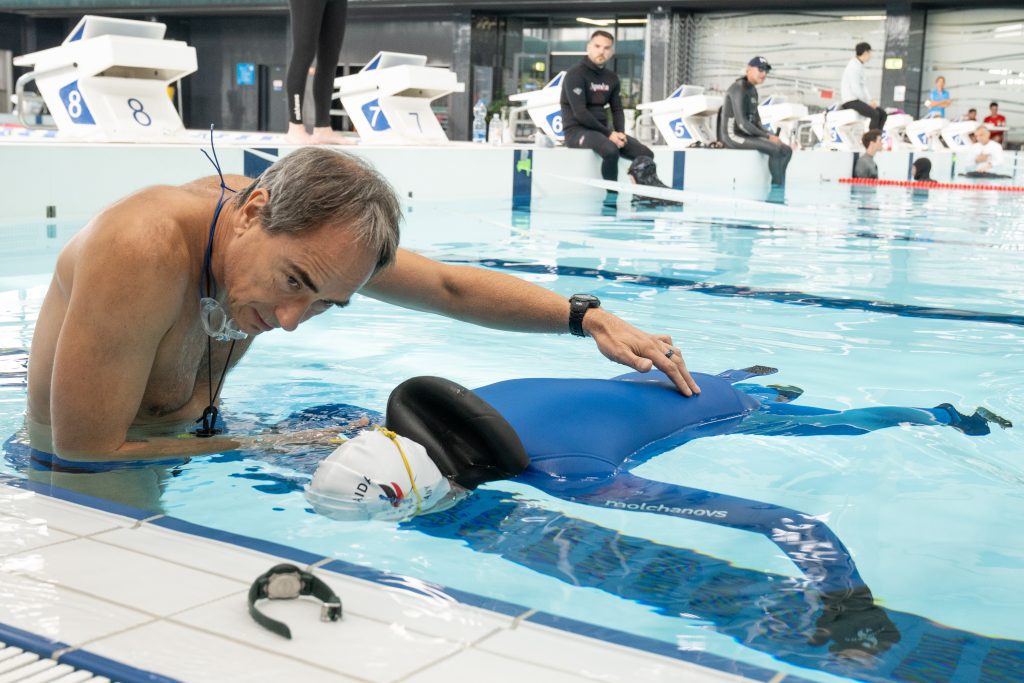
Heike Schwerdtner raised the historical level of the World Apnea 2026 Pool Championships with a new world record in Static Apnea -STA- on the third day of competition. The German held her breath for 9 minutes and 39 seconds at the Duna Arena in Budapest, a performance pending ratification following routine anti-doping controls. Static Apnea, a discipline in which athletes remain face down on the surface of the water trying to hold their breath for as long as possible, gave the championships their third world record in three days.
Schwerdtner’s mark comes in a new stage of progression that has brought the women’s discipline closer to the symbolic 10-minute barrier. In 2024, she became the first athlete in 11 years to break the previous women’s world record of 9:02 and, since then, has continued to raise her own benchmark. Her performance in Budapest followed the world records set by Magdalena Solich-Talanda in Dynamic Apnea with Bi-Fins and Mateusz Malina in Dynamic Apnea without Fins during the first two days of the championships.
Schwerdtner, 10 years of calm on the way to the record
Schwerdtner admitted after the performance that she was lost for words and proud to have achieved a mark for which she had been preparing for a long time. “I’ve been freediving for about 10 years and for 10 years I’ve trained Static Apnea regularly,” she explained. She also stressed that she had not specifically prepared for a world record, but for a strong performance beyond nine minutes. “I wanted to do a good static apnea of more than nine minutes. And now it has become a world record,” she said.
The German described Static Apnea as a special discipline because it allows her to be completely still and focused within herself. “I can be really calm inside myself,” she said. Klaus Kasten, her husband and coach, also plays an important role in that concentration as he supports her throughout the competitive process. Kasten explained that he tries to help her at home, in training and, above all, during the performance. “The most important thing during Static Apnea is to shield her from everything, so that she can focus only on herself,” he said. His aim, he added, is to give her security and allow her “to let go, stay relaxed and think about nothing”.
Dagoury wins, Malina returns to the podium and South Africa marks a historic day
The men’s gold went to Florian Dagoury, with 9:01. Aleksandr Maksimov took silver with 8:54 and Malina added bronze with 8:37, becoming the only athlete to win medals in all three pool disciplines contested up to that point. Dagoury, despite the title, admitted he was “a little disappointed” with his performance, although he recognised that “it’s not so bad” and that in sport you have to keep going. The Frenchman explained that he has been training five or six times a week for around two years, has practised freediving since 2012 and has specialised in Static Apnea for the last decade. He also said he likes the discipline because it works as a form of meditation, calms him and can be practised anywhere, unlike depth or dynamic apnea, which require more organisation, a pool or a club. “Doing breath-holds on the sofa” was, he said, a natural way to start approaching an event he could train in almost any context.
In the women’s competition, Yuriko Ichihara took silver with 7:41 and Fiona De Sousa won bronze with 7:25, a personal best and a new African record. Ichihara was pleased to have received a white card, although she admitted some frustration at not getting closer to her personal best. De Sousa, by contrast, described her performance as “smooth”, “amazing”, “easy” and “relaxed”, a feeling that, she explained, does not always appear in Static Apnea. The South African also highlighted the work of her coach, Eyal, and said she has been freediving for around four years, two of them competitively, and training specifically for Static Apnea for around two years. Her result was part of a particularly important day for South Africa, which celebrated two African records: De Sousa’s 7:25 in the women’s category and Anton De Wet’s 7:08 in the men’s competition.
Budapest sustains a record-breaking championships
The venue also featured prominently in the athletes’ assessments. Schwerdtner said she especially enjoys these championships because of the organisation, which she described as “fantastic”, and because of the chance to meet international athletes again, see familiar faces and share experiences. Dagoury also praised the level of the event, with large-scale facilities, several pools of different depths, filming under the water and above the surface, interviews, commentary to explain the events to specialists and new audiences, and anti-doping controls. De Sousa described the championships in Budapest as “phenomenal” and the facilities as “incredible”.
The day produced eight national records, six by women and two by men, and brought together 192 athletes in Static Apnea. The World Apnea 2026 Pool Championships, organised by AIDA International under the World Apnea brand, feature 264 athletes from 60 countries across four pool disciplines: Dynamic Apnea with Bi-Fins -DYNB-, Dynamic Apnea without Fins -DNF-, Static Apnea -STA- and Dynamic Apnea with Monofin -DYN-. After three consecutive days with world records, the competition will conclude on 6 June with the Dynamic Apnea event.
 Last related articles