Antonio Fernández Arimany (Madrid, 1968) conveys calm, reflection and reasoned arguments when explaining all the changes he has introduced since becoming president of World Triathlon in October 2024. After eight years as secretary general, the Spanish official took charge of a sport divided across different distances, organisers and circuits. Less than two years later, he has already announced a global reform that brings everything under the same umbrella: the new “Triathlon World Tour, which will begin in 2027”, as Arimany explains to SportsIn in an exclusive interview.
This month, World Triathlon announced its shared future with the Professional Triathletes Organisation (PTO), while also incorporating new disciplines such as the fitness racing developed by HYROX and strengthening the federation’s internal operations. Reaching this point, however, required a deep assessment of the organisation itself. “The first thing we did was try to carry out an independent analysis of what was happening and of the overall situation, not only within the international federation, but across the sport”, Arimany tells SportsIn. World Triathlon commissioned Deloitte to study triathlon’s commercial potential, the sale of media rights and the attraction of new sponsors. The report confirmed that the sport had an attractive product, but one divided among too many organisations.
Investors did not know where to enter
Arimany visited some of the major funds and advisers already active in the sports industry in London. The response was repeatedly the same: “Yes, of course we are willing to invest in triathlon, but we do not know where. We do not know whether to invest in your World Championship, in IRONMAN, in PTO, in Challenge or in Super League. When in doubt, they did not invest. As a result, I got to work because we needed to bring ourselves together to create a stronger product that would be more attractive to the major investors who now play an important role in the world of sport”. Arimany understood that innovation was necessary in order to progress.
The fragmentation also prevented the best triathletes from competing within a clearly recognisable international circuit. “There was no major circuit that served as the global reference point. We had our World Championship over the Olympic distance; Challenge and IRONMAN operated in long-distance triathlon; and PTO had emerged in middle-distance racing. The appeal for major commercial brands was lower and we always remained at a second level”.
Faced with this situation, and although it might have appeared to be a disadvantage, the nature of triathlon has helped the sport move quickly towards a new model. Arimany believes triathlon possesses a commercial base that other sports took much longer to develop. “Triathlon is a business. That is why there are so many private organisers. We have huge mass participation and, from that base, we can grow and contribute our experience as the sport’s governing body”. His intention is to move the model closer to golf and tennis, where amateur participation coexists with recognisable and commercially powerful professional circuits.
Triathlon’s MotoGP
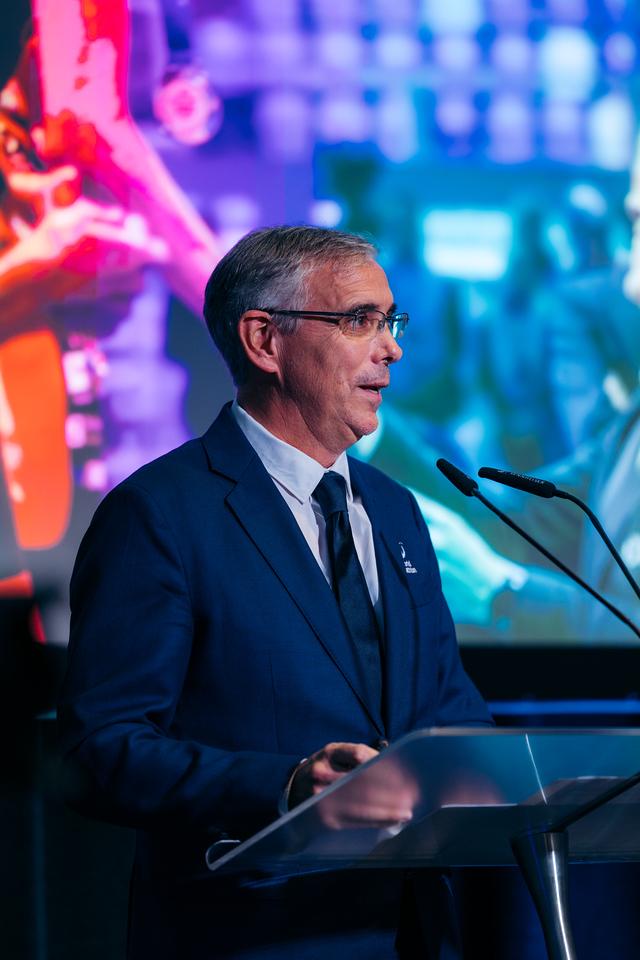 Negotiations with PTO have led to the creation of the Triathlon World Tour, which will begin in 2027. The structure will bring the existing T100 and the World Triathlon Championship Series together under the same brand, with the competitions becoming the T100 World Championship Tour and the T50 World Championship Tour. Beneath them will be Challenger competitions providing a route into both championships, incorporating the former World Cups and Challenge Family events following its acquisition by PTO.
“We are not creating a new company or a new entity. We are entering into a collaboration agreement in which each party contributes in the areas where it is strongest”. PTO will mainly be responsible for commercial operations, marketing and audiovisual development. “We will retain the sporting and official side: the rules, anti-doping and the delivery of the competition, which is where we have greater experience”.
For fans, Arimany compares the new structure to motorcycle racing. “We are creating something similar to MotoGP, with two world championships within the same circuit. Instead of having top-level triathlon on ten weekends, we will be able to offer it on twenty or twenty-five. We want broadcasts to be much more frequent and for triathlon not to appear and disappear, but to have regularity”.
The Olympic distance will be marketed as T50 and will coexist with T100 without forcing athletes to compete in every event. “They are different distances and different athletes, although some may compete in both. We know a triathlete cannot race twenty times a year because there are physical and health considerations. We want to protect our athletes”. The first calendars announced for 2027 include nine T50 events and eight T100 races, while the remainder of the structure is completed.
HYROX opens the doors of gyms to triathlon
World Triathlon’s expansion also extends to the fitness racing developed by HYROX. The federation’s Congress approved the recognition of this multisport discipline in October 2025, and it has since been integrated under the name Hyathlon.
“We call it hybrid racing. HYROX is a commercial brand that organises a hybrid competition, and triathlon is also, ultimately, a multisport competition. It fits within our DNA”. The president sees the format as a way to connect with people who train in cities and have less time available to practise outdoor endurance sports.
“The reality is that young people want to exercise for a maximum of one hour a day and in a place close to their home. Almost all of the world’s population lives in cities. Where can they do that? In gyms”. HYROX has also added a competitive objective to everyday training: “I no longer go to the gym simply to get fit. I have the goal of taking part in an accessible competition that also incorporates endurance, which is part of triathlon’s nature”.
Arimany believes that motivation explains much of the discipline’s growth. “When you have an event as a goal, you tell yourself that you cannot miss a session because you have to be ready for that day. That is what competition creates: it enables and encourages you to train”. The federation intends to use that community as a gateway into triathlon: “We will gain access to a section of the population that is already practising sport and to whom, in addition to HYROX, we will also be able to offer triathlon”.
Transparency as the route into Group A1
Alongside its adaptation to society’s new reality, World Triathlon has also progressed in other areas. In June, it reached Group A1 in the ASOIF review of international federations. It scored 210 points out of 240 and entered the highest category for the first time, alongside thirteen other organisations. The assessment covered transparency, integrity, democracy, development, sustainability and oversight mechanisms.
“Our main strength is transparency. All the information concerning the international federation can be found on our website: the accounts, the budgets and the agreements signed with the continental confederations, which set out the funding they receive for development”.
The promotion also recognised athlete representation, reporting mechanisms, procedures concerning conflicts of interest and policies protecting people from abuse. “We have implemented a new safeguarding code. It is the result of several years of work and now represents a responsibility. We cannot relax; we have to continue making progress, while always understanding who we are and the size of our international federation”.
Sport opens up to private operators
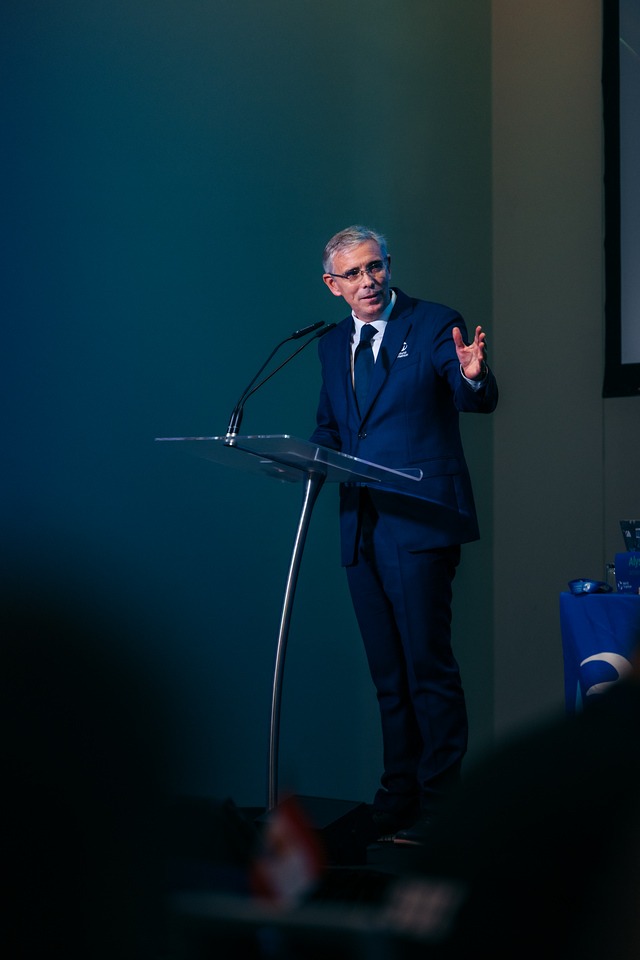 Arimany combines the presidency of World Triathlon with one of the vice-presidencies of the International Council of Arbitration for Sport (ICAS), the governing body of the Court of Arbitration for Sport (CAS). From that position, he observes how private investment is changing the traditional structures of sports federations. “CAS plays a fundamental role in resolving sports disputes, particularly because of the speed with which they are settled. Sport has a different nature, and resorting to ordinary courts would create problems because they would not always provide that specialist understanding”.
In his view, the deepest change is coming from outside the federations. “Sport has become both a sporting and entertainment product that is highly attractive to major global investors. Private organisers are appearing more and more frequently and will transform sport over the coming years”.
World Triathlon has chosen to partner with those operators rather than attempt to halt their growth. “What we are doing in triathlon will happen in many more sports. The competition rules applied by the European Union will reach sport, and we will have to learn to coexist with this new market environment”.
That process will require combining the European pyramid model, in which federations organise sport from grassroots level to the elite, with private structures closer to the American system. “We have to find a way to bring everything together so that sport can develop globally and so that work with young people and children is not lost by focusing solely on professional sport”.
To conclude, Arimany summarises his mandate by stressing the need to adapt without abandoning sport’s public role. “We must seek out all the opportunities that today’s world offers us. We live in a highly complex society with many conflicts, and sport is a powerful tool for progressing in peace. We have to evolve and give sport the importance it holds in our society”.
 Last related articles