The election of the next president of the Association of National Olympic Committees (ANOC) has taken on a new political and institutional dimension. Opposition to the proposed presidential power-sharing arrangement between Mustapha Berraf and Alejandro Blanco is now accompanied by serious questions about how the National Olympic Committees of the Americas are represented.
At the centre of the controversy is an October 31 letter signed by Panam Sports President Neven Ilic and Secretary General Jimena Saldaña. The document opposes the proposed rotation of the ANOC presidency between the two candidates and lists 38 National Olympic Committees.
Two subsequent letters, from Paraguay and Mexico, challenge the consultation and representation procedures surrounding that intervention. The three documents are reproduced at the relevant points below, with the central portions of handwritten signatures obscured.
The controversy is particularly significant because Ilic had previously expressed support for Blanco, as had European Olympic Committees President Spyros Capralos. Two continental leaders who supported the Spanish candidate have therefore opposed a presidential arrangement in which he himself participated.
A Letter Challenging the Agreement and Both Candidates
In their letter to ANOC President Robin Mitchell and Secretary General Gunilla Lindberg, Ilic and Saldaña argue that the proposed Berraf–Blanco arrangement would conflict with the ANOC Constitution and undermine an open and democratic electoral process.
The document refers to a reported agreement under which the candidates would each serve two years during the 2026–2030 presidential term. It invokes constitutional provisions concerning the General Assembly, election by secret ballot and a four-year presidential term.
The letter calls for an election respecting the duly submitted candidacies, with voting conducted on equal terms, and asks that the document be forwarded to the members of ANOC’s Executive Council.
These are substantial constitutional objections. They must also be distinguished from the separate question of whether every committee listed in the letter had authorised the position presented in its name.
The original arrangement had been presented as a political initiative subject to constitutional requirements and ANOC’s institutional procedures. Questioning whether it could be implemented is different from establishing that the candidates intended to deprive National Olympic Committees of their voting rights.
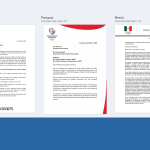
The Panam Sports letter dated October 31, 2026, addressed to ANOC President Robin Mitchell and Secretary General Gunilla Lindberg. The four-page document lists 38 National Olympic Committees. Central portions of handwritten signatures have been obscured.
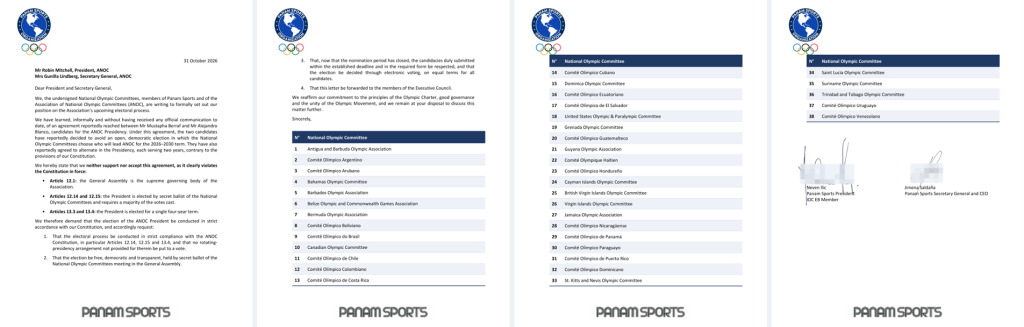
The Panam Sports letter dated October 31, 2026, addressed to ANOC President Robin Mitchell and Secretary General Gunilla Lindberg. The four-page document lists 38 National Olympic Committees. Central portions of handwritten signatures have been obscured.
Ilic and Capralos: A Striking Political Convergence
Ilic’s position becomes particularly interesting when examined alongside that of the European Olympic leadership.
In September, Ilic and Capralos had publicly supported Blanco’s candidacy. The European side subsequently opposed the proposed two-plus-two arrangement while maintaining its support for the Spanish candidate. The October 31 Panam Sports letter similarly rejects the proposed rotation without explicitly withdrawing Ilic’s earlier support for Blanco.
The political implications deserve scrutiny. An agreement involving Blanco and Berraf encountered opposition from influential continental leaders who had previously backed one of its participants.
Did those interventions help create the political conditions that enabled Blanco to disengage from the agreement and return to an independent presidential campaign?
The question became more relevant on November 6, when Blanco presented his campaign for the full 2026–2030 term.
The sequence does not establish prior coordination or a joint plan to dismantle the agreement. It does, however, warrant examination of the convergence of positions against the rotation and its consequences for Blanco’s campaign.
Sheikh Joaan’s Mediation and the Collapse of the Compromise
The Berraf–Blanco agreement emerged through mediation involving Sheikh Joaan bin Hamad Al Thani. The initiative sought a consensual solution to ANOC’s leadership question, potentially avoiding a divisive presidential contest.
Opposition to the rotation does not necessarily constitute opposition to Sheikh Joaan personally. Nevertheless, the compromise pursued through his mediation did not survive.
That outcome raises broader questions about relations among continental Olympic leaderships and their capacity to build and sustain common institutional initiatives.
Paraguay: Included Without Prior Consultation
The most consequential documentary development comes from the Paraguayan Olympic Committee’s letter dated November 2.
Paraguay appears among the 38 National Olympic Committees listed in the Panam Sports document. Yet Paraguayan Olympic Committee President Camilo Pérez López Moreira and Secretary General Juan Carlos Orihuela state that their organisation had not been consulted beforehand.
They explain that, had a consultation taken place, the matter would have been submitted to their Executive Committee, as required by their statutes, before an institutional position was issued.
Their letter requests that future collective positions intended to be expressed on behalf of member National Olympic Committees be discussed with each committee in advance.
This is a substantive objection to the process of representation. A committee appears in a document presenting a collective position while stating that it was not consulted before that position was communicated.
Through what procedure was Paraguay included, and who established that it had authorised the position attributed to it?
More importantly, is Paraguay an isolated case, or are there other committees on the list that were not consulted or had not approved the position presented in their names?
The answer goes directly to the credibility of the letter as an expression of collective institutional will.
The Paraguayan Olympic Committee’s letter dated November 2, 2026, stating that it was not consulted before appearing in the October 31 document. Central portions of handwritten signatures have been obscured.
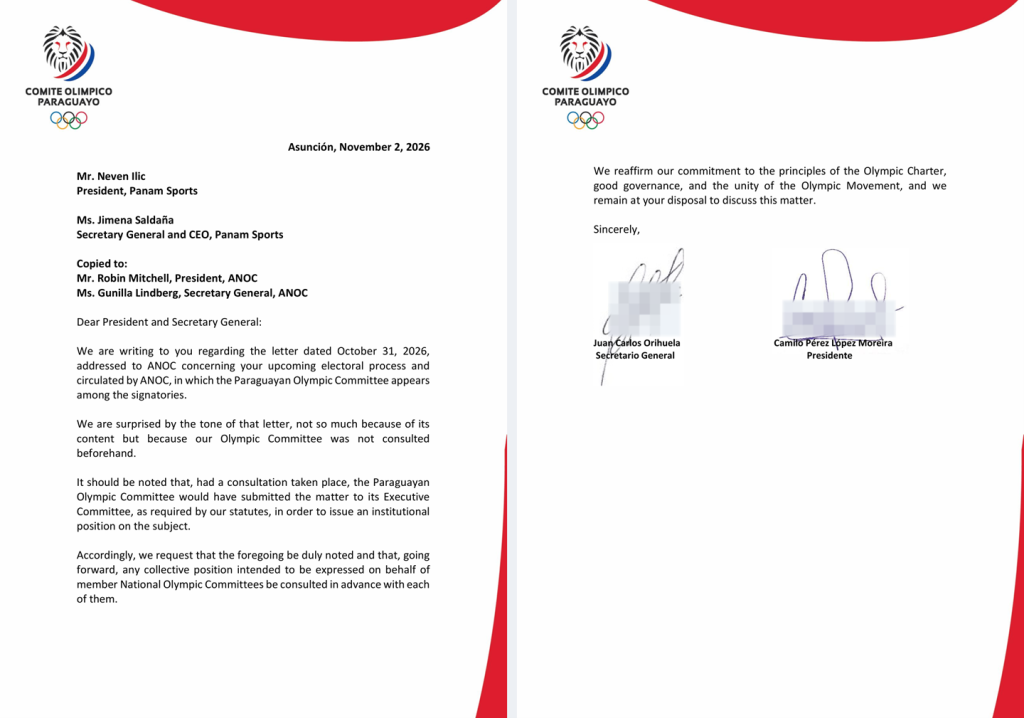
The Paraguayan Olympic Committee’s letter dated November 2, 2026, stating that it was not consulted before appearing in the October 31 document. Central portions of handwritten signatures have been obscured.
Mexico Raises a Direct Question of Transparency
A separate November 2 letter from the Mexican Olympic Committee adds another significant dimension.
Addressed to the presidents of the National Olympic Committees of the Americas, the letter is signed by President María José Alcalá Izguerra and Secretary General Mario A. García de la Torre.
Alcalá states that Mexico was not invited to a meeting, videoconference or telephone discussion to consider the matter and express its opinion. She also states that she received no invitation from Ilic or any member of the Panam Sports Executive Committee to participate in preparing, discussing or agreeing the letter’s contents.
Mexico is not included among the 38 committees listed in the October 31 document.
The Mexican letter also questions the institutional impression created by Panam Sports’ official letterhead and the signatures of its president and secretary general. It calls for a clear distinction between particular endorsements and a position representing the membership collectively.
The intervention extends beyond the election itself. It concerns access to information, the opportunity to participate and the procedures through which an organisation forms and communicates a collective position.
A continental organisation must be able to explain the authority and consultation supporting a statement presented in its members’ names.
The Mexican Olympic Committee’s letter dated November 2, 2026, raising concerns about consultation, participation and institutional representation. Original Spanish text. Central portions of handwritten signatures have been obscured.
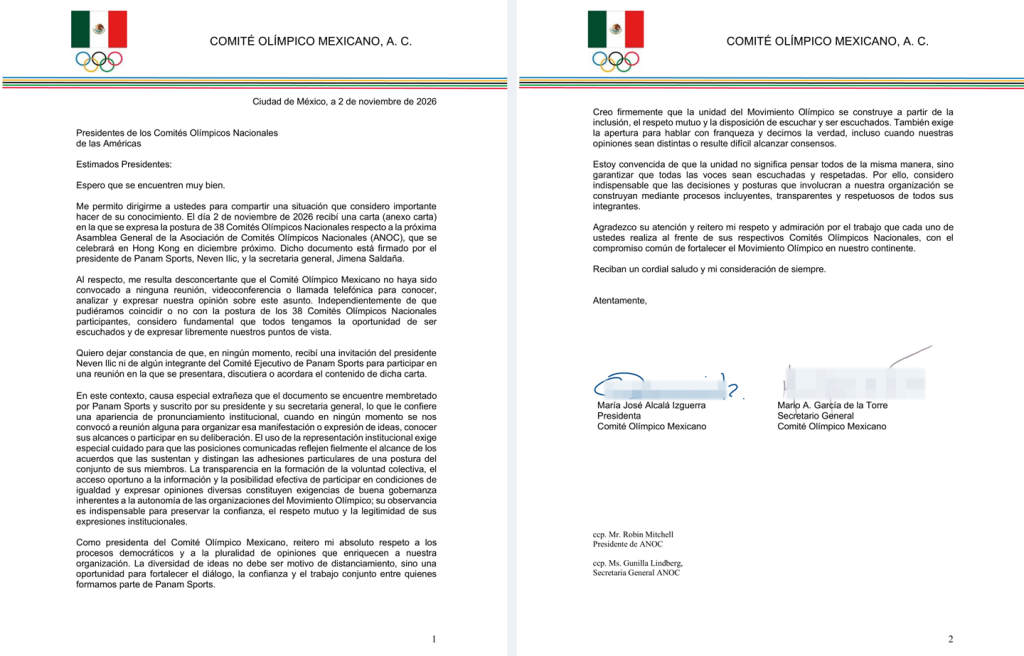
The Mexican Olympic Committee’s letter dated November 2, 2026, raising concerns about consultation, participation and institutional representation. Original Spanish text. Central portions of handwritten signatures have been obscured.
Panam Sports Has 41 Members. Why Are Only 38 Listed?
Panam Sports comprises 41 National Olympic Committees. The October 31 letter lists 38. The three absent committees are Mexico, Peru, and Saint Vincent and the Grenadines.
Mexico’s absence becomes particularly significant in light of its subsequent letter. Peru’s absence also deserves attention.
María José Alcalá of Mexico and Renzo Manyari of Peru were elected in August 2026 as representatives of the Americas on the ANOC Executive Council. Two of the absent committees therefore have direct representation in ANOC’s governing body.
Why are these committees not included? Were they invited to participate? Did they express a different position, choose not to support the initiative, or remain absent for another procedural reason?
Their omission alone does not establish disagreement or deliberate exclusion. An explanation from those involved is needed.
Were the Caribbean Committees Consulted?
The letter includes numerous Caribbean National Olympic Committees, including Jamaica, the Bahamas, Barbados, Aruba and Saint Lucia.
Following Paraguay’s response, a specific question arises: was each of these committees consulted before the letter was issued?
Was written consent obtained? Was the matter considered by a competent governing body? Was another form of authorisation used?
The supplied Panam Sports document bears the signatures of Ilic and Saldaña. It does not include separate signatures or approval decisions from the 38 committees listed.
Which of those committees authorised the position, through what procedure, and what records establish their consent?
Paraguay’s written response makes an explanation necessary. The process cannot be treated as a minor administrative detail when the document’s political weight depends on its claim to collective representation.
How United Is the Olympic Family of the Americas?
The letters from Paraguay and Mexico show why a fully unified institutional position cannot be taken for granted.
Paraguay challenges the process through which it was included. Mexico challenges the consultation process and the impression of institutional representation. Peru and Saint Vincent and the Grenadines are absent from the list, with the reasons requiring clarification.
These circumstances do not establish a common electoral position for those committees. They do raise serious questions about the scope of the representation attributed to the letter.
The political weight of a collective statement depends on more than the number of organisations it names. It also depends on whether those organisations had the opportunity to consider and authorise the position.
An Abandoned Agreement and Unanswered Questions
The political sequence merits close examination: a compromise emerged through Sheikh Joaan’s mediation; objections followed from continental leaders who had supported Blanco; and Blanco subsequently presented an independent campaign for the full term.
Did constitutional and political objections make the arrangement unworkable? Did interventions by Blanco’s supporters also provide a politically acceptable route out of the compromise?
The available documents do not establish the participants’ private intentions or prove coordination. Those questions must remain clearly distinguished from the documentary issue raised by Paraguay’s inclusion without prior consultation.
When a continental leadership invokes democracy, transparency and constitutional procedures to challenge an ANOC arrangement, those same principles should be demonstrable in the formation of its own collective positions.
Who approved the letter? How was the list of 38 established? Why were three members absent? And how many of the listed committees had been informed and had consented?
The answers matter to the credibility of institutional representation across the Olympic Movement.
SportsIn’s Open Invitation for Responses
SportsIn publicly invites Panam Sports, its president Neven Ilic and Secretary General Jimena Saldaña to explain how the October 31 letter was prepared and approved.
In particular, we invite answers about the process used to establish the consent of the 38 committees, Paraguay’s inclusion without prior consultation as described in its letter, and the absence of Mexico, Peru, and Saint Vincent and the Grenadines.
We also invite the Olympic committees of Mexico, Paraguay, Peru, and Saint Vincent and the Grenadines to present their positions, and the Caribbean committees listed in the letter to clarify whether they were informed beforehand and gave their consent.
We particularly invite María José Alcalá and Renzo Manyari, as representatives of the Americas on the ANOC Executive Council, to address the questions of consultation and institutional representation raised here.
SportsIn also extends a specific public invitation to Keith Joseph, President of the Caribbean Association of National Olympic Committees (CANOC), to clarify whether the Caribbean committees appearing in the Panam Sports letter had been informed of its contents in advance, whether their consent was sought and obtained, and whether the matter was discussed by any competent CANOC body.
We invite Keith Joseph to present CANOC’s position publicly on these specific questions.
SportsIn undertakes to publish in full, without cuts or alterations, the written responses received from all the organisations and representatives invited above, clearly attributing each response to its author.
This invitation seeks transparency, institutional accountability and a fully informed international Olympic community.
Democratic legitimacy is measured not only by how a president is elected, but also by how those invoking democracy represent the organisations in whose names they speak.
 Last related articles