The first edition of the Spanish Formula 1 Grand Prix in Madrid generated an economic impact of €544 million in the Community of Madrid and contributed to the creation and maintenance of 10,948 jobs. This is revealed by a study conducted by PwC, which also estimates the event’s tax revenue at €95 million, highlighting its ability to boost different sectors of the local economy.
The figures exceeded initial estimates and demonstrate how hosting an international competition can generate economic activity beyond the circuit. During the four days of the Grand Prix, 352,618 spectators attended, including a significant number of international visitors and people from other Spanish regions, whose spending directly benefited tourism, hospitality, transport and services.
An economic impact that exceeded initial forecasts
The €544 million generated by the Grand Prix represented 16.5% more than the €467 million initially projected. In terms of employment, the 10,948 jobs created and maintained exceeded the estimated 8,850 positions by 23.7%, while tax contributions reached €95 million, 14.5% above initial forecasts. According to the report, every euro of economic activity directly linked to the race generated €4.60 across the Madrid economy.
The scale of this economic activity was also reflected in its distribution across different industries. The hospitality sector benefited the most, generating €114 million, followed by manufacturing, with €86 million, and construction, with €51 million. Together, these three sectors accounted for 59% of the €425 million in indirect, catalytic and induced economic impact. Furthermore, the economic contribution represented 0.16% of the GDP of the Community of Madrid and 0.30% of the capital’s GDP, according to José Vicente de los Mozos, Chairman of the Executive Committee of Ifema Madrid.
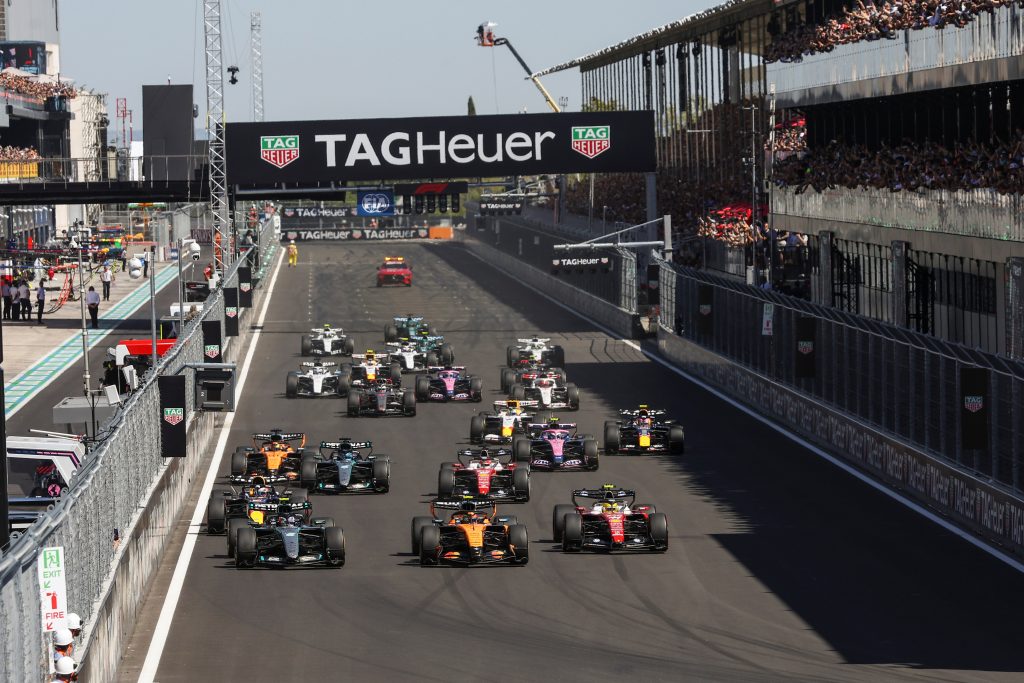
More than 350,000 spectators and a boost for tourism
During the four days of competition, 352,618 spectators were recorded, of whom 35% came from abroad and 20% travelled from other Spanish regions. International visitors played a particularly important role in event-related spending: each spent an average of €2,772 during their stay, including admission, compared with €1,099 for visitors from other Spanish regions and €659 for residents of the Community of Madrid. International tourists spent an average of €591 per day and stayed for 4.7 days, more than twice the usual 2.3-day average for international visitors to the region.
Transport and accommodation figures also help illustrate the event’s impact on Madrid’s tourism infrastructure. 86% of spectators used public transport, taxis or ride-hailing services (VTC) to reach the circuit: 65% travelled by metro, bus or commuter rail, 21% used taxis or VTC services, and only 14% arrived by private vehicle. Among those travelling to Madrid from outside the region, air travel was the main means of arrival, accounting for 65%, while trains and private vehicles each represented 16%. Regarding accommodation, 49% chose hotels, 32% opted for short-term rentals and 19% stayed with family or acquaintances. Additionally, 95.3% of spectators believed the Grand Prix had improved Madrid’s international image, while 98.1% said they would recommend the city as a tourist destination.
 Last related articles