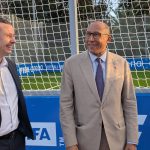
Philippe Diallo has agreed to challenge Gianni Infantino for the FIFA presidency. The president of the French Football Federation (FFF) has the backing announced on Monday by the European national associations represented on UEFA’s Executive Committee and the FIFA Council. The election will take place on 18 March 2027 in Rabat, and his entry turns the confrontation between UEFA and FIFA into an electoral contest over who decides how competitions are run and commercially exploited. The FFF’s ratification was scheduled for Tuesday, 17 November.
Diallo, 63, has experience in the administration of French professional football, the league and FIFA’s own dispute resolution structures. He became interim FFF president in January 2023, was elected in June and secured another term in December 2024 with 55.34% of the vote, against Pierre Samsonoff’s 44.65%. He has also served on UEFA’s Executive Committee since 2023. His background helps explain Europe’s choice: he understands the relationships between clubs, federations and international bodies, although he must now demonstrate that this experience can help him build a global majority.
Ceferin and Germany, the support behind the candidate
The main institutional driving force is Aleksander Ceferin, who chaired the meeting that produced the backing for Diallo. His prominent public supporters include Bernd Neuendorf, president of the German football association, who considers him an excellent candidate and advocates a different approach to exercising the role. The choice came after Arsene Wenger, an option UEFA had explored, ruled himself out. Victor Montagliani, president of Concacaf, had also been mentioned but opted to seek another term at the head of his confederation. That sequence reflects the difficulty of finding someone willing to challenge Infantino. It also makes it necessary to clarify the scope of the announcement: unanimity among the representatives present does not amount to a commitment from all 55 European associations.
Diallo himself had backed Infantino before the 2026 World Cup. France’s break came in September, following the proposal to open a company holding the commercial assets of FIFA’s competitions to private investors. Money and control over those assets explain the change in position. The proposal was ultimately abandoned, but it left a crisis of confidence that now has a candidate.
The World Cup business plan that triggered the split
The project was called FIFA Forward Enterprise (FFE) and proposed bringing broadcasting rights, sponsorship, ticketing, licensing and tournament operations together in a subsidiary initially valued at $20 billion. FIFA intended to raise up to $4.2 billion through minority stakes and maintained that it would retain control and authority over all sporting matters. The proposed structure included Thrive Eternal, as the intended lead investor; Greg Maffei, the former chief executive of Liberty Media, as a commercial adviser; and J. P. Morgan. These are the actors involved in the business project that triggered the crisis, not confirmed supporters of Diallo. In return, associations were offered exceptional funding and increased development funds: a particularly significant promise for those with fewer revenues of their own.
The conflict also has a legal dimension. UEFA has approached a court in Florida to obtain documents for a possible criminal mismanagement complaint in Switzerland, although that step does not amount to a conviction or establish any wrongdoing in itself. On the electoral front, Diallo will also have to contend with the announced ambitions of Kozo Tashima, honorary president of the Japanese football association, and former Swiss footballer Ramon Vega. The potential consequence is a fragmented opposition: sharing criticism of Infantino does not guarantee agreement on a candidate, a programme or a division of responsibilities. For Ceferin, backing the Frenchman therefore opens a second negotiation, this time among those seeking a change of leadership.
Europe’s economic power is not enough to win
The arithmetic explains why Infantino remains the favourite. Each of FIFA’s 211 member associations has an equal vote: even a completely united Europe would represent little more than a quarter of the electorate. Diallo needs to secure support on other continents. His opponent has one concrete endorsement: the president of the Asian Football Confederation, Salman bin Ibrahim Al Khalifa, announced his support for Infantino’s continued leadership in October. Asia has 46 FIFA member associations, although a confederation’s endorsement does not make every individual vote a foregone conclusion. The Frenchman will have to convince those associations that his alternative addresses their needs and does not simply reflect European priorities.
That is where the substance of his candidacy will be tested. Infantino defends his record by pointing to increased funding: at the May Congress, he put development investment over the previous decade at $5 billion. Diallo will need to present an alternative explaining how those resources would be maintained, who would oversee commercial agreements and what decision-making powers the associations would retain. Winning would require him to turn an opposition alliance into a shared project; losing could strengthen Infantino if the margin were wide.
 Last related articles