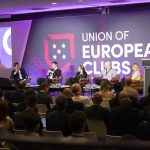
The Union of European Clubs -UEC- has brought a dispute over who can influence European football’s rules and revenue distribution before the European Commission. On 16 November, the association filed a complaint challenging the agreement between UEFA and European Football Clubs -EFC-, formerly the European Club Association -ECA-, which was extended in October 2024 until July 2033. It is seeking an investigation into whether the arrangement breaches European rules prohibiting anti-competitive agreements and abuse of a dominant position. Its argument is that EFC’s exclusive recognition, combined with unequal representation within the organisation, allows the most influential clubs to shape decisions affecting their competitors: access to competitions, payments and the space occupied by the international calendar.
Founded in 2023, the UEC brings together clubs with different circumstances. Its public membership list includes Osasuna, Union Saint-Gilloise, Aberdeen and Lokomotiva Zagreb, alongside Spanish second-tier clubs Burgos, Albacete and Eibar. That diversity helps explain its position: European decisions affect regular participants in continental competitions, clubs hoping to qualify and those receiving solidarity funding. “The question is simple: who gets a say in the rules that shape every club’s future?” asks Dennis Gudasic, the organisation’s general secretary and a Lokomotiva Zagreb executive. The complaint challenges one association’s exclusive mandate when, the UEC argues, many clubs lack an effective voice.
Who can change the rules
That institutional influence operates through a specific mechanism. EFC nominates 16 of the 20 members of UEFA’s Club Competitions Committee, which reviews changes to formats, access and revenue distribution. UEFA’s Executive Committee retains the final decision, but the publicly available 2023 agreement requires it to refer proposals back for reconsideration if it disagrees. If the deadlock persists, the two organisations’ presidents must seek a solution. Without agreement, the existing arrangements remain in place, subject to certain urgent exceptions. That ability to preserve existing rules forms part of the UEC’s complaint. Miguel Poiares Maduro, a former advocate general at the Court of Justice of the European Union and an adviser on the complaint, argues that giving a group of clubs power over competition access and revenues “harms competition in European and national football”.
Exclusivity also affects the ability to establish alternative representation. Clause D.4 of the 2023 agreement commits the former ECA to ensuring that its members do not belong to other associations bringing together clubs from more than one country. The UEC challenges that restriction alongside EFC’s exclusive recognition and is calling for the agreement currently in force to be published. The debate also concerns how power is distributed within EFC, chaired by Nasser Al-Khelaïfi. The organisation has more than 900 members and has announced reforms for the 2027–2031 cycle to broaden representation and restructure its board with 33 members. Its membership encompasses clubs of different sizes, although the UEC argues that this diversity does not give less powerful clubs sufficient influence.
European money also shapes domestic competition
Revenue distribution illustrates why participation in those decisions matters. Under the 2024–2027 model for the Champions League and Europa League, 27.5% is distributed equally, 37.5% is performance-related and 35% comes through the value pillar, which incorporates factors linked to broadcasting markets and club coefficients. UEFA’s published figures for 2025/26 put the initial payment for reaching the Champions League league phase at €18.62 million per club, compared with €4.31 million in the Europa League and €3.17 million in the Conference League, before other payments are added. For two clubs competing in the same domestic league, qualifying for different European competitions already creates a substantial financial gap. Within each competition, part of the distribution also depends on factors beyond results in that particular edition.
The economic study submitted with the complaint examines how those advantages can accumulate. The paper by Petros C. Mavroidis and Damien J. Neven, with research assistance from Luca Zerman, finds that the 50 most frequent participants accounted for approximately 80% of Champions League appearances since 2000. The authors argue that access and distribution rules help entrench repeat participation and weaken competitive balance in domestic leagues. The mechanism they describe is familiar: European revenues increase a club’s resources relative to its domestic rivals, improve its ability to maintain a competitive squad and make qualification more likely again. Clubs attempting to qualify for the first time, or return after several seasons away, face opponents whose budgets are regularly boosted by European football.
Solidarity and a say in decisions
UEFA and EFC maintain that their partnership also benefits clubs outside the competitions. The 2024–2027 cycle increased the proportion of revenue allocated to non-participating clubs from 4% to 7%, with an annual benchmark of €308 million. Distribution primarily benefits top-flight clubs, although second-tier teams can receive a share under certain conditions and with the agreement of first-division clubs. This provides a direct financial connection to the lower divisions. The UEC proposes expanding redistribution mechanisms and estimates that its Player Development Reward initiative would have directed around €67 million to clubs outside top divisions in 2025/26. That is an estimate for a proposal awaiting adoption. “Every club deserves a voice — and a genuine say in the decisions that shape its future,” says UEC president Ovidiu Costesin.
The complaint seeks binding changes to an agreement running until 2033: obtaining and publishing its contents, removing clauses the UEC considers restrictive and broadening representation in decisions on the calendar, access and funding. The association is asking the European Commission to open a formal investigation and determine whether the arrangement breaches Articles 101 and 102 of the Treaty on the Functioning of the European Union. The complaint is on the agenda at the fourth UEC Football Forum, scheduled for 17 November in Brussels, with Maduro, LaLiga president Javier Tebas and representatives of European domestic leagues expected to participate. UEFA and EFC have also been invited to attend.
 Last related articles