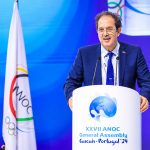
Three key proposals from Mustapha Berraf’s presidential program will be discussed at the December General Assembly, placing National Olympic Committees and athletes at the heart of the debate.
As the Association of National Olympic Committees (ANOC) prepares for its General Assembly in Hong Kong on December 8–9, three issues at the heart of Berraf’s presidential program are set to feature prominently in the discussions: a stronger voice for National Olympic Committees, greater support for athletes beyond competition, and improved conditions for Olympic preparation and participation.
Berraf, President of the Association of National Olympic Committees of Africa (ANOCA) and a candidate for the ANOC presidency, first outlined these priorities publicly on July 7. Their appearance on the Hong Kong agenda brings attention to proposals that seek to strengthen the relationship between ANOC, its 206 member committees and the athletes they represent.
“I welcome the inclusion of these three priorities on the agenda of our General Assembly in Hong Kong. We presented them publicly on July 7 as part of a vision shaped by my forty years of service to the Olympic Movement and by my dialogue with National Olympic Committees across all five continents. Their inclusion shows that the concerns raised by NOCs are being heard. This is an important first step for the committees and the athletes they support.
“Our programme also commits to expanding leadership opportunities for women and young people, supporting NOCs in their digital transformation, and developing strategic partnerships that generate additional revenue to be reinvested directly in support for NOCs.
“Unity, solidarity and mutual respect will guide our work together. One Olympic Family. One common ambition. One shared future.”
The first area of discussion concerns the role of National Olympic Committees in shaping ANOC’s future. A dedicated “NOCs’ Voice” session, announced on November 19, will provide an opportunity for committees to identify their priorities for the next four years. Berraf had already invited all 206 NOCs to contribute their proposals in September, advocating a consultation process that would identify individual needs, direct greater assistance toward committees with limited resources and introduce annual reporting on the results achieved.
Athlete support represents another important dimension of the Hong Kong discussions. Berraf’s program places particular emphasis on the transition between sporting careers and life beyond competition, including education, employment, well-being and athlete participation in decisions that directly affect them. The Assembly’s planned panel on athlete support will provide an opportunity to examine how NOCs can translate these objectives into practical services.
The third priority focuses on the conditions under which athletes prepare for and participate in the Olympic Games. Berraf has proposed wider access to training camps, sports science and technical expertise, together with additional logistical assistance for smaller delegations. Such measures address the different levels of resources available to NOCs and the practical challenges faced by athletes on their path to the Games.
Beyond these three priorities, his program also addresses opportunities for women and younger leaders, digital transformation and the development of commercial partnerships capable of generating additional resources for NOCs.
The Hong Kong discussions will not, by themselves, determine how these proposals are implemented. They will, however, provide a platform for National Olympic Committees to examine several issues already identified in Berraf’s presidential program and to consider how ANOC can respond to their needs over the coming four years.
For Berraf, the significance lies in connecting the debate over ANOC’s future with the practical responsibilities of the organization: listening to its members, supporting athletes and strengthening solidarity across the Olympic Movement.
 Last related articles