The Association of Summer Olympic International Federations (ASOIF) has published the sixth edition of its Governance Review, the report that assesses the institutional performance of Olympic international federations and has become one of the leading benchmarks for transparency and good governance in global sport. The evaluation examined 36 federations through 60 indicators related to transparency, integrity, democracy, sustainability and control mechanisms.
The main conclusion is a positive one for the Olympic Movement. All full member federations exceeded the minimum threshold required by ASOIF and the average score increased once again compared to the previous review. The report particularly highlights progress in gender equality, athlete safeguarding, reporting procedures, financial transparency and internal control mechanisms. Within that progress, World Triathlon stands out.
World Athletics tops the list
The leading federation in this edition is World Athletics, which emerges as the highest-rated federation across the Summer Olympic Movement. The organisation led by Sebastian Coe heads the A1 group, the highest category established by ASOIF to recognise federations with the strongest governance standards.
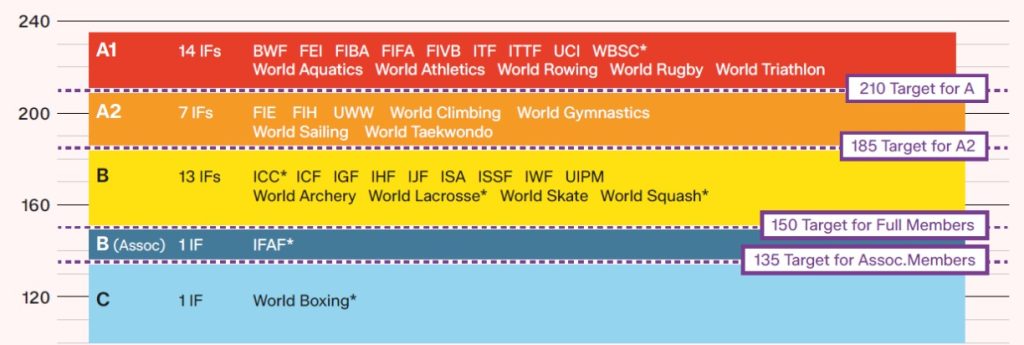
Alongside World Athletics are several organisations that have consolidated their position as institutional leaders. The UCI achieved 225 points out of a possible 240 and remains among the three highest-scoring federations for the third consecutive review. FIFA recorded its best-ever result with 218 points, while World Triathlon entered the A1 group for the first time after reaching 210 points.

The federations included in the A1 excellence group are:
- World Athletics (athletics)
- World Aquatics (aquatics)
- UCI (cycling)
- FIFA (football)
- World Rugby (rugby)
- FIVB (volleyball)
- FIBA (basketball)
- ITF (tennis)
- ITTF (table tennis)
- World Rowing (rowing)
- BWF (badminton)
- FEI (equestrian)
- WBSC (baseball and softball)
- World Triathlon (triathlon)
The inclusion of World Triathlon is one of the major developments highlighted in the report. The federation led by Antonio Arimany improved its score by twelve points compared to the previous review and entered the group reserved for organisations with the strongest governance practices for the first time. A significant achievement.
Federations that still have room for improvement
ASOIF avoids producing a public ranking of “winners and losers” and does not explicitly identify the lowest-rated federations. However, it does divide organisations into different performance groups, making it possible to identify those that remain some distance from the highest governance standards.
Among the areas where challenges remain are risk management, due diligence processes, oversight of distributed funds, diversity within governing bodies and the practical implementation of approved policies. ASOIF notes that many federations have developed modern regulations but still need to demonstrate that these measures are effectively embedded in their day-to-day operations.
Although they are not part of the A1 excellence group, federations such as World Archery, the International Canoe Federation, the International Weightlifting Federation, ISSF, UIPM, World Sailing and United World Wrestling continue working to close the gap with the leading organisations in governance.
An increasingly important issue for the IOC
The publication of this report comes at a particularly significant moment for the Olympic Movement. Kirsty Coventry’s presidency has placed governance among the IOC’s strategic priorities, while international federations face growing pressure in areas such as integrity, athlete protection, sustainability and institutional transparency.
For that reason, ASOIF believes that good governance is no longer simply a reputational issue. According to the report, it has become a competitive advantage for international federations operating in an increasingly complex political, economic and sporting environment.
The picture emerging from this sixth review is clear: World Athletics continues to set the benchmark for governance within the Olympic Movement, while organisations such as FIFA, UCI, World Aquatics and World Triathlon have strengthened their position among the best-governed federations in international sport.
 Last related articles