
At the 2026 World Cup, some stories appear in anthems, shirts and celebrations, but others are found in a much smaller detail. Some boots have become a space for family memory, a place where footballers display flags that do not always match the national team they represent, but help explain an essential part of their journey to the tournament.
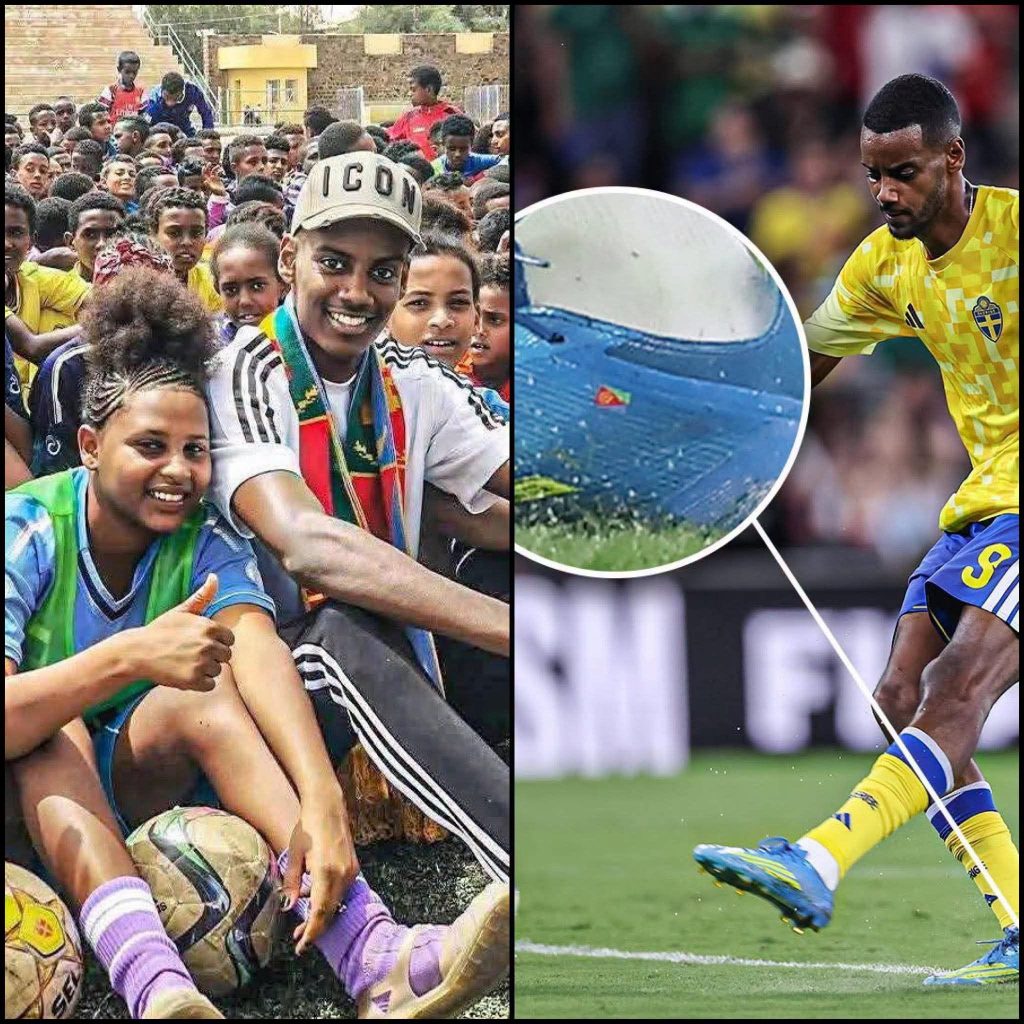
Lamine Yamal plays for Spain while carrying Morocco and Equatorial Guinea with him. Cole Palmer represents England with Saint Kitts and Nevis also on his boots. Zidane Iqbal plays for Iraq with Pakistan as a visible part of his story. Alexander Isak competes for Sweden while remembering his Eritrean roots. In each case, the shirt marks the national team; the boots complete a wider family biography.
Lamine Yamal, Spain on the shirt and Africa on the boots
Yamal’s case is the most recognisable because of both his sporting profile and symbolic weight. Born in Spain, the son of a Moroccan father and an Equatorial Guinean mother, the winger has chosen to compete for the Spanish national team, but has worn the flags of Morocco and Equatorial Guinea on his boots. His father, Mounir Nasraoui, comes from Larache, while his mother, Sheila Ebana, was born in Bata. The two flags therefore point to the two family origins that form part of his story.
The gesture also fits with the way Yamal has built his public identity. The footballer grew up linked to Rocafonda, in Mataró, and celebrates his goals by marking 304, the final digits of the neighbourhood’s 08304 postcode. In his case, the boots do not appear as an isolated symbol, but as a continuation of that story: Spain on the shirt, Africa in his roots and the neighbourhood as a mark he has carried onto the world stage.
 Cole Palmer and Zidane Iqbal, two flags to explain a heritage
Palmer has also turned his boots into a form of family recognition. Born and raised in England, the forward wears the English flag and the flag of Saint Kitts and Nevis because of his father’s heritage. He himself explained that the St Kitts flag appears on his boots “as a little tribute” to his father and his father’s family. His grandfather emigrated from the Caribbean to the United Kingdom in the 1960s, a family story that connects his career with the Kittitian diaspora.
Iqbal brings another kind of story. Born in Manchester, to an Iraqi mother and a Pakistani father, he represents Iraq and has become the first footballer of Pakistani origin to play at a men’s World Cup. “I play for Iraq, grew up in England, but my dad was born in Pakistan. My grandad was a first-generation there, so I have a lot of respect for that side of my family,” the midfielder explained. His boots, with the Iraqi and Pakistani flags, bring together the national team that has taken him to the World Cup and a community that finds in him a symbolic presence at a tournament Pakistan has never reached with its men’s national team.
Alexander Isak and the memory of Eritrea
Isak was born and raised in Sweden, but his family story begins in Eritrea. His parents left the country in the late 1980s, during a period of war and conflict, and settled in the Stockholm area. Isak grew up in Solna and Bagartorp, started playing for AIK as a child and went on to become one of the leading forwards in the Swedish national team.
That is why the Eritrean flag on his boots carries a more concrete meaning than a simple generic tribute. It points to the country his parents left behind, the migratory journey that brought the family to Sweden and an Eritrean diaspora that has seen Isak become one of its most recognisable names in European football.
A similar thread runs through the case of Taha Ali, who was born in Sweden and has Somali roots. Publications linked to the Somali community have associated him during the World Cup with the Somalia flag on his boots. His story, in any case, fits the same pattern: European footballers who represent one national team while keeping a different family root visible. The boots worn by Yamal, Palmer, Iqbal and Isak show a reality that is becoming increasingly common in international football. Many of its protagonists arrive with biographies more complex than a single sporting nationality. In 2026, some of those stories can be read by looking down, in a few centimetres of leather, fabric or colour where two countries, a family and a way of belonging can fit.
 Last related articles


