
Argentina and Austria meet this Monday at the World Cup with Lionel Messi inevitably at the centre of attention, but the match also carries a much less obvious story on the other side of the pitch. Carney Chukwuemeka arrives with Austria after being born in Vienna, growing up in England, becoming a European champion with England’s youth teams and switching national teams just before the tournament opened a door that had not always seemed written into his path.
Chukwuemeka has said that, as a child, before football, he wanted to sing. The turn came through his older brother, Caleb, whom he watched with the ball until the game began to draw him in as well. “I saw my older brother playing with the ball and started to enjoy it myself,” he explained in an interview with Borussia Dortmund’s media channels. “And that’s how I started playing football,” he added of his first steps in the game.
Caleb Chukwuemeka, Carney’s first mirror
Caleb holds a central place in that story. He was a reference point, a stimulus and also an early form of rivalry at home, the figure who put football in front of Carney before clubs, scouts or national teams did. The two grew up in Northampton, shared a school environment and followed a path that would eventually take them close to professional football, but in Carney’s case that bond with his brother appears as the first emotional explanation for what came later: he did not start by looking at major stars, but by looking at Caleb.
At school, however, the attention soon shifted. Jamie Wilcock, one of his coaches at Northampton School for Boys, recalled that Chukwuemeka was already “a crowd-drawer”. When he played, younger pupils would come down to watch because they knew he was on the pitch. It was not just that he stood out; he created a small sense of expectation around his games. Wilcock described him as a footballer who made the game look “easy”, able to glide across the pitch and beat opponents with a naturalness unusual for his age.
 Northampton, Barnet and a Ronaldinho shirt
His first emotional memory as a fan was not a major final or a World Cup stadium, but a Northampton Town–Barnet match he went to “when I was about four or five” with his father, mother and Caleb. Chukwuemeka said the ground was about ten minutes from the house where they lived at the time and that it was his first real experience of watching football live. What stayed with him was not so much the result as the noise, the atmosphere and the feeling of imagining what it must be like for a player from the inside: “The atmosphere was crazy,” he recalled years later.
Another childhood image connected him more directly with the global game. His first World Cup shirt was a Brazil one with Ronaldinho on the back, much too big for him, “probably my dad’s shirt”, he recalled. That shirt fits with the players he looked up to: Ronaldinho and Kaká, footballers whose freedom of movement and ability to play without being fixed to one position have stayed with him. Between the pitch in Northampton and that Brazilian shirt, a very personal part of his story was already taking shape: an English childhood, a World Cup imagination and a relationship with the ball born at home.
From England to Austria, a door that opened in time
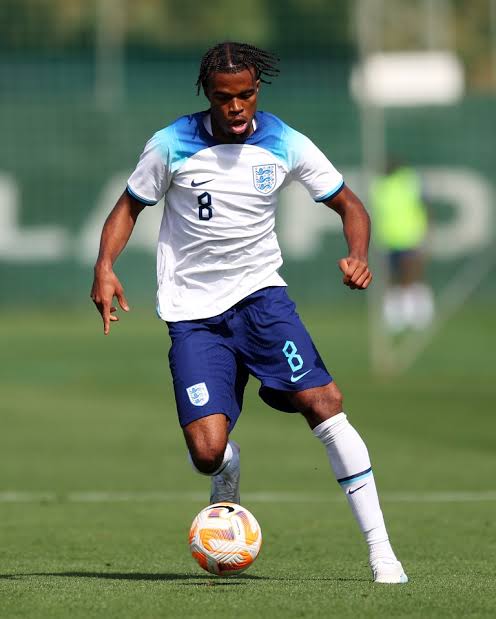
The best-known part of his path could have tied him permanently to England. Chukwuemeka won the European Under-19 Championship with England in 2022 and scored in the final against Israel, a detail that explains why his later switch was not that of a player outside any international structure. He had already won with England, had already been important in a title-winning generation and had already entered the radar of a country with huge competition in his area of the pitch.
Austria appeared at the right moment. Chukwuemeka was born in Vienna, although he lived there for only two years before growing up in England, and that root allowed him to open a different international route. When he arrived at Borussia Dortmund, he admitted that he did not speak German well precisely because he had left so young, although he also said his father speaks it fluently and that he would try to learn from him. That detail captures an identity split between birthplace, English upbringing, family roots and an Austrian national team that moved in time to bring him in before the World Cup.
The Fédération Internationale de Football Association -FIFA- confirmed in March that Chukwuemeka was eligible for Austria, alongside Paul Wanner, another footballer recruited by the Austrian federation before the tournament. This Monday, against Argentina, Chukwuemeka arrives at the World Cup not only as a player who changed national teams, but as the result of a story that began with a boy who wanted to sing, continued with an older brother playing with the ball and found in Austria the international opportunity England could no longer guarantee.
 Last related articles


