Weightlifting completed five days of competition at the Glasgow 2026 Commonwealth Games, with 16 titles shared among athletes from all five continental federations. The SEC Armadillo, which also hosted the sport in 2014, staged 15 sessions from 26 to 30 July featuring three-time women’s champions, Malaysia’s best performance in Games history and the arrival of a generation preparing to begin the road to Los Angeles 2028. Asia finished with six gold medals, Oceania claimed four, Africa won three, Canada supplied two for the Americas and Europe’s victory came through England’s Emily Campbell.
Mirabai Chanu became the first woman to win three Commonwealth Games weightlifting titles after taking the 48kg gold with a 190kg total, finishing 22kg ahead of Nigeria’s Ruth Nyong. “This sport has changed my life. It has given me everything and I am a very proud weightlifter. I have to try for more medals,” said the athlete representing India, who even considered competing at the 2030 Games. Maude Charron then completed her own hat-trick in the 63kg category, before Eileen Cikamatana achieved the same feat at 86kg, having won for Fiji in 2018 and Australia in 2022 and 2026. Campbell completed the group of established Olympic figures by retaining the +86kg title with 278kg, 25kg ahead of Aqilah Farhana.
Malaysia tops the standings for the first time
Aniq Kasdan began Malaysia’s run with victory at 60kg. Aznil Bidin won at 65kg to become the first Asian male lifter to claim three Commonwealth Games titles, while Erry Hidayat prevailed at 79kg, Hafizuddin Roslin at 88kg and Syahmi Nor-Ghazali at 94kg. The delegation arrived in Glasgow after a training camp of several weeks in Türkiye and finished with five gold medals and one bronze. “Within the federation, we set ourselves a target of five golds,” explained its President, Ayub Rahmat, who believes the performance can establish weightlifting as one of Malaysia’s leading medal-producing sports at major multi-sport events.
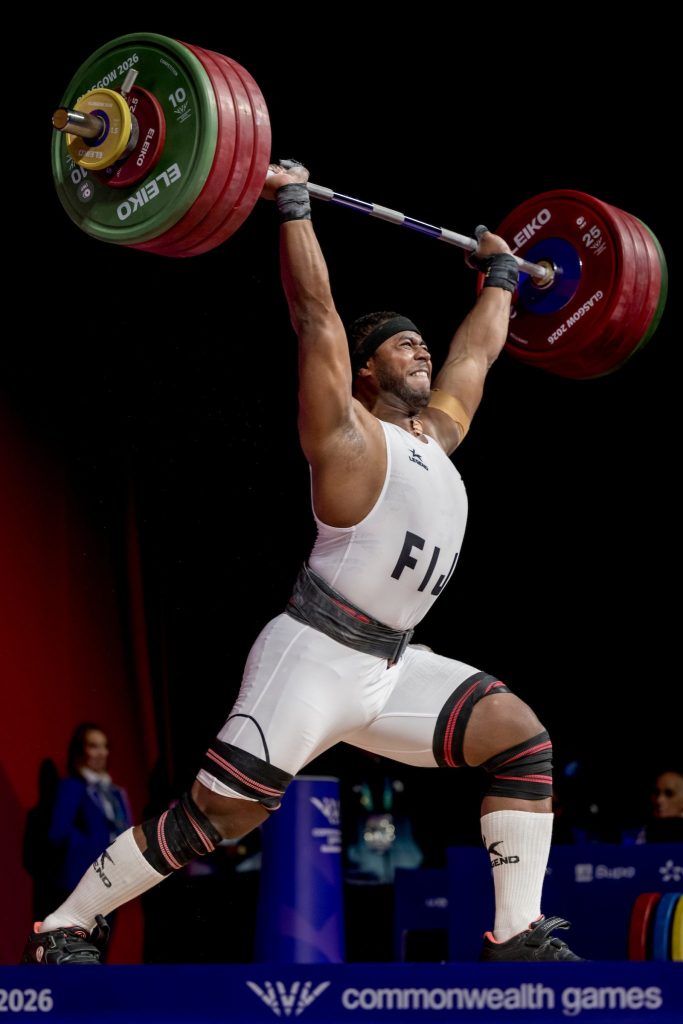
Nigeria finished second for titles after recording three consecutive victories on the second day. Edidiong Umoafia won at 71kg, Onome Didih broke the Commonwealth snatch, clean and jerk and total records at 53kg, and Rafiatu Lawal completed six successful attempts to take the 58kg crown. “We all encourage each other. Nobody thinks they are better or more important than anybody else,” Didih said of the team’s approach. Canada added the titles won by Charron and Charlotte Simoneau, while the remaining gold medals went to Chanu, Campbell, Cikamatana, Samoa’s Seine Stowers at 77kg, Fiji’s Taniela Rainibogi at 110kg and New Zealand’s David Liti at +110kg. For the second consecutive Games, all five continental weightlifting federations secured at least one victory.
 The next generation finds its place
Stowers was the youngest champion of the week at 18 and followed the example of her sister, Feagaiga Stowers, who won the super-heavyweight category in 2018. Simoneau, a two-time junior world champion, claimed her first major senior title at 21 and set a Commonwealth clean and jerk record in the 69kg category. Femily Notte, representing Nauru, earned 63kg bronze at 17 against Charron and Sarah Davies-Smale, both aged 33, while Canada’s Etta Love, 18, finished third in Campbell’s category. The competition placed established Olympic medallists alongside young athletes preparing to take part in an Olympic qualification cycle for the first time.
Joshua Mboya’s 60kg bronze gave Kenya its first Commonwealth Games weightlifting medal since 1994. The 20-year-old improved his personal best by 19kg and completed all six attempts after receiving an Olympic scholarship at the beginning of 2026. “Without it I would have to be working or studying. This support means I can train full-time, twice a day,” he explained. At the other end of the age range, the women’s 53kg event featured three mothers over 40: Johanni Taljaard, Dika Toua and Jenly Wini. Wini ended her international career and will move into coaching, while Taljaard and Toua intend to pursue qualification for Los Angeles 2028. Chris Murray also returned to the podium with a bronze medal after overcoming shoulder and elbow injuries, a torn hamstring, two quadriceps tears, glandular fever and shingles.
The Athletes’ Commission steps in for Madias Ngake
Madias Ngake returned to the Games 16 years after representing Cameroon and won the 86kg silver medal for England. She remained in the United Kingdom and sought asylum after London 2012 because of her sexuality, with same-sex relations remaining illegal in her country of origin. Years later, doping disqualifications moved her from sixth to third in the Olympic competition. The bronze medal was sent to Cameroon in 2020, but she has never received it. Forrester Osei, Chair of the International Weightlifting Federation -IWF- Athletes’ Commission, announced in Glasgow that the body would contact the International Olympic Committee -IOC- to trace the medal or secure a replacement. “She earned that bronze medal and she should have it in her hands,” he said.
Cyrille Tchatchet II completed another return to the venue where he had represented Cameroon in 2014. After deciding it was unsafe to return home, he remained in the United Kingdom, experienced homelessness and suffered from depression before beginning an asylum process that lasted several years. He later trained as a mental health nurse, competed at Tokyo with the IOC Refugee Olympic Team and qualified as a cognitive behavioural therapist. In Glasgow, he completed all six attempts and won 110kg silver for England, accompanied by his mother as she watched him compete for the first time. The championships also produced an unexpected bronze for Scottish firefighter Angus Doig, who trains alone in his garage, and a full-house reception for Campbell’s victory. “They made so much noise I couldn’t hear myself think,” the champion said after a competition that brought together Olympic medallists, athletes returning from long absences and some of the leading prospects for the next cycle.
 Last related articles