Jakob Ingebrigtsen returned to competition after 11 months and won the 5,000 metres at the Birmingham 2026 European Athletics Championships in 13:15.29. The Norwegian finished ahead of Germany’s Florian Bremm, who took silver in 13:15.60, and France’s Etienne Daguinos, bronze medallist in 13:16.09, after completing the final lap in around 54 seconds. “I dreamt of this moment two weeks ago when I put my name on the list. I crossed my fingers that I would be here and feel better. It was just enough, so I am extremely happy. With 600 metres to go, I knew I was going to get that gold medal. I was just hoping and hoping that I was not going to get too tired,” he explained. Asked about the closing stages, he responded with a question that reflected an almost instinctive self-belief: “Did it look like I panicked? No, I think I felt pretty strong over the last 600 metres.”
The victory carried particular significance after 17 months of Achilles problems and surgery on his left Achilles tendon in February 2026. Ingebrigtsen had completed only around six weeks of consistent training and, three weeks before the race, was still unable to cope with his usual volume. He therefore distinguished between being healthy and being back to his best: “I’m healthy, I’m 100%. I’m fully recovered from my surgery. Now it’s all about fitness and building again.” Asked to estimate his competitive condition, he replied: “Maybe 88%? 92%?” Those final percentages, he added, “can be very tiny in numbers and tenths of a second”.
Training without breaking down again
“If you knew what I know, you wouldn’t believe this was possible. He is very poorly prepared,” his older brother Filip Ingebrigtsen acknowledged to Norwegian broadcaster NRK. The comment illustrates the distance between the result and the preparation behind it. Jakob had completed no specific speed work and had only just returned to consistent running. “This year, or now, he’s been healthy at least and doesn’t have any pain. But he hasn’t done any speed in training. He just got back into running. But he has some talent,” Filip added.
Ingebrigtsen also wanted to contest the 1,500 metres, but his team gave him two alternatives: miss the European Championships or compete only in the 5,000 metres, which carried less risk. “We put our foot down and said, ‘You’re not going to race both.’ This was his first competition and we wanted to make sure. We wanted him to take the natural step and not do anything with too much risk,” Filip explained. The athlete accepted that calculation: “It’s all about calculating the risk,” including the possibility of compromising his training when he had no foundational preparation. “We decided that risk was not really there anymore.” Competing in Birmingham did not mean ignoring his limitations, but determining that he could race without placing his recovery in danger again.
Winning without training for speed
His preparation was less aggressive than usual and focused on accumulating mileage without causing the pain to return. Ingebrigtsen accepted that he would arrive with less specific speed work to ensure that he remained healthy. “It doesn’t matter how much speed you have if you’re tired. I’ve been trying for the last three weeks not to be so tired. It’s usually the least tired and fatigued runner who wins a 5,000m,” he explained. The victory supported that assessment: he remained sheltered within the pack, avoided expending energy too early and waited until the race entered territory where he could trust his accumulated ability.
He did not even present his final lap as an extraordinary performance in isolation. “If you isolate the 54-second lap, it’s not very fast. But it’s coming off 4,600 metres, which makes it maybe a little bit faster,” he said. Filip saw the same transformation from the outside: “Once he starts going and the speed increases, he looks better and better.” As Jakob did not know his precise level of fitness, he chose not to drive the pace from a long way out and saved his decisive acceleration for the home straight. He had not trained for speed, but arrived sufficiently fresh to use the explosiveness that has become a defining feature of the Norwegian’s finishes and has, on more than one occasion, overwhelmed his opponents.
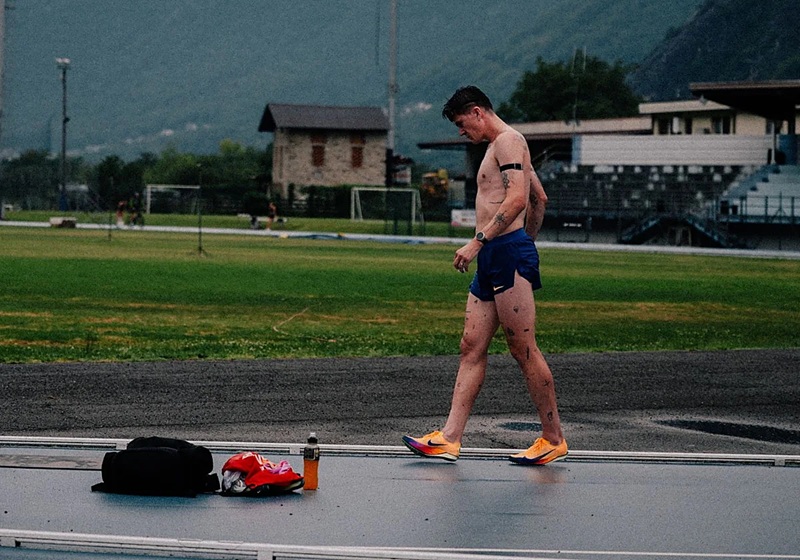
The talent to adapt the method
Ingebrigtsen’s greatest talent in Birmingham was not training more than his rivals. It was understanding what his body could withstand, temporarily giving up important parts of his preparation and trusting the foundations, experience and competitive ability he has developed since becoming European champion for the first time at 17. His method was not an unchangeable formula, but a tool he adapted to keep progressing. Knowing himself meant identifying what he could not yet do while also recognising what remained, even before his physical condition had fully returned.
Since he stopped working with his father, Gjert Ingebrigtsen, in 2022, the Norwegian has assumed greater control over his preparation with the support of his brothers Henrik and Filip. “I’m following Jakob and helping him in training, and trying to guide him as best as I can with his career,” the latter explained. Filip has also begun coaching other Norwegian athletes.
A method studied beyond Norway
The so-called Norwegian method, based on high but controlled training volume, threshold sessions and constant monitoring of intensity and fatigue, has attracted interest from runners and coaches in other countries. The Ingebrigtsens played a decisive role in popularising it, although its foundations were already present in Norwegian athletics. Its influence does not lie solely in a particular session or the measurement of specific values, but in the principle of accumulating high-quality work without turning every training session into a competition.
Jakob’s recovery also shows that copying a programme is not the same as understanding it. The method that helped him become one of the world’s leading middle- and long-distance runners could work against him if followed without regard for his physical condition. In Birmingham, innovation did not mean introducing a new formula, but knowing when to step away from the established one. He won because he accepted that he temporarily had to stop training like the athlete he had been in order to become that athlete again.
A champion still rebuilding
The same personality is evident in the confidence with which he discusses the future. Three weeks before the European Championships, he could not complete his usual workload; after winning, he maintained that he was ready to improve quickly. “Now I can train properly. From here on, I’m going to be a lot better. Astonishingly better,” he said. He even claimed that “in two weeks” he would be “double”, an exaggerated statement in physiological terms but one that reflects the confidence and ambition with which he approaches every recovery. He does not regard the gold medal as the completion of his comeback, but as the point from which he can begin building again.
Birmingham also corrected some of the decisions made during the previous season. At the Tokyo 2025 World Championships, he competed while injured, failed to advance from the first round of the 1,500 metres and finished tenth in the 5,000 metres. “Last year he was injured, so he shouldn’t have been racing. It was so painful that he couldn’t jog or anything, but still he wanted to race. We should have stopped him,” Filip admitted. This time, the brothers limited his programme and ensured that competition did not disrupt his recovery. The difference was not only the result, but also a better decision about how far to take the risk.
The triumph was his fourth consecutive European 5,000 metres title and his seventh individual outdoor gold at the European Championships, more than any other male athlete in the competition’s history. Ingebrigtsen, however, refuses to regard that record as a completed body of work. He is healthy, can withstand training again and believes he remains some distance from his best condition. His victory in Birmingham reaffirmed his dominance of the event, but also revealed a less visible talent: observing himself, temporarily accepting his limitations and changing the route without abandoning the destination. “Hopefully I’m not halfway. I’m still very young,” he said when reflecting on his seven European gold medals.
 Last related articles