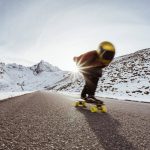
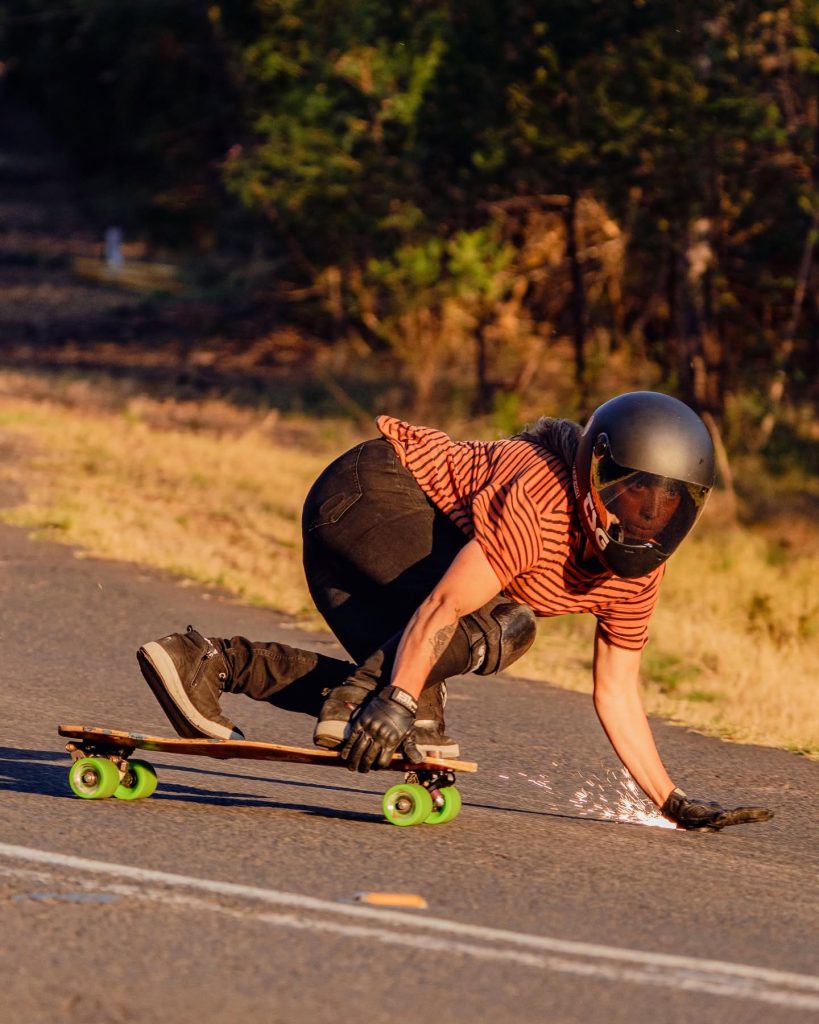
Anna Pixner finished fourth on Monday in the downhill final at the World Skate Games, held at Cerro Lambaré in Paraguay. The Austrian competes on a longboard, an elongated skateboard on which she can reach between 90 and 100 km/h in races and on closed courses. But she began skating in search of something quite different: an activity she could enjoy alone, without feeling that others were watching. Since then, her board has accompanied her on travels, workshops with children and a Himalayan expedition that also ended with a marriage proposal.
She grew up in Innsbruck, skiing and climbing, but competitive pressure and shyness made her uncomfortable. She wanted to skate, yet felt intimidated by skateparks where she rarely saw girls and others could watch her learning. “I’ve always hated people watching me when I’m learning something new,” she told the European Outdoor Film Tour -EOFT-. Around the age of fifteen, she bought a longboard online and began practising on a cycle path behind her house, alone and listening to music. Progress was gradual: “For the first six months, I practically only practised braking,” she told ‘Der Tagesspiegel’. A workshop in the city introduced her to other skaters and, about a year after starting, she was already entering races.
The connection between speed and meditation
In 2018, she crashed into a guardrail in Israel. As she told ‘Der Standard’, she suffered a punctured lung, four broken ribs and two fractured vertebrae. Recovery did not end when she could move again: getting back on the board brought panic attacks, particularly in places that reminded her of the crash. She went to therapy and began writing about her feelings; she also read psychology and philosophy to understand her reactions. With a mentor’s support, she took up yoga, meditation and breathing exercises, even while her mobility was still limited. Her aim, she later explained to the ‘#myinnsbruck’ blog, was specific: “I wanted to enjoy being on the board again. That was the goal.”
The connection between speed and calm remains central to how she describes her sport. “For me, speed and meditation are connected,” she told ‘Netzathleten’. On the board, she has to focus on the moment and react without sudden movements; off it, she uses breathing exercises to manage everyday situations that can also make her nervous. That calm takes preparation. In Tyrol, she sometimes heads out at dawn before traffic builds, with fellow skaters communicating by radio to warn of approaching vehicles. During training, she slows down to work on technique. “It’s not about winning, but about the feeling,” she told ‘#myinnsbruck’, explaining what she found in downhill skating.
 A life across continents
Pixner studied education and temporarily put an almost-completed master’s degree in gender and social change on hold to focus on skating. During the pandemic, she spent time in Portugal, took up surfing and produced videos for her sponsors while competitions could not take place. She now lives in Australia with Rod Soares, a Brazilian photographer and filmmaker. They met while travelling in Europe in 2019 and maintained a long-distance relationship before reuniting. Today, they work together on photographs and films documenting their adventures. Surfing is part of that life too: in an interview published in September, she announced her intention to represent Austria at the World Surfing Games.
One of their projects took them to Umling La in the Himalayas, at an altitude of around 5,800 metres. The idea emerged after she contacted skaters in India and developed into a record attempt and the film project ‘The Highest Ride’. Pixner prepared by running in the mountains, training in the gym and on her board, and using meditation to manage stress. Rod accompanied the expedition to film it and took the opportunity to propose: “When we were there I got down on one knee and proposed. And she said yes,” he told ‘The Australian’. The outcome of the record attempt had yet to be revealed when the September profile was published.
What the videos do not show
Although she appears in films and photographs, the teenager who avoided attention has not entirely disappeared. “I still don’t feel very comfortable in front of cameras or speaking in public,” she admitted to ‘Girls on Board’. After travelling, she writes, draws and paints to process her experiences. On the road, she has also found support within a small community: fellow skaters have invited her to dinner and offered her a sofa to sleep on, hospitality she returns when someone visits her hometown. She told EOFT that she no longer feels she has to set extreme goals for every descent, and that enjoying herself more also helps her skate better.
Her interest in teaching took her to Ramallah in 2016, where she volunteered with SkatePal. She had heard about the organisation while in Israel and decided to travel there by bus. She and another volunteer took two skateboards to different schools; two long queues of children eager to try them quickly formed. “We didn’t even speak the same language, but it didn’t matter,” she recalled to ‘Girls on Board’. Her lessons do not need to recreate the descents in her videos: teaching participants to push and brake on flat ground also gives them a chance to explore what they can do on a board.
A helping hand onto the ramp
The future tour of ‘The Highest Ride’, she announced in September, will include fundraising for projects supporting young people with mental health difficulties. That remains a planned initiative, while her workshops have already produced memorable encounters. At one, she met a girl who reminded her of herself: very shy, keeping apart from the group and only wanting to speak to Anna. She began skating away from the others and then asked Pixner to hold her hand as she rode onto a ramp. By the end of the session, Pixner recalled, the girl was smiling and proud of what she had done.
 Last related articles