The Board of Directors of the International Sport for All Federation -FISpT- has approved its 2026–2028 Strategic Plan and unveiled World Sport for All as its new operating brand. The two decisions form part of the same institutional renewal: the organisation intends to update its structure, expand the services available to members and adopt a name that is easier to understand internationally, although its statutory name will remain Fédération Internationale du Sport pour Tous.
The strategy is intended to convert FISpT’s recognition and historical legacy into visible programmes, tools and results. The document establishes five pillars covering governance, activities, partnerships, knowledge and communications. “Our goal is to become the global Sport for All federation that connects policy to practice and supports national systems with real tools, not just titles,” said chief executive Marco Tomasini.
Five operational pillars
The governance reform covers new membership criteria, an updated constitution, the election of a diverse Board, audited accounts, annual reports, published minutes and training for members. The federation currently lists 42 national members, 46 individual members, 23 committee members and 12 associate members. The proposed framework distinguishes five categories and reserves one national membership position per country for the organisation recognised by its Olympic committee or sports authority, or otherwise demonstrated to be the legitimate national reference point for Sport for All. The internal survey included in the plan shows that 48.4% of respondents have no paid staff and depend on volunteers, while 96.8% are willing to participate actively in development commissions.
The second pillar will translate this structure into low-cost programmes that can be replicated nationally. FISpT is preparing an annual World Sport for All Day campaign, materials for local organisers, seminars on inclusion and training for national projects. It also envisages micro-grants, evaluation tools and activities connected with young people, schools, active ageing, refugees and the environment. Their reach will be measured through the use of programme materials, participation in campaigns and the documented local impact of pilot projects.
 Knowledge and partnerships
The federation intends to act as a bridge between its members and organisations such as the International Olympic Committee -IOC-, the United Nations Educational, Scientific and Cultural Organization -UNESCO- and the World Health Organization -WHO-. It will also seek agreements with The Association For International Sport for All -TAFISA-, the International Sport and Culture Association -ISCA- and the International Council of Sport Science and Physical Education -ICSSPE-. The plan includes policy documents connecting physical activity with the Sustainable Development Goals and sets a benchmark of producing at least two joint initiatives or policy products.
Knowledge production will be organised around a future Sport for All Observatory, a digital library of research and good practice, and an annual report on the state of the sector. Implementation will follow three stages. The 2026 phase covers legal registration, completed in Rome in January, the statutes, the visual identity and the first Open Board. In 2027, FISpT plans to submit an Erasmus+ application, pursue access to Olympic Solidarity, introduce campaign toolkits and begin its first certification programmes. The annual report, local pilot grants, measurements of member satisfaction and consolidation of the brand are scheduled for 2028.
Resources and projects
The financial model estimates an initial annual operating cost of €20,000: €10,000 for travel, €6,000 for administration, €3,000 for communications tools and €1,000 to support activities and identify potential hosts. The initial phase does not envisage permanent employees, so delivery will depend on temporary project teams, consultants, volunteers, universities and partner organisations. The recruitment of an executive director and staff is scheduled for 2027. Revenue would come from events, licences, courses, certifications, international grants, Erasmus+, sponsorships and host agreements.
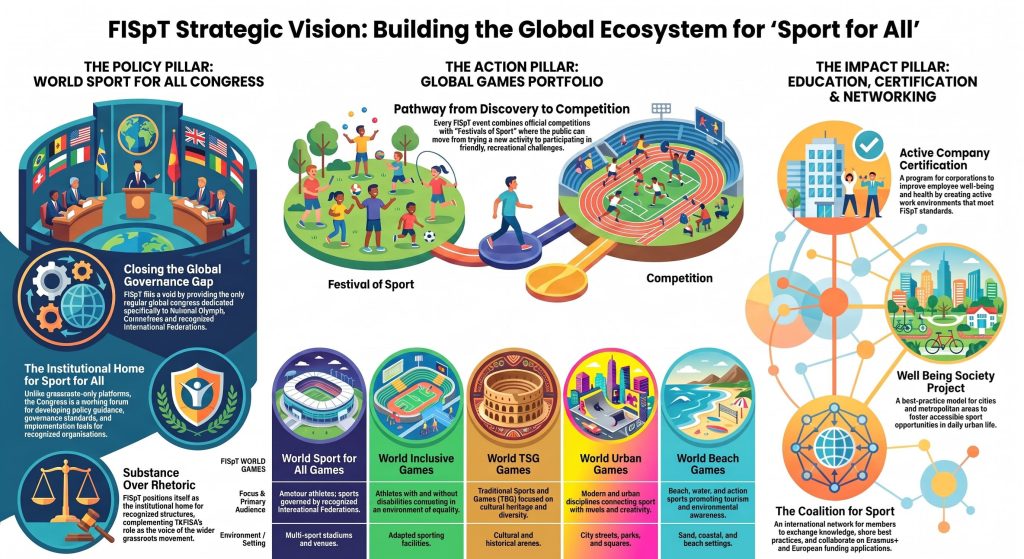
The document also proposes a portfolio of activities for which no dates or hosts have yet been confirmed. It includes a World Sport for All Congress conceived as an institutional forum complementing TAFISA’s congress, as well as five event models: the World Sport for All Games, World Inclusive Games, World Traditional Sports and Games, World Urban Games and World Beach Games. These would be joined by the ‘Active Company’ certification for businesses, ‘Well Being Society’ for cities and communities, and a coalition intended to facilitate project exchanges and the preparation of international applications.
A new identity
The new identity depicts five interwoven human figures, one for each continent, forming a circle resembling a globe. Its five colours correspond to those of the Olympic rings, while the figures are intentionally non-gendered to represent participation without distinctions based on sex, culture, ability or background. The choice of the name World Sport for All follows the wider trend among international organisations that have replaced their former acronyms with brands beginning with ‘World’, but does not alter FISpT’s legal identity or history.
The federation was founded on 3 April 1982 in Strasbourg, received full IOC recognition in 1995 and transferred its legal registration to Rome in January 2026. Its own analysis acknowledges a less extensive public programme record than TAFISA’s, limited staff and financial resources, questions surrounding continuity following its recent reactivation and the risk of duplicating functions in a sector containing several international organisations. “With this plan, we are committing FISpT to become that bridge – from policy to practice, from recognition to real impact,” Tomasini said.
 Last related articles