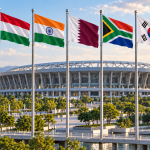
The Dakar 2026 Youth Olympic Games will mark an unprecedented moment for international sport: it will be the first time the YOG are held on the African continent. From October 31 to November 13, Dakar, Diamniadio and Saly will welcome young athletes from around the world, but the event will extend far beyond the courts, stadiums and competition venues. Senegal is preparing a celebration in which sport will coexist with art, music, history and local traditions, using the event as a window to showcase a cultural identity that remains largely unknown to much of the world.
In the streets of Dakar, that transformation is already becoming visible. Murals, artistic competitions, music, design and various initiatives linked to the Games are taking the spirit of Dakar 2026 far beyond the sporting venues. The intention is for the population, particularly young people, to be more than spectators at an international event and instead become protagonists of a celebration built around their own culture. As Mamadou Diagna Ndiaye, president of the National Olympic and Sports Committee of Senegal and the Dakar 2026 Organising Committee, explains, culture gives the event a depth that sport alone cannot achieve.
Urban art as part of the Games
One of the most visible expressions of this connection between sport and culture can be found on Dakar’s walls. In March, one of the busiest stations of the Regional Express Train became the setting for a mural measuring almost seven metres long and four metres high, dedicated to three generations of Senegalese athletes: Julie Marie Gomis, the country’s first female Olympic athlete in 1976; Combé Seck, African open-water canoeing champion and one of Senegal’s flag bearers at Paris 2024; and Tening Faye, a young bronze medallist at the 2025 Cadet Taekwondo World Championships. The artwork, created by artist Dieynaba Sidibe, known as Zeinixx, seeks to connect the country’s sporting memory with new generations and spark the curiosity of those who pass through the city every day.
The mural is part of Yeesal, a project that aims to turn different spaces in Dakar, Rufisque, Bargny, Diamniadio and Saly into an open-air gallery. In total, 43 graffiti artists will create 43 murals measuring seven by four metres, inspired by sporting heritage, Olympic values and cultural diversity. The initiative takes on particular significance in Senegal, where graffiti has its roots in the Set Setal movement of the early 1990s, when young people used the walls of their neighbourhoods to communicate campaigns related to cleanliness, hygiene and public health. For Zeinixx, who became Senegal’s first female graffiti artist, bringing this artistic expression to the Games means recognising a form of culture that has historically served as a tool for education and social participation.
A celebration built around Senegalese identity
The cultural dimension of Dakar 2026 is also taking shape through initiatives that seek to directly involve young people. One example is the competition to design the Games’ mascot, which attracted 500 students from 41 schools across 16 regions of Senegal. The winning design, created by Ndeye Mariama Diop, a 16-year-old student from Saint-Louis, gave life to Ayo, a lion cub whose name means “joy” in Yoruba. The character combines traditional and contemporary elements: he wears a tengaade, a conical hat associated with the Fulani community, alongside a football shirt, reflecting two dimensions that coexist in the country’s everyday life.
The same approach extends to music, fashion and craftsmanship. “Terenga”, composed by Senegalese artist Mamy Mbaye, will be the official song of Dakar 2026 after being selected through the “Wonéel sa bop” project, an initiative that involved performers, instrumentalists, producers and composers from across the country. The song connects the tradition of griots with the contemporary popularity of mbalax, while young designers and craftspeople have also been invited to participate in the creation of medals and uniforms. During the Games, Dakar, Diamniadio and Saly will also host festivals, concerts, street performances and fashion shows around the sporting venues, expanding the stage of competition into the host cities themselves.
 Last related articles