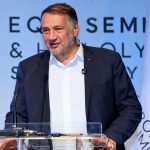
Mustapha Berraf wants to bring to the agreement with Alejandro Blanco the priorities that shaped his bid for the presidency of the Association of National Olympic Committees (ANOC): strengthening its 206 members, expanding cooperation across continents and improving access to resources and opportunities. The understanding between the two leaders opens a new phase for his ANOC Vision 2036 programme, which will now need to be incorporated into a joint proposal for the 2026–2030 term.
The agreement, reached on the sidelines of the Aichi-Nagoya Asian Games, proposes that Berraf serve as president from 2026 to 2028, with Blanco succeeding him until 2030. This arrangement is subject to ANOC’s Constitution, electoral procedures and approval by its General Assembly. Both have committed to presenting a joint programme before 8 November, ahead of the December election in Hong Kong, where the successor to current president Robin Mitchell will be chosen.
Berraf enters this phase as president of the Association of National Olympic Committees of Africa (ANOCA), which brings together 54 committees, and with responsibilities as a member of the International Olympic Committee, ANOC Vice-President for Africa and president of the Olympafrica Foundation. In June, his candidacy received unanimous backing from ANOCA’s Extraordinary General Assembly, attended by 52 African committees. The organisation noted at the time that no African leader had ever served as ANOC president.
From African experience to a worldwide programme
Unveiled on 7 July, ANOC Vision 2036 seeks to bring that continental experience to an organisation whose members operate in widely differing circumstances. Its commitments include training and knowledge-sharing among committees, new international partnerships, greater support for athletes and access to leadership positions for women and young people. The project also includes digital transformation and artificial intelligence as tools that should be accessible to every committee.
Sarah Noura Arif, an adviser to Berraf, places the agreement with Blanco within that same approach: “Unity has meaning only when it delivers results for the NOCs”. In her assessment of this new phase, she explains that the aim is to “combine experience, identify shared priorities and develop a programme that responds to the needs of all 206 members”. She also maintains that Berraf’s contribution should draw on “the knowledge acquired over decades of work within the Olympic Movement”.
The process of opening the programme to contributions from other committees had already begun before the agreement. In September, Berraf invited ANOC members to share their experiences and proposals to help develop ANOC Vision 2036. The aim was to ensure that solutions implemented in one country could benefit others, and that cooperation would serve both well-resourced committees and those with more limited capacity to act.
 Last related articles