An agreement designed to avoid an electoral confrontation has become a new source of tension in the race for the presidency of the Association of National Olympic Committees (ANOC). The European Olympic Committees’ (EOC) leadership has rejected the arrangement that would allow Mustapha Berraf and Alejandro Blanco to share the 2026–2030 term, with each serving two years as president. At the same time, it maintains its support for the Spanish official’s candidacy, despite his being one of the agreement’s two signatories. That dual position takes the debate beyond the feasibility of the handover: it affects the relationship between the candidate, his continental supporters and the commitments made to other representatives of the Olympic Movement.
The position is set out in a letter dated 26 October, signed by Spyros Capralos, President of the European Olympic Committees (EOC), and Secretary General Carlo Mornati. According to the document, the Executive Committee decided at its 8 October meeting in Split not to endorse the proposed rotation between Mustapha Berraf and Alejandro Blanco. The communication reached European National Olympic Committees 18 days later, with a deadline of 29 October to respond. The agreement had been signed following mediation by Sheikh Joaan bin Hamad Al Thani, President of the Olympic Council of Asia and Senior Vice-President of ANOC, with the aim of bringing the two sides together and preventing the election from deepening divisions between the candidacies.
Europe backs the candidate and rejects his agreement
The arrangement known as 2+2 envisaged Berraf leading the organisation for the first two years of the term and Blanco for the following two, subject to ANOC’s constitutional requirements. The European Executive Committee’s rejection introduces a political contradiction that its support for the Spaniard does not, in itself, resolve. Supporting a candidate while questioning a commitment he has signed requires clarification of how far that disagreement extends. The letter does not establish that Blanco has changed his position, knew of the European initiative in advance or supported it. Nor is there verified evidence of coordinated action to facilitate his withdrawal from the agreement. What remains unresolved is whether he stands by the commitment and how he intends to defend it before those supporting his candidacy.
The decision also affects the outcome of Sheikh Joaan’s mediation. Capralos and his Executive Committee are entitled to question both the political merits of the agreement and its institutional compatibility, but the letter does not explain whether those objections were discussed beforehand with the mediator and the two candidates, whether modifications were considered or whether an alternative exists. The rejection weakens the compromise reached, although it does not demonstrate an intention to confront Asia. That distinction matters: attributing intentions that the document does not substantiate would distort the analysis, but so would ignoring its political consequences. If Europe’s objective is to preserve Olympic unity, its leadership should explain how it proposes to maintain the rapprochement that gave rise to the agreement.
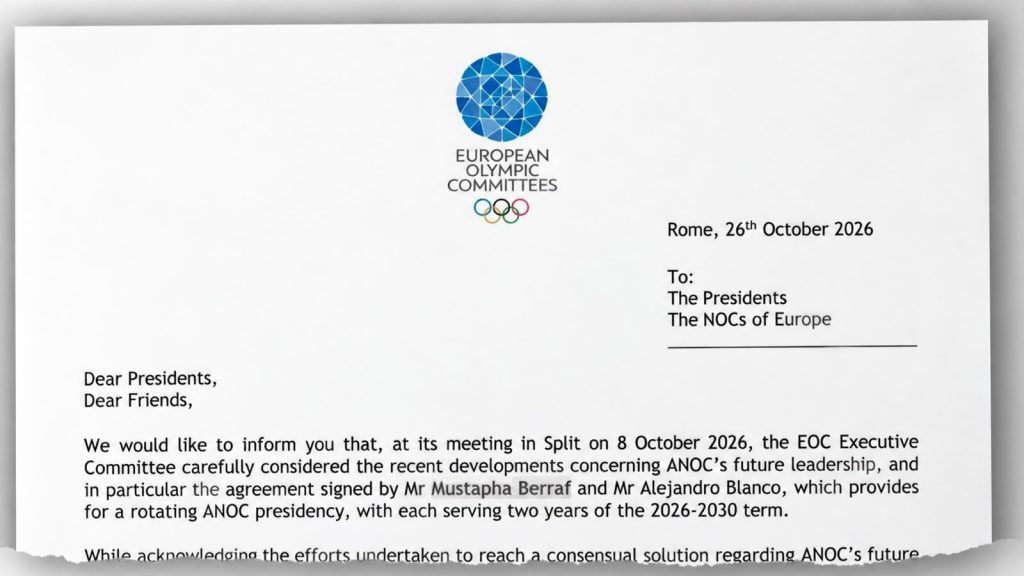
Eighteen days to communicate and three to consult
The timetable adds another element of controversy. Eighteen days elapsed between the Executive Committee’s decision and its communication to members, while National Olympic Committees were given three days to submit their views. The letter does not explain that interval or establish whether it was used to hold discussions with those involved or explore other solutions. Moreover, the consultation opened after the leadership had adopted its position: members were asked to respond to a stance already established. That does not invalidate their responses, but it requires a distinction between prior deliberation and seeking support for an existing decision. The document summarises the agreement without reproducing it in full; it is also unclear whether the complete text was provided separately. The quality of the consultation depends on the time and information available to assess its implications.
That institutional distinction means the Executive Committee’s rejection cannot be presented as the collective position of all European National Olympic Committees until their responses are known. It also calls for caution against automatically interpreting the dispute as a confrontation between blocs. Berraf leads the Association of National Olympic Committees of Africa (ANOCA), Blanco enjoys the support of the European leadership, and the rapprochement was promoted by an Asian official, but those circumstances do not, in themselves, turn the dispute into a continental conflict. The risk of polarisation arises if the agreement collapses and each candidacy again relies primarily on its continental base. For anyone seeking to lead an organisation of 206 National Olympic Committees, the credibility of their commitments must also hold beyond the group supporting their election.
A handover that signatures do not guarantee
The political disagreement adds to a difficulty that THE IN had already identified: the agreement alone cannot ensure an automatic transfer of the presidency. According to the constitutional analysis published by this outlet, Article 13.10 provides that a presidential vacancy leads to temporary succession by the Senior Vice-President and an election at the next Ordinary General Assembly. A potential resignation by Berraf in 2028 would therefore not automatically make Blanco president. The agreement needs an implementation mechanism compatible with the Constitution, as well as political will. The European rejection does not amount to a formal ruling on its validity, nor does it mean that an amendment has been proposed and defeated; it demonstrates that the arrangement faces resistance beyond doubts about its implementation.
If a constitutional amendment were required to guarantee the transition, THE IN’s analysis places the threshold under Article 21.1(d) at affirmative votes from at least 75% of the entire membership: 155 of the 206 committees, alongside compliance with the applicable deadlines and procedures. That requirement makes it necessary to build support far beyond the two signatories. Berraf and Blanco have yet to specify the route they propose for implementing the agreement and whether both maintain its terms following the European intervention. Capralos, in turn, should explain the grounds for the rejection, the consultation timetable and the alternative he supports. Those answers would make it possible to assess whether a negotiated solution exists and what support it could secure ahead of the Assembly.
 Last related articles