Equestrian sport presents the Olympic program with a distinctive bargain: exceptional riding skill and a long competitive tradition, delivered through a partnership in which the quality, training and welfare of another living athlete are indispensable. That partnership is its defining attraction. It also creates costs, access barriers and ethical responsibilities that deserve a harder examination as the IOC reviews disciplines for Brisbane 2032. THE IN’s assessment is that, if equestrian competition is reduced, Eventing has the most difficult case to defend.
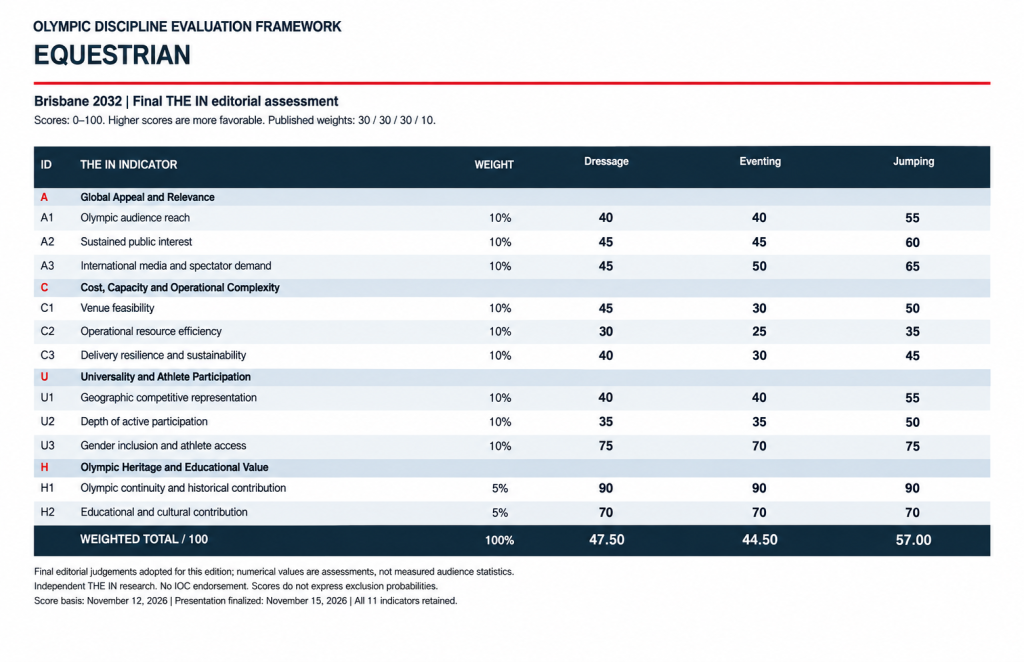
Our independent framework evaluates eleven indicators across appeal, delivery demands, athlete participation and heritage, weighted 30/30/30/10. We examine Dressage, Eventing and Jumping separately, rather than copying a single audience or cost assessment across equestrian sport. Dressage receives 47.50 out of 100, Eventing 44.50 and Jumping 57.00. These are THE IN’s editorial judgments for this edition, not an IOC ranking. Eventing’s lower delivery ratings, combined with our more restrained assessment of its reach and participation, explain its weaker total.
There is relevant Australian audience research, although it must be read precisely. An Omnipoll national online survey of 1,237 adults, conducted April 18–23, 2024, found that 3% spontaneously named equestrian among up to five Olympic sports they intended to follow or watch on television. Swimming received 51 percent and athletics 41 percent. This is a limited measure of unprompted pre-Games interest, not a television rating or an allocation of viewers among the three equestrian disciplines. It supports scrutiny of broad host-market appeal without erasing the enthusiasm of equestrian’s committed audience.
The financial-access question goes deeper than the spectator experience. A rider must reach elite human performance while obtaining access to a suitably trained horse, coaching, facilities and competition support. The horse’s ability is part of the result, and the resources needed to develop that partnership are part of the pathway. In our view, this creates substantial economic barriers. The comparison with equipment-dependent or motorized competition is useful only in examining access to performance resources; a horse is a living partner with welfare interests, not a machine, and the comparison does not diminish the rider’s athletic skill.
Brisbane is not starting from an empty field. Toowoomba Showgrounds is an established equestrian center, with proposed additional arenas, warm-up areas, stabling and an international-standard cross-country course. GIICA lists the project in planning and approvals. The 2025 infrastructure review judged the upgrade feasible and identified existing infrastructure that could be reused, while leaving a Games equine-quarantine protocol to be developed. Those are real advantages and real outstanding requirements. Neither an existing showground nor an upgrade announcement establishes the final cost of staging each discipline.
Eventing adds a cross-country phase to Dressage and Jumping, creating a distinct land, course-management and safety requirement. Horse importation also brings Australia’s biosecurity system into the delivery equation, although the Games arrangements must be established specifically. Safety cannot be described as static: the FEI reports progress in reducing rotational horse falls and uses obstacles designed to collapse or deform under specified impacts. Its welfare program and that technology deserve recognition. The relevant programme question is whether Eventing’s additional requirements deliver sufficient sporting and audience value; its removal would not automatically eliminate shared stabling, transport or veterinary costs.
Equestrian competition also has strengths that our assessment credits, including men and women competing directly against one another and a substantial Olympic heritage. Those strengths do not answer every question about affordability, geographic access or the use of animals in elite competition. We see Eventing as the first discipline that should face the closest comparative scrutiny if a reduction is contemplated, while Dressage must defend its broader appeal and Jumping its resource demands. No IOC decision establishes that any will be removed. Our argument is that tradition should inform the assessment, while each discipline demonstrates the present value of the place it occupies.
 Last related articles