At 14, Seraphina Seropian has a schedule that leaves little room for the usual routine of teenage life. She trains three to four days a week, around three hours at a time, while keeping up with school, exams and homework. Even getting to the gym can involve a long journey.
The Lebanese rhythmic gymnast has competed at several international events in recent years. In 2025, she represented Lebanon at the FIG Junior World Championships in Bulgaria. In 2026, she competed at the Asian Junior Championships in Bishkek, Kyrgyzstan, where she won bronze in the All-Around Qualification with a score of 67.150.
For Seropian, the demands of elite sport have become part of everyday life.
“My days are planned around training, school and competitions. Sometimes I have to give up the time my friends have to relax and enjoy themselves and spend it training instead.”
Her route into rhythmic gymnastics began with ballet. She was already attracted to movement, music and performance when she discovered the sport and found a combination of two disciplines she enjoyed.
“I loved how it brought together the artistic expression of dance with the strength and discipline of a sport.”
Learning from international competition
Competing internationally has given Seropian a clearer understanding of the level required in rhythmic gymnastics. It has also strengthened her belief that she can compete on the same stage.
She pays close attention to experienced gymnasts, studying their routines, execution and difficulty and looking for details that could help her improve.
“I watch their routines carefully, study their execution and difficulty, and then look at what I can take from that experience to improve myself.”
Her bronze medal in the All-Around Qualification at the Asian Junior Championships is one of the results she values most. Competing as a junior, she recorded Lebanon’s highest score and sees the result as confirmation that her level is progressing.
“I believe one of my biggest strengths is my determination. When I set myself a goal, I work extremely hard to reach it.”
She also believes she has developed the ability to remain focused under pressure.
The next challenge will be the senior category. Seropian is preparing for the increased difficulty and expectations that come with competing against more experienced gymnasts.
“I want to continue developing my difficulty, execution, artistry and consistency so that I can be genuinely competitive with internationally recognised senior gymnasts.”
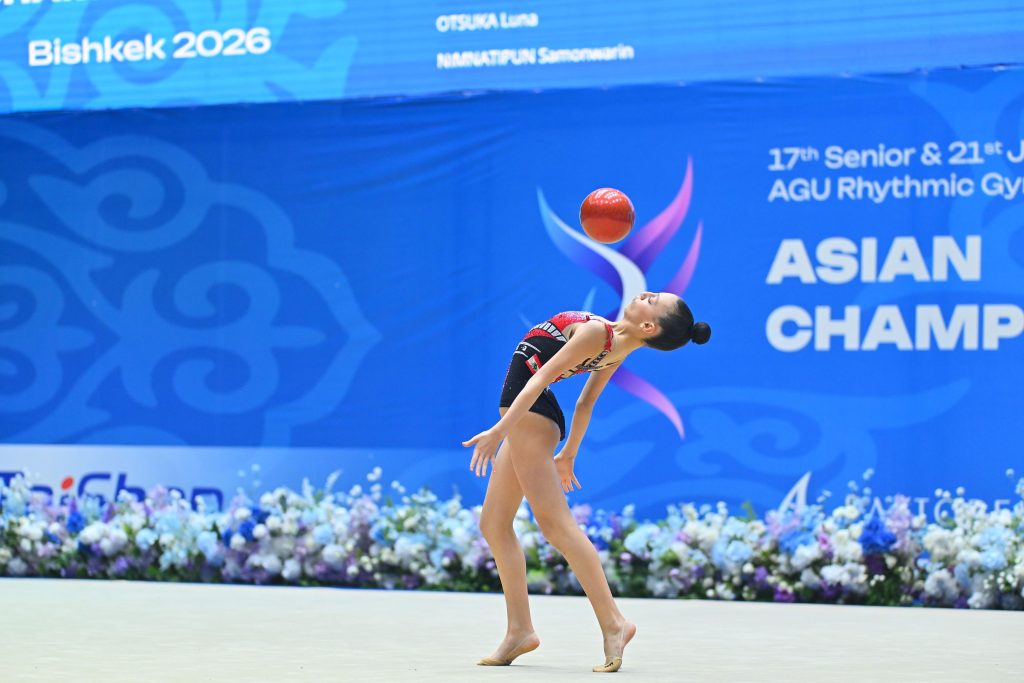
Representing Lebanon
One of the most significant experiences of her young career came with her selection to represent Lebanon at the Mediterranean Games.
“Representing my country is one of the greatest honours an athlete can have. The moment I put on the flag, I feel immense pride alongside a deep responsibility.”
She says the experience was particularly significant because rhythmic gymnastics had not previously been represented by Lebanon at the Mediterranean Games.
At 14, she was also the youngest Lebanese athlete at the event, according to her account.
Stepping onto the competition floor therefore carried a significance beyond her own result.
“I knew I was not only competing for myself. I wanted to represent the country with dignity and show what I could do despite all the challenges I had faced to get there.”
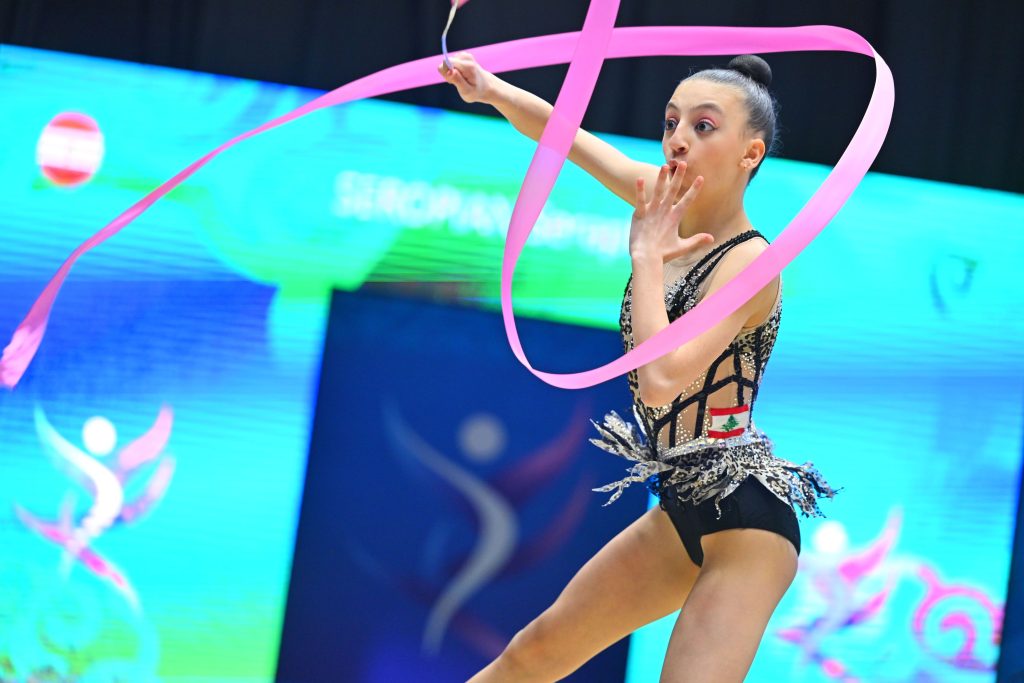
Training during instability
The difficulties surrounding sport in Lebanon are another part of Seropian’s story. She has continued training through periods of war, bombardment and insecurity. At times, even travelling to the gym has been uncertain.
“There have been times when travelling to training was frightening because I could not be certain what the security situation would be. There were days when the decision to go to training was not simply about motivation. It was about whether it was safe to travel.”
Whenever it was possible, she continued.
For a rhythmic gymnast competing internationally, however, training is only one part of the equation. Appropriate facilities, equipment, coaching, travel and regular international competition all require financial resources.
Seropian says she has relied heavily on sacrifices made by her family to continue her career.
“I am proud of what I have achieved with the opportunities I have had, but I also know how much further I could go with a stronger professional support system around me.”
She believes greater investment in young athletes could help develop gymnastics in Lebanon and provide athletes with a clearer route towards international competition.
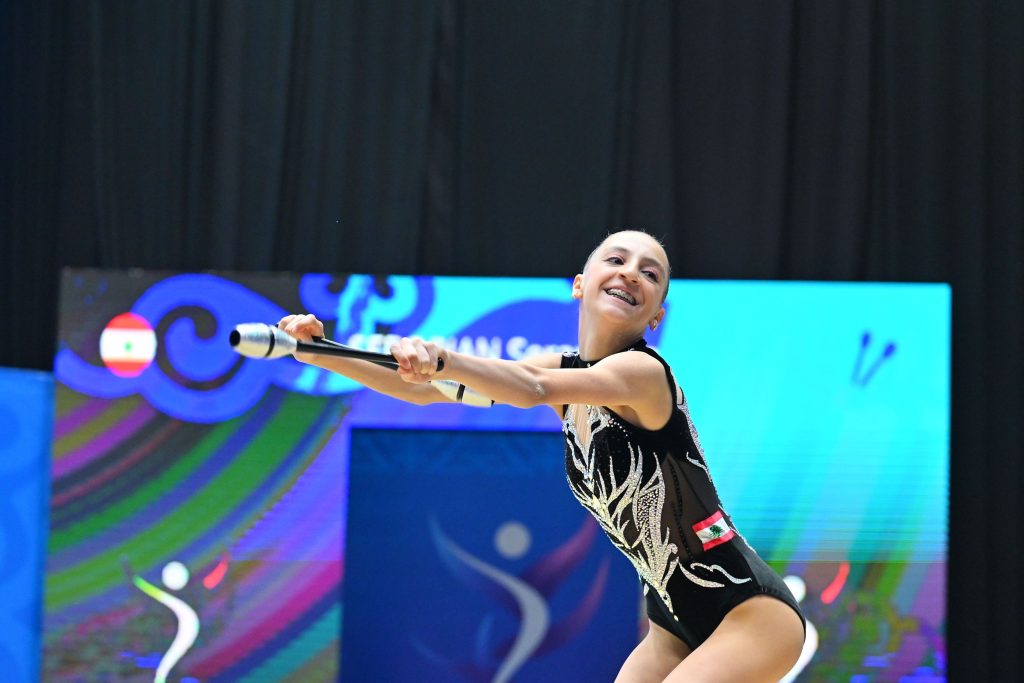
Balancing school and elite sport
The demands of training must also be fitted around education.
Seropian remains a full-time student and says there is often little recognition of the demands placed on young athletes who have to combine international competition with school.
“When I miss something at school because I am representing Lebanon internationally, it is not because I am choosing to neglect my education. I am working to represent my country while continuing my education at the same time.”
She would also like to see greater recognition and practical support for young female athletes.
“Government support is essential for young students.”
For Seropian, the challenge is not simply finding time to train. It is maintaining a sporting career while continuing to meet the expectations placed on a young student.
The Los Angeles ambition
The next stage of her career will begin when she moves into the senior category. Beyond that lies an ambition she makes no secret of: competing at the Olympic Games.
Seropian has set her sights on Los Angeles 2028.
She understands that an Olympic place has to be earned through performance and says that is precisely why she is working to improve.
“I know that an Olympic place must be earned through performance. That is exactly why I am working so hard.”
Lebanon has yet to be represented in rhythmic gymnastics at the Olympic Games. Seropian hopes that if an opportunity for Lebanon to receive a quota place arises, she will be considered.
“I would be deeply honoured to be considered for it, not simply because I dream of being an Olympian, but because I want to prove that a young athlete from Lebanon, even after everything she has had to overcome, can stand proudly among the world’s best.”
For now, the 14-year-old is preparing for the demands of senior gymnastics. The competition will become tougher, the technical requirements higher and the margin for error smaller.
Her immediate priorities remain straightforward: train, study and improve.
The Olympic ambition is there, but Seropian knows the route to Los Angeles will have to be built through the performances that come first.
 Last related articles