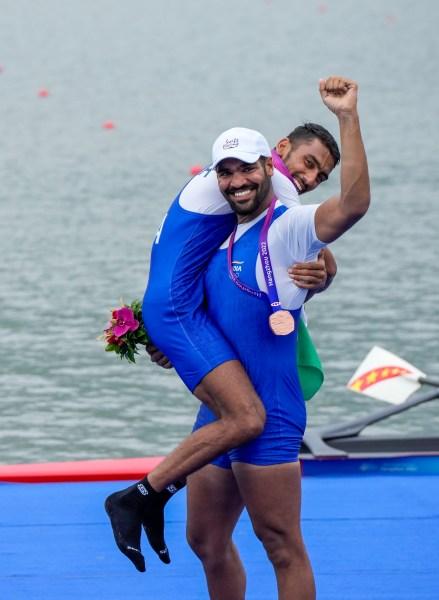
Salman Khan and Satnam Singh had trained together in the same quadruple sculls crew for several months, but they had never competed as a pair. Five days after forming their new partnership, the two rowers won bronze in the men’s double sculls at the Aichi-Nagoya 2026 Asian Games. They finished behind China and Uzbekistan, securing India’s first medal in the history of the event. The new combination brought together an Army serviceman who had driven an Uber through Delhi and a Navy sailor who, until that week, had occupied a different place within India’s rowing plans.
The result completed a journey that had begun nowhere near a boat. Salman, 28, could not swim when he took up rowing and tried to avoid a sport that frightened him. He had previously worked to support his mother and five younger siblings after the sudden death of his father. When Salman and Satnam stepped out of the boat after racing two kilometres in the heat, they could barely stand and needed help to walk. They then embraced and began to cry, releasing the tension that had accumulated since a crew reshuffle placed them together in the double sculls only five days earlier.
From the driver’s seat to the Army
Salman spent his childhood in Tauru, in the state of Haryana, where his father, Mohd Kasim Khan, worked in the construction and repair of truck bodies. His death in 2016 forced the family to return to their home district of Amethi and left the eldest of six siblings with a responsibility he regarded as his own. Salman moved to Delhi and began driving a WagonR for Uber between the capital and Gurgaon. He worked from 5am to 9am and returned to the road from 5pm to 10pm. “My brothers had to study and my sisters had to be married. I was the eldest, so it was my responsibility. I had to earn,” he explained after winning the medal.
While working as a driver, he continued applying to join the Indian Army. He had failed the written examination once and even told his mother that he would continue driving, but a friend persuaded him to try again because of his 1.93-metre height and physical build. Salman began training three times a day, often alone, until he passed the selection process. After approximately one year on Delhi’s roads, he sold the taxi and fulfilled one of his father’s wishes by joining the armed forces. He now holds the rank of naib subedar, a junior commissioned officer rank positioned between the Army’s non-commissioned and commissioned officers, and serves with the 122 Engineer Regiment.
 Fear of the waves
Rowing entered his life during his military training in 2018. Coaches Satywan, Satish Siraat and Prabhat Mishra noticed his height and build and sent him to try the sport, but Salman did not want to take part. “I didn’t even know how to swim. I didn’t want to take up rowing. Early in my training, the boat overturned once and I was terrified,” he recalled. He was frightened by the waves and considered quitting twice during his first two years. His coaches and a senior officer persuaded him to continue until he gradually became accustomed to the water and the possibility of falling out of the boat.
His progress took him to the Army Rowing Node in Pune, the military’s specialist rowing training centre, where he worked under coach Kudrat Ali. In 2022, he won gold at the National Games in Gujarat, followed by victories at the senior national championships and the national sprint championships the following year. The former driver who entered the sport unable to swim became a regular member of the national team. After claiming bronze in Japan, his first calls were to his mother, Jaburunnisha, and his wife, who had spent the previous night praying for him to win a medal.
A partnership built in five days
Salman arrived at the Games after spending six or seven months preparing for the quadruple sculls alongside Satnam, Balraj Panwar and Jakar Khan. Typhoon Dujuan forced the rowing programme to be reduced from four days to two, and the Rowing Federation of India -RFI- reorganised several crews shortly before competition began. The federation argued that the changes were intended to produce the strongest combinations under the revised schedule, while some athletes complained about a lack of communication and considered refusing to train. Salman and Satnam were moved into the double sculls and sat together in that boat for the first time five days before the final. “We were devastated. We couldn’t eat or sleep,” Salman admitted, describing his previous crewmates as part of a bond formed through months of uninterrupted work.
Before competing, Salman called the coaches who had guided him through his early years and explained what had happened. Their response became the message he later passed on to Satnam: “Row so hard that you empty the river.” During the race, Salman repeatedly urged his partner to increase the intensity and they held on to cross the finish line in third place. They later cried for Balraj and Jakar, believing their quadruple sculls crew could have challenged for gold, although Salman also emphasised that they had won a medal after only five days in their new boat. Satnam found another way to explain what would remain from the improvised partnership. The reference carried an additional resonance in India, where Khan and Singh are surnames commonly associated with Muslim and Sikh communities respectively: “Even after we are gone, the world will remember that a Khan and a Singh won India’s first Asian Games medal in the double sculls.”
 Last related articles