Before a ball was kicked in Debrecen, Ireland and Israel had already turned a UEFA Nations League fixture into a test of how football responds when political conflict enters the stadium.
Ireland’s players wore black armbands, lowered their heads during Israel’s national anthem and declined the customary pre-match handshake and exchange of pennants. UEFA had been informed in advance that Ireland would not participate in the handshake and accepted the arrangement. Ireland then won 3-0, but the significance of the evening extended well beyond the result.
The political background dates to October 7, 2023, when Hamas and other Palestinian armed groups launched coordinated attacks in southern Israel. The UN Independent International Commission of Inquiry reported that more than 1,200 people were killed, including at least 809 civilians, while 14,970 people were injured and at least 252 people were abducted to Gaza as hostages. The war that followed transformed the political environment surrounding Israel, including in Ireland.
The Football Association of Ireland had called for Israel to be suspended from UEFA competitions, while there were also calls in Ireland for the national team to boycott its scheduled matches. The FAI ultimately proceeded with the fixtures. Before the Debrecen match, goalkeeper Gavin Bazunu withdrew from the squad, saying he believed it would be wrong to participate. His decision led to several hours of discussion among the Irish players before a significant majority voted to fulfil the fixture.
The political disagreement was nevertheless visible before kick-off. FAI chief executive David Courell said the black armbands were being worn in recognition of lives lost in the conflict, while the players’ actions during the anthem and pre-match ceremony made their position impossible to overlook.
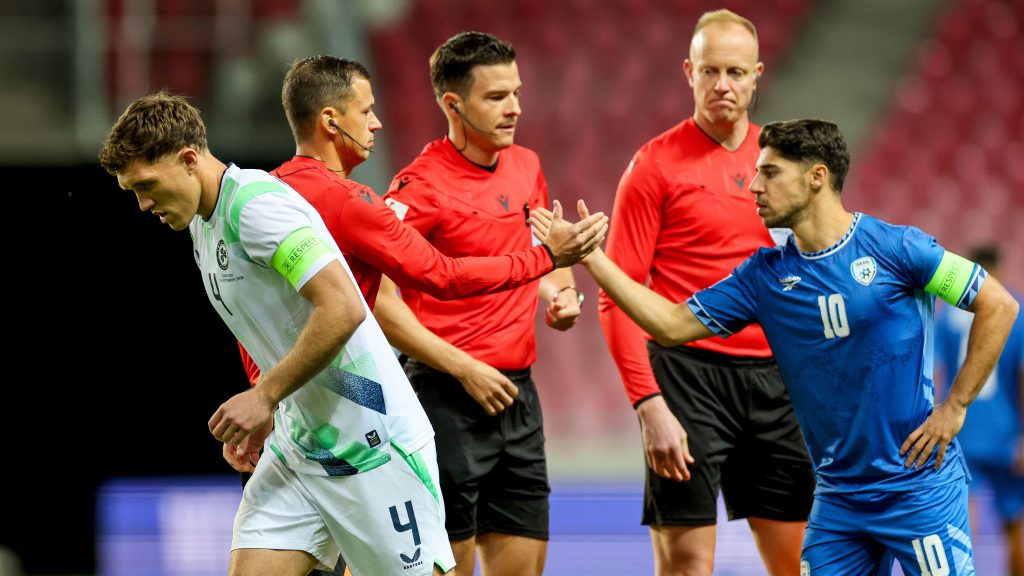
Dara O’Shea refuses to shake hands with Israel’s captain
This is where UEFA’s regulations become relevant. The 2026 UEFA Disciplinary Regulations require those subject to them to observe principles including ethical conduct, loyalty, integrity and sportsmanship. Article 11 also identifies the use of sporting events for manifestations of a non-sporting nature as an example of a breach.
That provision does not, by itself, establish that Ireland’s players committed a disciplinary offence. UEFA would have to assess the specific conduct and circumstances. Declining a handshake is not automatically equivalent to a disciplinary violation, particularly when UEFA had been informed beforehand and accepted the arrangement. The question is whether the wider conduct could fall within UEFA’s rules concerning political or other non-sporting manifestations.
UEFA has dealt with the intersection of politics and football before. The FAI also asked whether Ireland and Israel could be kept apart in future competition draws, referring to existing arrangements involving Spain and Gibraltar, Armenia and Azerbaijan, and Ukraine and Russia. UEFA rejected the request, with the FAI saying it had been told that such decisions are considered according to the circumstances of each case.
That distinction is important. UEFA does not treat political circumstances as entirely outside football, but neither does it automatically separate teams whenever political tensions exist. In the case of Ireland and Israel, UEFA’s position was that the circumstances did not justify such a restriction. The two countries therefore met in competition despite the political dispute surrounding them.
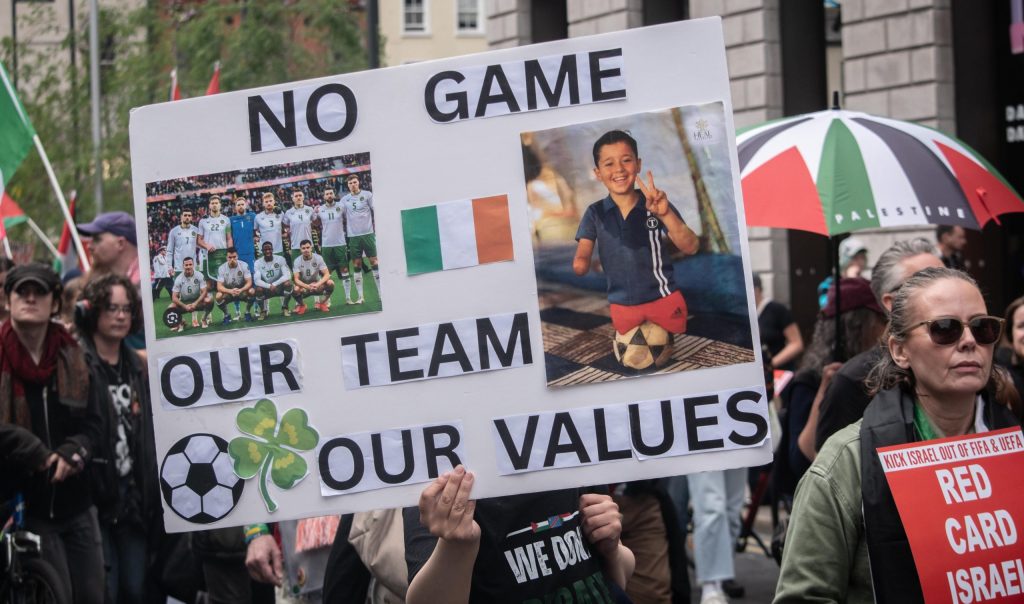
Protesters In Dublin – Sep 2026
The Debrecen match illustrates the difficulty of separating national-team football from the political environment in which it operates. Players represent their football associations and countries, but they are also individuals who may hold political views. Once Ireland chose to fulfil the fixture, however, its players remained subject to UEFA’s competition and disciplinary framework.
The challenge for UEFA is whether it can apply those rules consistently when political expression becomes part of an official match ceremony. The fact that UEFA accepted the decision not to conduct the handshake does not necessarily determine how other elements of the players’ conduct should be treated under the disciplinary regulations.
There is a broader issue for international football. National teams increasingly compete in an environment shaped by wars, diplomatic disputes and political pressure. Football can attempt to keep politics outside the stadium, but international football is built around national symbols, anthems and representatives of states. That makes complete separation difficult when political conflict directly involves the countries on the pitch.
Ireland made its position visible in Debrecen while still fulfilling its UEFA obligation to play. The question now is how UEFA applies its own rules when political expression enters the formal rituals of an international match.
The answer could have significance beyond Ireland and Israel. It may help define where UEFA draws the line between individual expression, political protest and conduct it considers incompatible with the rules of European football.
 Last related articles