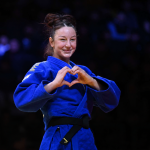
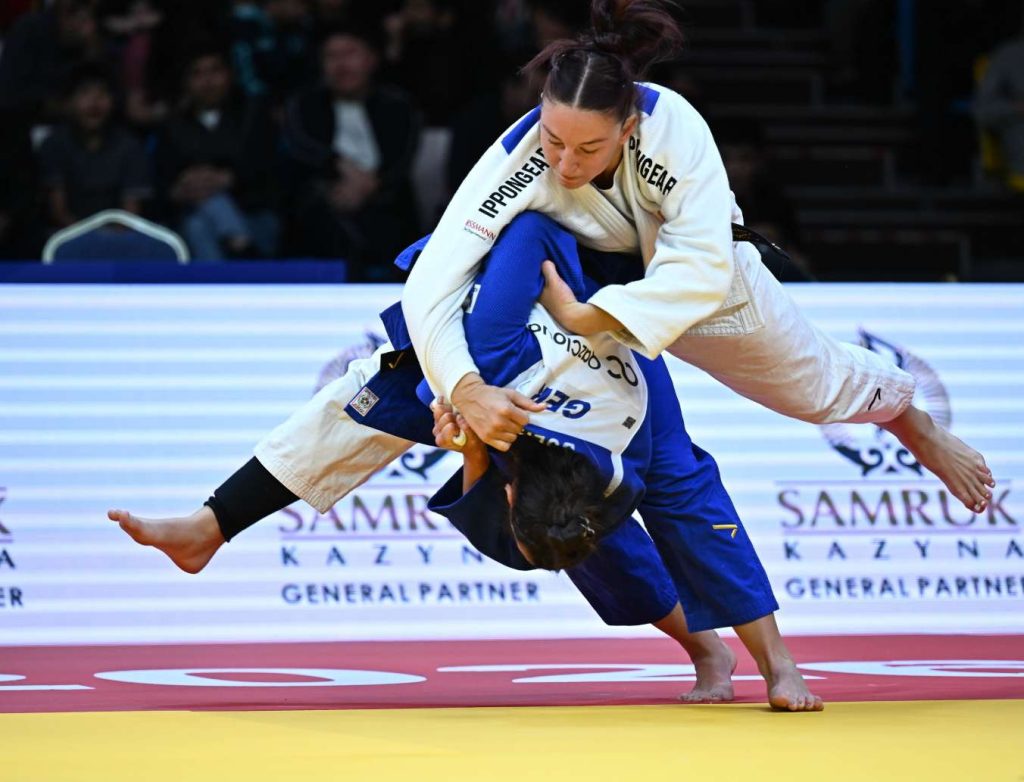
Anna Monta Olek will compete on Friday at the World Judo Championships in Baku, Azerbaijan, as the world number one in the −78 kg category, having won world and European silver medals in 2025. The 24-year-old German judoka remembers how she marked reaching the top: “When I first took the number one spot, I took screenshots,” she told ‘Sport Bild’. Her story outside competition began much earlier: between swimming and judo training, a television appearance against an Olympic medallist and small handmade items to help children with cancer.
At London 2012, she had watched Dimitri Peters, who trained in Hannover, win bronze. A year later, aged eleven, she challenged him on the German television show ‘Klein gegen Groß’. It was not a judo contest: they had to move along a series of judogi suspended from the ceiling, swinging from one sleeve to the next. Anna won 63–51 in a test she knew from training. “It’s an exercise we do as part of a circuit to develop grip strength,” she explained. A reminder remains where she learned judo: “The sleeves are still hanging in our dojo today.”
An Olympic ambition to surpass her father
Two elite sports shared the family home. Her father, Detlef Knorrek, competed in judo at Barcelona 1992 and Atlanta 1996 and won European bronze in 1991. Her mother, Petra, had won the same medal at the 1985 European Water Polo Championships. Anna accompanied her father to the training hall as a baby and began practising judo at five, although she also swam. For a time, she would go straight from the pool to the mat with her hair still wet. “When I was eleven, I decided that my heart was in judo,” she recalled in an interview with the European Judo Union -EJU-.
Knorrek still helps with her physical preparation and tactics, and they exchange views during competitions. “I got into judo entirely because of him,” she told the German university sports association. She now notices a change in how they are introduced: “I used to always be introduced as his daughter; now it sometimes happens the other way round, and he is introduced as my father,” she told ‘Sport Bild’. When her father jokes that she has already surpassed him, she adds a qualification: “But I still haven’t competed at an Olympic Games. He has been to two.” At the 2025 World University Games in Germany, she was able to bring family and friends together to watch her compete, an unusual opportunity in a calendar that normally takes her around the world.
 Wings for the children of Hannover
Her grandmother’s illness brought her into contact with Hannover’s association supporting children with cancer when she was still young. She made small items to raise funds connected to ‘Mutperlen’, coloured beads that children use to mark different stages of their treatment. Her involvement in charitable initiatives also included, at eight, a UNICEF project supporting girls’ education in Nepal. Olek credits her mother with that outlook: “She taught me from an early age to look beyond my own surroundings,” she explained in the university sports association interview.
In 2018, she launched ‘Engel verleihen Flügel’ —“Angels give wings”—, an initiative that collected donations through handmade wings to help fund a space for physical activity in a paediatric oncology unit in Hannover. She also participated in a campaign that registered 63 potential stem cell donors. “Anyone can find themselves in a difficult situation and would also be grateful for help,” she said in a report published by the Lower Saxony sports federation in 2019. In 2021, she received a medal of merit from the German state for her charitable work.
Studies, athlete representation and small rituals
Alongside training, Olek is studying a degree combining engineering and business management at the distance-learning university SRH Fernhochschule. She works through modules rather than conventional semesters, allowing her to fit her studies around her schedule. That flexibility does not remove the fatigue: she admits that, after demanding training sessions, she sometimes would rather lie down and watch Netflix than study. Her aim is to graduate before retiring so she can move into professional employment afterwards. She has also brought her interest in helping others into sport: in 2025, she explained that she wanted to contribute to a project for athletes who fall outside official support structures. In March, the German Judo Federation -DJB- announced her temporary appointment to its executive board as an athlete representative, following Igor Wandtke’s departure.
Away from the mat, she enjoys baking cakes and sweet treats, particularly carrot cake. On it, she has learned to manage nerves that once appeared as early as a week before competing. “Now, thanks to working with a sports psychologist, I focus more on what I can control and on myself,” she explained. Before each contest, she reviews three tactical options so she has alternatives ready if the first does not work. She also keeps certain routines: she wears the same T-shirt and shorts beneath her judogi and sticks to the same drinks and breakfast. “I always bring the same drinks and always eat porridge.”
 Last related articles