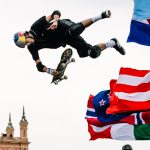
The World Skate Games bring together world championships across 11 sports and 40 disciplines in Asunción, Paraguay, from October 2 to 18, under the organisation of World Skate. The event brings together nearly 6,000 athletes and more than 10,000 accredited participants from over 90 countries. The programme ranges from Olympic skateboarding to artistic and speed skating, rink and inline hockey, downhill and freestyle disciplines. That variety makes the Games a meeting point for sports that share wheels but require different facilities, formats and organisational structures.

World Skate President Sabatino Aracu
The fifth edition continues a journey that began in Nanjing, China, in 2017, followed by Barcelona in 2019, Buenos Aires in 2022 and Italy in 2024. It is the second edition held in South America, maintaining the approach of bringing different world championships together under one organisational framework and within the same period. World Skate President Sabatino Aracu connects that scale with the ability to unite diverse sporting communities: “But perhaps the most powerful image of these Games is seeing representatives from more than 90 countries come together in one place.” He also highlights cooperation with Paraguayan authorities and the country’s facilities as factors that made hosting the event possible.
The facilities that remain in Paraguay
A tour of the venues helps explain how that diversity is accommodated. The Olympic Park of the Paraguayan Olympic Committee -COP-, located in Luque, in the capital’s metropolitan area, brings together specialist facilities within a complex covering more than 100 hectares. Other venues include the arenas of the National Sports Secretariat -SND-, urban spaces in Asunción and Cerro Lambaré, used for downhill events. The championships therefore combine permanent facilities with courses prepared for specific requirements: a speed skating track, a hockey arena and a downhill road each demand a different operational approach.
The additions include the Olympic Park’s park and street skateboarding facilities. Darren Pearcy, Head of Performance and Pathway at Skateboard GB, highlighted that choice: “Paraguay has made a clear decision. Skateboarding belongs alongside its other Olympic sports, so they’ve built environments that reflect that.” Sports Minister César Ramírez Caje places the longer-term objective in broader participation: “Our goal is for the legacy of ASU26 to create concrete opportunities, above all for our sporting present and for future generations.” The question extends beyond providing a competition venue to how those spaces will introduce new athletes to the sports and support their development.
One federation, different ways to compete
This week’s activity illustrates the breadth of the programme. While skateboarding stages its Park World Championship, rink hockey reaches the women’s and men’s under-19 semi-finals, with Argentina, Italy, Portugal and Spain represented in both categories. The Speed World Championships begin on Saturday, with 406 athletes from 47 countries expected across the junior and senior categories. Competition will move from the COP track to the road circuit and marathon. The Games provide a shared international setting for Olympic and non-Olympic disciplines, reflecting World Skate’s remit beyond skateboarding.
The organisation also brings together institutions with different responsibilities. World Skate provides the international sporting framework, while the COP, SND and organising committee coordinate facilities and services alongside national authorities. ASU26 Deputy General Director Larissa Schaerer identifies that cooperation as a less visible part of the event: “This kind of institutional cooperation is not seen on a television broadcast, but it is the reason everything else works.” COP and organising committee President Camilo Pérez López Moreira links the ability to host the championships to infrastructure development over recent years. Their remarks place facilities and organisational experience among the resources Paraguay aims to retain after the Games.
World Skate Day and open participation
Bringing that community together is not limited to the championship calendar. Every April 21, World Skate Day commemorates the federation’s foundation in Montreux, Switzerland, in 1924. This year marked its 102nd anniversary, with an invitation to participants across all disciplines and levels to skate in streets, parks and sports facilities. The federation encouraged people to share images of their activities to showcase the community on wheels. Although the celebration took place in April, it connects with the diversity represented in Asunción: alongside athletes competing for world titles, recreational skating and beginner participation also form part of World Skate’s work.
That open participation will take a concrete form in the October 18 marathon, bringing together the Speed World Championships and the World Skate Marathon Tour in downtown Asunción. The event welcomes national teams, registered tour teams and individual athletes, as well as masters and amateur skaters. The format is expected to bring hundreds of additional participants to the final day of the speed skating programme. The same course will accommodate athletes competing for world titles and skaters entering through the tour’s open categories.
 Last related articles