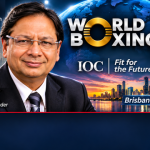
The rejection of a prominent Indian boxing leader raises questions about electoral fairness, governance and the international federation’s capacity to meet the IOC’s evolving expectations for Brisbane 2032.
World Boxing was established with the promise of a new era in international boxing governance, built on transparency, credibility and institutional renewal. Having secured provisional recognition from the International Olympic Committee and assumed responsibility for Olympic boxing following the IOC’s withdrawal of recognition from the International Boxing Association (IBA), it now faces a dual challenge: demonstrating that it can develop and promote the sport internationally while proving that the principles of good governance it advocates are applied consistently, without exceptions or selective interpretation.
The decision to declare Ajay Singh, president of the Boxing Federation of India (BFI) and chairman and managing director of SpiceJet, ineligible to contest a position on World Boxing’s Executive Board brings these questions into sharp focus. Singh is not an ordinary candidate. He is an established businessman with extensive corporate leadership experience and a longstanding role in the administration of boxing in a country with enormous sporting potential and growing international influence.
His exclusion from the November 20 elections in Panama warrants particular scrutiny because the publicly reported grounds concern disclosure obligations, legal proceedings and integrity assessments rather than any established violation of boxing’s competition rules.
What exactly led to his exclusion?
According to reporting on the findings of World Boxing’s three-member Vetting Panel, Singh was declared ineligible following an assessment of information disclosed during the nomination process. A panel report dated September 18 reportedly identified two related but distinct concerns: whether Singh had adequately disclosed material information concerning investigations and legal proceedings, and whether he satisfied the applicable standards of integrity and good standing.
Singh was given an opportunity to respond to the panel’s questions, but his explanations did not satisfy the reviewers. The determination reportedly relied on World Boxing’s statutes and Article 1 of its Ethics and Judicial Procedure Rules. BFI executive director Colonel Arun Malik subsequently characterized the rejection as arising from technical grounds unrelated to boxing.
The distinctions are important. An ongoing investigation, a commercial dispute, insufficient disclosure and a proven ethical violation are not interchangeable concepts. World Boxing has both the right and the responsibility to scrutinize candidates seeking positions of authority. But it also has a responsibility to explain precisely which circumstances were considered, which rules were applied and why exclusion was deemed necessary.
The information currently available in the public domain does not permit a complete independent assessment of the decision. That does not establish that the panel acted improperly or that political considerations determined the outcome. It does, however, raise legitimate questions about transparency, proportionality and consistent application of the rules.
A candidate with significant international weight
Ajay Singh combines business experience, institutional relationships and sports leadership — qualities that can be particularly valuable to an international federation seeking to strengthen its financial foundations and global influence. His involvement in the development and restructuring of SpiceJet, which previously became India’s second-largest airline, reflects experience operating in a highly competitive commercial environment.
His business career has not been without financial challenges or legal disputes. Nevertheless, such circumstances should not automatically be equated with established personal misconduct. Business success does not place anyone above ethical scrutiny, just as unresolved commercial or legal matters do not, by themselves, establish a lack of integrity.
Within boxing, Singh has led the Indian federation through significant periods of institutional change and Olympic preparation. India represents one of the sport’s largest potential growth markets, with opportunities to attract investment, sponsorship, broadcasting interest and new generations of athletes. The participation of individuals with international business experience and access to major markets could contribute to the sport’s development, provided that all applicable eligibility requirements are satisfied.
Precisely for that reason, an exclusion carrying such significant consequences must be supported by clear, sufficiently reasoned and consistently applied standards.
Independence must be demonstrated, not merely declared
World Boxing emphasizes the independence of its candidate-vetting procedures, which include an external panel responsible for reviewing nominations. Such arrangements can provide important safeguards, but their existence alone does not establish that every resulting decision is objective or proportionate.
Genuine independence requires clear rules, reasoned decisions, safeguards against conflicts of interest, equal treatment of candidates and effective review procedures. In Singh’s case, several questions remain unanswered. Which specific investigations or legal proceedings were considered material? Did the panel identify insufficient disclosure alone, or did it reach a substantive conclusion about his suitability? How were the integrity requirements interpreted? Were identical disclosure standards applied to every candidate, and what effective opportunity existed to challenge the determination?
The release of appropriate information, subject to legitimate confidentiality and data-protection requirements, could resolve these uncertainties. Without sufficient explanation, questions about electoral interests and institutional relationships are likely to persist, regardless of whether they have any factual foundation.
The political context cannot be ignored
The decision comes amid an intense internal dispute within the Boxing Federation of India. Singh faces opposition from a faction led by secretary general Pramod Kumar, with the rival sides contesting the legitimacy of administrative actions and claims of support among state associations. The Punjab and Haryana High Court intervened to place a proposed special general meeting concerning a no-confidence motion on hold, with further proceedings scheduled for November 13.
The dispute has also acquired an international dimension. Former World Boxing president Boris van der Vorst visited India and publicly supported stability and continuity within Indian boxing, acknowledging the work of Singh and his administration in developing the country’s athletes and high-performance structures. World Boxing subsequently clarified that van der Vorst was not authorized to represent the organization or communicate official positions on its behalf.
That clarification may reflect a legitimate need to distinguish personal opinions from institutional positions. Nevertheless, the sequence illustrates the sensitivity surrounding the Indian federation as World Boxing prepares for its own elections.
There is insufficient evidence to conclude that Singh’s exclusion was politically motivated. But the timing and intensity of the competing interests make transparency even more essential. An international federation must not only remain independent of domestic political disputes; it must also be able to demonstrate that independence.
The right to vote, but not the right to stand
Another important distinction concerns India’s representation at the World Boxing Congress. According to the BFI, India retains its full membership and voting rights, and Singh is expected to attend the Panama Congress as a voting representative. His exclusion therefore concerns his personal eligibility to seek election to the Executive Board, not India’s membership or voting status.
This raises a legitimate governance question: how can an individual remain entitled to represent a national federation in the organization’s highest decision-making assembly while being considered ineligible to seek an executive position within the same institution?
The two roles may be subject to different constitutional requirements, and that distinction may have a sound legal basis. If so, World Boxing should explain it clearly rather than allow uncertainty to undermine confidence in its procedures.
World Boxing: Institutional recognition is not a development strategy
Singh’s case also highlights a broader challenge that World Boxing cannot afford to overlook. Following the IOC’s withdrawal of recognition from the IBA, World Boxing assumed the role of the IOC-recognized international federation for Olympic boxing. This responsibility extends beyond maintaining an administrative structure or organizing competitions. It requires the federation to demonstrate that it can develop the sport, strengthen its international visibility and establish the foundations for long-term financial and institutional sustainability.
World Boxing has established a competition calendar, organized international events and undertaken responsibilities associated with the Olympic pathway toward Los Angeles 2028. These are identifiable activities, but they do not automatically demonstrate that boxing has achieved the global visibility, commercial reach or institutional momentum it needs.
International Olympic-style boxing continues to face a serious visibility challenge. Beyond major Olympic competitions and isolated news stories, sustained coverage of international tournaments in leading sports media, greater recognition of elite athletes and the creation of a compelling global competition product remain essential objectives.
Publishing announcements and results on an official website is not the same as delivering an effective international communications strategy. Nor does IOC recognition, by itself, demonstrate successful development. World Boxing should be prepared to present measurable results concerning broadcasting reach, global audiences, commercial partnerships, revenue, athlete visibility and the sport’s presence across international media.
Boxing possesses extraordinary history, powerful national traditions, recognizable athletes and immense global potential. The question is not simply whether World Boxing can organize tournaments, but whether it can transform those assets into a strong, modern and internationally visible sporting enterprise.
In that environment, the ability to attract individuals with business experience, international connections and access to major markets becomes particularly important. Such individuals must meet the same ethical standards as everyone else. But their evaluation must be demonstrably objective and free from avoidable doubts about fairness.
An international federation entrusted with Olympic boxing cannot limit its ambitions to maintaining the institutional recognition it has obtained. It must demonstrate that it can offer the sport a stronger future.
Fit for the Future: Can World Boxing meet the IOC’s new expectations?
The IOC’s evolving strategic direction under President Kirsty Coventry, including the Fit for the Future initiative and the new approach to evaluating the Olympic program ahead of Brisbane 2032, creates a more demanding environment for international federations. A sport’s place on the Olympic program can no longer be assumed solely because of its history, traditions or institutional recognition. International relevance, development, effective governance, financial sustainability and the capacity to adapt to changing expectations are increasingly important considerations.
Against this background, World Boxing must ask whether its current model of leadership, international representation and promotion can genuinely respond to the challenges ahead. The technocratic administration of a competition calendar, the organization of championships and the publication of administrative announcements do not, by themselves, constitute a comprehensive development strategy for a global Olympic sport. A limited international presence, without measurable progress in audience engagement, media exposure and commercial development, would be an inadequate response to the challenges of the next decade.
Boxing is not a marginal sport still searching for its identity. It is one of humanity’s oldest sporting disciplines, included in the ancient Olympic Games as early as 688 BC, with deeply rooted traditions across continents and a distinctive place in the global culture of combat sports. Few sports can claim a comparable historical and social legacy.
A sport of this magnitude cannot settle for an administration that merely keeps the machinery running. It requires leadership with vision, international influence, commercial ambition and the ability to restore boxing to the center of global sporting attention.
World Boxing should not confuse IOC recognition with a permanent guarantee of boxing’s Olympic future. Recognition provided an institutional opportunity, not a certificate of achievement. If the federation confines itself to administrative management without a compelling international presence and demonstrable development, it may face difficult questions as the sport is assessed in the context of Brisbane 2032.
Boxing’s extraordinary historical significance does not relieve its present leadership of the responsibility to demonstrate that it can build upon that heritage.
THE IN will undertake a systematic, independent assessment of international federations, sports and disciplines ahead of Brisbane 2032, examining available evidence against the IOC’s new methodology and strategic direction. Boxing will be included in this examination alongside other Olympic sports, without predetermined conclusions or preferential treatment.
The question facing World Boxing is straightforward but demanding: can its leadership demonstrate that its performance matches the scale, history and potential of the sport it governs, or is it content merely to administer the institutional position it has acquired?
Boxing does not simply need an organization capable of managing its Olympic participation. It needs international leadership capable of demonstrating why this historic sport deserves to remain strong, relevant and indispensable to the future of the Olympic Movement.
The real test of credibility
The credibility of an international federation is measured not only by the rules it adopts, but by how those rules are applied when influential personalities, competing interests and contested elections are involved.
Ajay Singh’s exclusion should not become an exercise in public condemnation based on incomplete information. Nor should the business standing or institutional influence of any candidate place that individual above legitimate ethical requirements. What matters is fair, proportionate and fully reasoned application of the rules.
World Boxing must demonstrate not only that it can administer Olympic boxing, but that it can strengthen its development, improve its global visibility and inspire confidence among national federations and athletes. The Singh case is an important test of that credibility.
THE IN calls on World Boxing to disclose the precise grounds for Singh’s exclusion
Given the seriousness of the matter and its implications for international boxing governance, THE IN publicly calls on World Boxing to disclose clearly and precisely the specific grounds on which Ajay Singh’s candidacy was declared ineligible.
We request clarification of the exact statutory and regulatory provisions applied, the material facts underlying the determination and whether the exclusion resulted solely from disclosure-related issues or also from a substantive assessment of the candidate’s suitability. World Boxing should also clarify the available review or appeal procedures and the safeguards ensuring that identical standards are applied fairly to all candidates.
The release of relevant information, within appropriate confidentiality and data-protection limits, would strengthen both the independent assessment of this decision and the credibility of World Boxing itself.
Transparency cannot be a selective obligation. It must apply equally to everyone — both those seeking to govern sport and those deciding who is entitled to do so.
 Last related articles