THE IN is launching its Olympic Discipline Evaluation Framework, an independent research initiative examining the evidence that may shape the programme for Brisbane 2032. The project will assess global appeal, delivery requirements, international participation and historical and educational contribution, publishing its methods before the first sports discipline is evaluated.
The initiative follows the publication of the IOC programme policy, approved by the Executive Board on October 30, 2026. The IOC has announced intended intermediate decisions in December 2026, including recommendations for inclusion and progression to further comparison, with the final programme decision scheduled for the IOC Session in April 2027. Progression through that process and final inclusion are different outcomes, and THE IN will examine them separately.
The research distinguishes sports, sports disciplines and events, with athlete quotas treated separately. Its principal unit of analysis is the sports discipline. A shared federation does not establish that every discipline has the same position, while changes to events or quotas can have substantial consequences even when a discipline remains included. The applicable IOC classification will be documented before each assessment.
The proposed model contains eleven indicators across four domains: Global Appeal and Relevance, Cost, Capacity and Operational Complexity, and Universality and Athlete Participation each carry 30 percent; Olympic Heritage and Educational Value carries 10 percent. These weights are independently proposed by THE IN. The additional heritage domain is independently defined within this research; the model does not reproduce an official IOC scoring system.
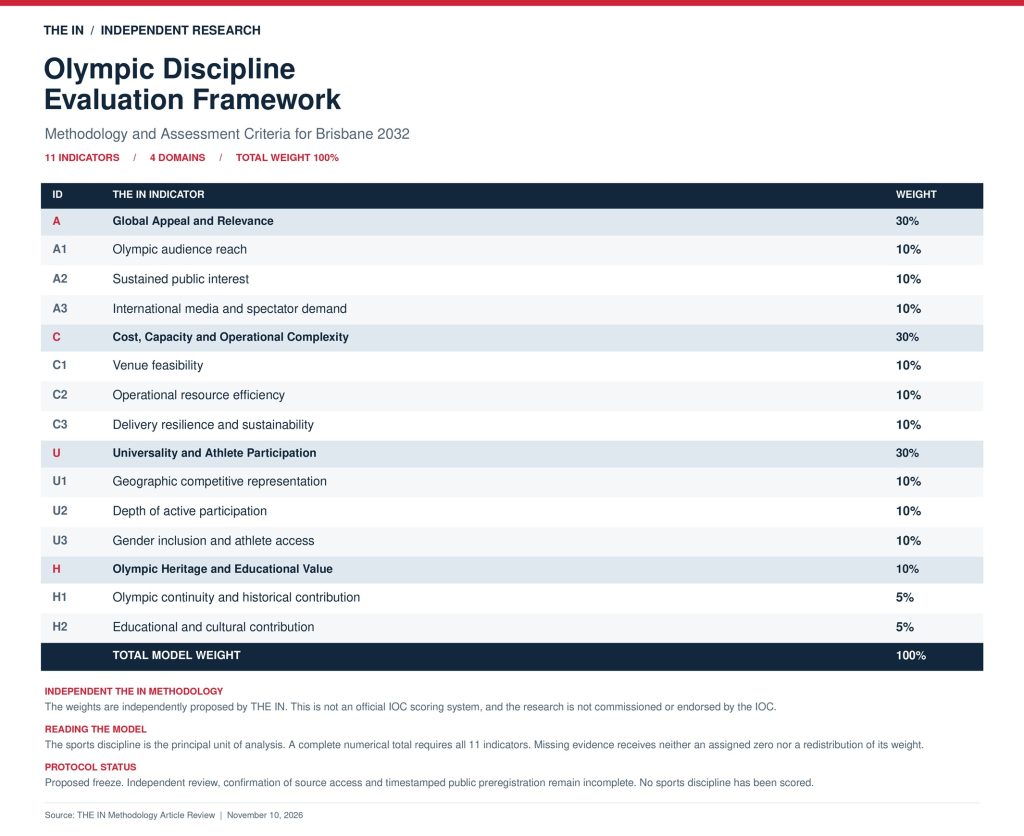
THE IN methodology table with eleven indicators across four domains and independently proposed weights totaling 100 percent.
Each indicator is supported by a technical specification defining its components, denominators, observation periods, numerical boundaries and evidence requirements. Quantitative values will be converted to a 0–100 scale before aggregation; higher scores will represent stronger performance under the stated definition. Operational and educational judgments will use observable conditions and fixed combination rules. The nine indicators in the first three domains each carry 10 percent of the total, and the two heritage indicators each carry 5 percent.
The resulting score will describe performance under the published model. It will not represent a probability of retention or exclusion. Governance, competition integrity, anti-doping, athlete health and safeguarding will be examined separately, with allegations, pending proceedings, final findings, appeals and remedial action distinguished by their actual status. Popularity or low delivery costs cannot resolve an institutional concern.
Missing evidence will remain visible. A complete numerical total will require all eleven indicators. Where verified coverage reaches at least 70 percent of the principal model weight, including a complete indicator in every domain, THE IN may publish a partial assessment with its unrescaled contribution subtotal and explicit bounds. Missing values will receive neither an assigned zero nor a redistribution of their weight. Evidence quality will be reported separately from performance.
Comparisons with candidate disciplines will respect differences in the available evidence. A candidate without Olympic exposure cannot supply an Olympic audience measurement, and historical continuity inherently favors established disciplines. Common comparisons will therefore use nine separately reported indicator profiles, with Olympic audience and history identified as distinct context. No substitute audience series or reweighted total will be presented as an equivalent comparison.
The research will test its conclusions under the principal 30/30/30/10 weighting and three alternatives emphasizing appeal, delivery or participation. Predetermined checks will also examine numerical boundaries and component assumptions. These choices will be fixed before assessment; they will not be adjusted to produce a preferred result for the first discipline. Any institutional forecast will be published as a separate, reasoned judgment with its evidence, limitations and confidence explained.
The technical protocol is currently a proposed freeze. Independent review, confirmation of source access and timestamped public preregistration have not yet been completed. No sports discipline has been scored in developing this protocol. Assessments will begin only after the complete specification, source rules and calculation software have been finalized, reviewed and registered. Synthetic arithmetic checks support reproducibility; they do not establish scientific validity.
The first phase will focus on a selected group of incumbent disciplines, followed by candidate analysis where comparable evidence permits. Greco-Roman Wrestling is the planned opening study, subject to confirmation of the evaluation unit and completion of the preregistration gate. The wider research shortlist will not be announced in advance. When IOC outcomes become available, THE IN will compare them with its previously published assessments and explain material differences.
The research is not commissioned or endorsed by the IOC. Its contribution will be an assessment whose evidence and assumptions readers can inspect, and whose conclusions can subsequently be checked against the decisions that shape the Games.
 Last related articles