Mauricio Pochettino will be the next manager tasked with restoring Manchester United to a position the club have spent years trying to reclaim. Michael Carrick’s dismissal, announced on 12 November, comes just months after his team won twelve of their final seventeen Premier League matches and finished third. That recovery earned him the permanent job; eight points from this season’s opening ten matches have cost him it. The Argentine will take over on 18 November and face Liverpool four days later. He inherits a team in eighteenth place and a responsibility familiar to his predecessors: solving problems from the dugout that also depend on those who lead, plan and make decisions above the manager.
To understand the scale of that decline, it is worth remembering where United stood as European football accelerated its commercial expansion. They topped the first eight editions of Deloitte’s revenue rankings before Real Madrid took the lead with their earnings for the 2004/05 season. The international appeal of players such as David Beckham accompanied the transformation of leading clubs into global brands. In Manchester, that business grew alongside a winning football operation: the 1999 treble, the 2008 Champions League and Alex Ferguson’s final league title in 2013 all belonged to that era. The club were selling an identity that the team continued to uphold on the pitch.
The transition in the boardroom
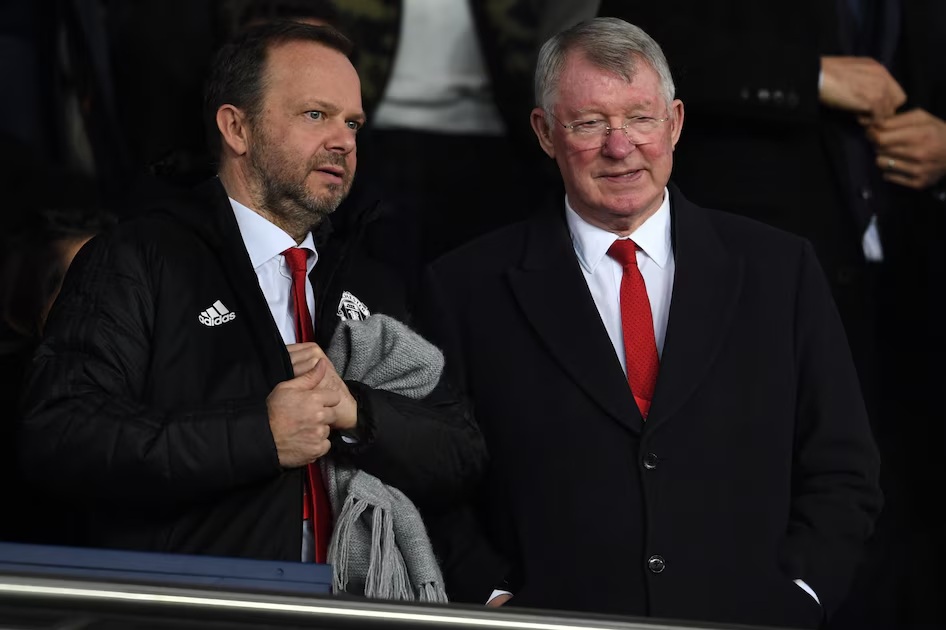
Ferguson’s retirement coincided with the departure of David Gill, the club’s chief executive. United simultaneously lost the manager who had built their dominance and an executive who understood how that organisation worked. Ed Woodward, whose background was in finance and commercial operations, became executive vice-chairman and took on a decisive role in the next chapter. Under his leadership, the club retained an enormous ability to attract sponsors and secure international partnerships while cycling through managers and squads assembled for different approaches. Speaking to investors in 2018, Woodward said that playing performance did not significantly affect the club’s commercial opportunities. The team had just finished second, but the remark illustrated how resilient the brand could remain without recovering its former dominance.
José Mourinho, the manager responsible for that second-place finish, later explained the difficulties he had encountered within the organisation. In a 2024 interview with ‘Rio Ferdinand Presents FIVE’, he described Woodward as intelligent and decent, although “probably not prepared for the sports side”. He also criticised the absence of “a structure that shares the same principles and the same ideas” and the difficulties of communicating directly with the ownership. The Portuguese manager had won the Europa League and League Cup in 2017, but his tenure ended with another dismissal in December 2018. His assessment placed part of the problem in the relationship between those choosing the manager and those responsible for giving him the means to work.
Trophies without sustained success
Since Ferguson’s retirement, Manchester United have won two FA Cups, two League Cups and a Europa League, alongside two Community Shields. Those achievements mean the period cannot be dismissed as entirely unsuccessful, but none has led to another Premier League or Champions League title. Before Pochettino, David Moyes, Louis van Gaal, Mourinho, Ole Gunnar Solskjær, Erik ten Hag, Ruben Amorim and Carrick all held the job permanently, with several interim appointments between them. Their methods, experience and footballing preferences differed. What they shared was the difficulty of establishing a team capable of regularly challenging for the biggest honours.
Meanwhile, Manchester City and Liverpool occupied much of the space United had vacated, and Arsenal completed their rebuilding process with last season’s title, their first in twenty-two years. Chelsea, despite their own instability, also won the Champions League again in 2021. The comparison is particularly uncomfortable because United’s internal problems were identified some time ago. In April 2022, Ralf Rangnick spoke of the need for “open-heart surgery”. He was calling for fundamental intervention while the club were still searching for the manager to lead their next phase. Four years later, Pochettino will be the fourth permanent appointment since that warning.
A different structure, with results still to come
The arrival of INEOS, with Jim Ratcliffe overseeing football operations and the Glazers remaining majority shareholders, brought organisational changes. Omar Berrada joined as chief executive, while Jason Wilcox, a former player with experience in football development and management at Manchester City and Southampton, eventually became director of football. His background differs from Woodward’s. Yet the restructuring has also involved abrupt changes: Dan Ashworth left his sporting director role after barely five months, and the appointment of Amorim gave way to Carrick. The same leadership team that backed Carrick after his spring recovery has now chosen Pochettino to address the subsequent downturn.
Financially, the decline is less straightforward than the league table might suggest. United generated record revenue of £677.6 million in the year ending June 2026, although they recorded a net loss of £43 million. Their earning power remains extraordinary; their position relative to competitors has deteriorated. In the 2026 edition of Deloitte’s revenue rankings, based on the 2024/25 season, they finished eighth, their lowest position in the report, behind Liverpool, City and Arsenal. Commercial strength has sustained spending through years of inconsistent results. Missing the Champions League, however, reduces income that other rivals receive regularly, while each rebuild requires players and contracts to be adapted to a new direction.
The project Pochettino inherits
Pochettino is leaving a United States team with whom he had extended his contract until 2030 after reaching the last sixteen of their home World Cup. In his farewell statement, he highlighted the “tremendous talent” available from the youth teams through to the senior side. Returning to club football therefore means leaving a project that still had years to run. United also explored Unai Emery’s situation, although, according to ‘Sky Sports’, his Aston Villa contract, which had no release clause, complicated any move, and no direct negotiations took place. Their eventual choice brings back a manager they had considered before, with knowledge of English football from spells at Southampton, Tottenham and Chelsea, as well as experience at Paris Saint-Germain and Espanyol.
The Argentine’s first responsibility will be to improve the squad’s performances; that of Berrada, Wilcox and the ownership will be to establish a plan that survives changes in results. Recruitment, contract renewals, the relationship with the academy and the distribution of authority in the transfer market will shape his prospects as much as his tactical system. United have repeatedly demonstrated that they can hire established managers and pay for leading players. They are now changing coach again without those responsible for recent decisions having publicly explained what went wrong with the previous appointment. The Manchester United Supporters’ Trust demanded precisely that after Carrick’s departure: “It is time for the owners to explain themselves and show some accountability.”
 Last related articles