Modern Pentathlon was conceived for a different world. Introduced at Stockholm 1912 under Pierre de Coubertin, it brought together skills associated with the military officer and the ideal of the complete athlete. That inheritance explains its place in Olympic history. It does not, in our judgment, provide a sufficient argument for its future. Under the IOC’s discipline-focused review for Brisbane 2032, pentathlon must establish why this particular combination of sporting skills deserves its share of a finite program.
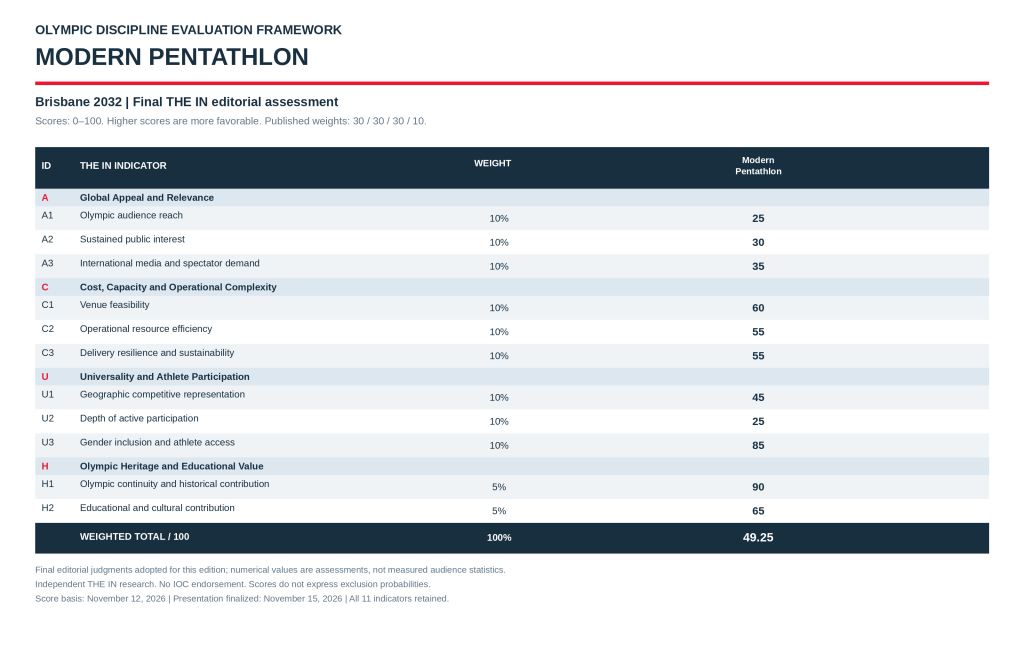
THE IN begins its series with sports and disciplines that, in our assessment, warrant closer scrutiny for possible reductions. Modern pentathlon receives 49.25 out of 100 under our eleven published indicators. Global appeal, delivery requirements and athlete participation each carry 30 percent, with heritage and educational contribution accounting for 10 percent. Our audience and interest judgments are low, as is our assessment of active competitive depth. Historical contribution and opportunities for both men and women receive substantially stronger credit. These are independent SportsIn editorial ratings, not IOC scores or probabilities of exclusion.
The participation argument must concern athletes competing in the complete sport. UIPM reported more than 170 athletes at its 2025 senior World Championships, the first to include obstacles. Its larger promotional figure of an expected 2,000 participants across the 2026 Pentathlon and Obstacle World Championships covers two competitions, not 2,000 full pentathletes. Neither figure is a worldwide census. Our concern is the depth and reach of the complete competitive pathway; the growth of obstacle racing alone cannot establish that depth for modern pentathlon.
Replacing riding with obstacles is nevertheless a substantive reform, and a fair assessment must recognize what it changes. It removes the need to supply and manage horses within pentathlon and creates a more adaptable competition format. LA28 lists fencing, obstacles, swimming and the combined running-and-laser-shooting finale in one venue. That can reduce the delivery burden, but organizers still have to integrate different technical areas, equipment and schedules. We assess the current format, rather than carrying the former equestrian requirements into its cost profile.
Brisbane also has an existing venue reference. Ipswich City Council identifies Brighton Homes Arena, the home of the Brisbane Lions’ AFLW team, in the Games masterplan and records its earlier designation for modern pentathlon. The March 2025 infrastructure review found that a proposed second field was not required for Games competition. This materially weakens an argument that pentathlon necessarily demands a new permanent stadium. The remaining question concerns the complete competition overlay and operating plan, including swimming, fencing and obstacles, rather than the existence of a stadium alone. The sport allocation remains subject to the finalized program.
Australian research also provides a counterargument to an unqualified claim that the reform has created no momentum. In June 2026, UIPM published findings from a commissioned YouGov survey of 1,500 Australians: 35 percent of Generation Z respondents and 34 percent of Millennials said a Ninja-style obstacle race would make them more likely to watch the Olympics on television or livestream. Those are generational intentions about the Games, not observed audiences for the full pentathlon competition. Even so, they give the federation a credible opportunity to convert curiosity about obstacles into sustained interest in its complete sport.
Our conclusion remains demanding. In THE IN’s judgment, the revised presentation has not yet made a sufficiently persuasive case for broad, sustained relevance and a deep full-sport participation base to offset the coordination demands of the combined contest. The reform and the existing Ipswich venue deserve credit; neither ends the examination. The IOC’s published timetable places the programme decision at its April 2027 Session. Modern pentathlon needs to demonstrate that its transformation has changed more than the competition apparatus. Coubertin secured its historical identity. Its contemporary Olympic value must now stand on its own.
THE IN’s next evaluation will be this Thursday for Equestrian.
 Last related articles