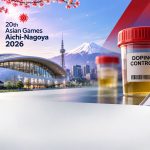
Nearly two months after the conclusion of the Asian Games in Japan, the Olympic Council of Asia (OCA) has confirmed three anti-doping rule violations involving athletes from Uzbekistan and Turkmenistan. The cases concern mixed martial arts, karate and rugby sevens, with consequences ranging from individual disqualification to the forfeiture of a bronze medal.
The findings resulted from samples collected by the International Testing Agency (ITA), which was entrusted by the OCA with the independent implementation of the Games’ anti-doping program.
Meldonium costs Uzbekistan a bronze medal
Uzbekistan’s Nodirbek Shavkatov, who secured bronze in the men’s modern mixed martial arts 71kg category on September 21, must surrender his medal following the detection of meldonium. The analysis of his B-sample by the Tokyo laboratory confirmed the original analytical finding, establishing the basis for the announced medal forfeiture.
Meldonium, a pharmaceutical substance originally developed for the treatment of cardiovascular conditions, has been prohibited by the World Anti-Doping Agency (WADA) since January 2016. Classified as a metabolic modulator, it is banned both in and out of competition because of its potential to influence endurance, energy metabolism and recovery.
The substance attracted international attention in 2016 following a series of positive tests involving prominent athletes. A decade later, its continued detection in international competition remains a concern for anti-doping authorities.
The second case concerns Turkmenistan’s Dayanch Keletliyev, who competed in the men’s karate kumite 67kg category. An earlier ITA announcement identified meldonium as the prohibited substance detected in his sample. Initially placed under provisional suspension, Keletliyev has now been disqualified from the Asian Games competition. As he did not finish in a medal-winning position, the decision does not affect the distribution of medals.
An anabolic steroid
A different substance was identified in the case of Uzbekistan rugby sevens player Azizkhon Nurillaev. His sample, collected on September 30, revealed the presence of drostanolone and its metabolite, an anabolic androgenic steroid prohibited at all times under the WADA Prohibited List. The substance has potential effects on muscular strength and body composition.
Despite the individual violation, Uzbekistan’s rugby sevens team retains its 12th-place finish. The OCA confirmed that the team would not be disqualified, illustrating the distinction between individual anti-doping responsibility and the regulatory consequences applicable to team competitions.
The responsibility of international federations
The published findings establish the presence of prohibited substances but do not disclose the circumstances in which they entered the athletes’ bodies or establish whether their use was intentional. Those questions may become relevant during subsequent disciplinary proceedings.
The three cases also underline an important feature of anti-doping governance at major multisport events. While the OCA has jurisdiction over results and sanctions related to the Asian Games, responsibility for determining further periods of ineligibility rests with the relevant international federations. The loss of a medal or disqualification from the Games is therefore not necessarily the end of the disciplinary process.
A setback for mixed martial arts on its Asian Games debut
For mixed martial arts, the timing is particularly unfortunate. The sport made its Asian Games debut in Aichi-Nagoya as part of a broader effort to strengthen its institutional standing within the Olympic Movement. The forfeiture of a medal on anti-doping grounds during its inaugural appearance serves as a reminder that sporting popularity alone is not sufficient to establish institutional credibility.
The cases should not be interpreted as evidence of widespread doping within any of the three sports or the countries concerned. They do, however, demonstrate why independent testing, effective athlete education and consistent disciplinary enforcement must remain central to the organization of major international sporting events.
 Last related articles