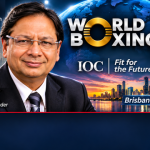
The IOC secured boxing’s Olympic future by replacing the IBA. But with the old federation still active, controversial eligibility decisions and questions over the new body’s capacity, has the sport been reformed or simply divided?
World Boxing’s Congress in Panama marked another stage in the federation’s rapid expansion, with 47 new national members bringing its total to 170, alongside statutory reforms, regulatory changes and new Executive Board elections. The organization also reported improved governance assessment results, presenting these developments as further evidence of its readiness to lead Olympic boxing toward Los Angeles 2028.
There is progress here, and it should be acknowledged. But three years after the IOC withdrew recognition from the International Boxing Association (IBA), a much more important question remains unanswered: what has fundamentally changed in the governance of international boxing?
The IOC’s intervention was intended to address serious concerns over governance, integrity and financial transparency. World Boxing emerged as the alternative, eventually securing provisional Olympic recognition. Yet many of the national federations operating under the new organization are the same institutions that previously belonged to the IBA. Their participation is neither surprising nor objectionable. They are the foundations of the sport. But changing the international organization above them does not automatically change the governance culture beneath it.
The recent exclusion of India’s Ajay Singh from World Boxing’s Executive Board elections illustrates why these questions matter. An independent Vetting Panel ruled him ineligible, citing insufficient disclosure of material information concerning investigations and legal proceedings. Importantly, the panel acknowledged the limits of its mandate, which did not extend to fully investigating whether the underlying conduct had occurred.
The distinction matters. Eligibility screening is legitimate and necessary, but so are transparency, proportionality and consistency. If a national federation’s representative is considered unsuitable to hold office while remaining eligible to participate in the organization’s electoral processes, the federation must be able to explain clearly the different standards being applied. Otherwise, governance risks appearing selective rather than principled.
The broader challenge is equally serious. World Boxing now represents 170 national federations, yet the adequacy of its professional structure, international communications and administrative capacity remains open to question. Governance cannot be measured solely through statutes, committees and assessment scores. It must be demonstrated through daily operations, accessible information, institutional independence and the consistent application of rules.
Meanwhile, the IBA has not disappeared. It remains operational and is preparing its own elective Congress in Istanbul on December 5, with Russian President Umar Kremlev standing as the sole presidential candidate. It continues to organize competitions, maintain relationships with national federations and present itself as an international authority in boxing.
The result is a sport operating around two competing international centers of power, one recognized by the IOC and the other continuing independently. The division cannot be reduced neatly to East versus West, but its political and institutional implications are unmistakable.
This raises an uncomfortable question about the legacy of former IOC President Thomas Bach’s approach to boxing.
The IOC had legitimate reasons to demand reform from the IBA. Its concerns were serious, and preserving boxing’s Olympic future was essential. But the ultimate objective should have been a stronger, more transparent and more unified sport, not simply the establishment of a different governing authority acceptable to the Olympic Movement.
Could the IOC have imposed more demanding structural conditions, independent oversight and professional standards? Could it have pursued a solution capable of reforming the existing international boxing community without leaving two competing organizations? These questions deserve examination, particularly now that the immediate crisis over LA28 participation has been resolved.
The IOC achieved an important short-term objective: boxing remains on the Olympic programme. What it has not yet demonstrated is that its intervention produced a sustainable institutional solution for the sport as a whole.
World Boxing must now prove that it offers more than a different name, different leadership and new constitutional documents. It must establish a professional organization capable of serving its members, enforcing its rules consistently and earning confidence through transparency rather than recognition alone.
And the IOC must confront a broader question about its own responsibility. When it intervenes so decisively in the governance of an international sport, should success be measured only by whether that sport remains in the Olympic Games, or also by whether the intervention leaves the sport institutionally stronger?
The IOC saved Olympic boxing. But it has left international boxing divided. Replacing the IBA was a decision. Reforming the sport was supposed to be the achievement.
 Last related articles