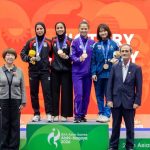
Muaythai has produced two significant national championships this week in Algeria and Australia, both marked by high participation numbers, a qualification role for the upcoming world championships of the International Federation of Muaythai Associations –IFMA–, and a presentation that extended the focus beyond competition itself. In Blida Province, the Algerian championship brought together more than 600 athletes over four days, while in Melbourne the Australian national finals gathered close to 400 competitors after a preliminary qualification process held across the country’s six states.
The two events also shared another important feature within the recent muaythai calendar: both helped shape the teams that will compete at the upcoming IFMA World Championships and, in the Australian case, also at the youth world championship. From there, each event carried a different emphasis. Algeria placed the weight on territorial reach, national symbolism and a cultural connection with muaythai. Australia staged a championship with strong competitive depth, the inclusion of special and para athletes, the presence of cultural disciplines, and a broad response both in attendance and in digital engagement.
Algeria and a distinctive cultural presentation
The Algerian Muaythai Federation concluded its national championship in Blida after four days of competition involving male and female athletes from every region of the country. The federation itself presented the event as the official qualification tournament for Algeria’s senior and youth national teams ahead of the upcoming IFMA World Championships, and underlined that the finals offered an image of competitive depth and nationwide representation. The event placed Algeria among the African nations with the strongest current development in muaythai.
The Wai Kru ceremonies were combined with elements of Algerian heritage in an approach designed to connect national identity with the traditional codes of the sport. The federation explicitly presented that fusion as a way of foregrounding shared values such as respect, honour and unity. Alongside that, the championship included a cultural seminar aimed at broadening understanding of muaythai traditions and their international significance.
The event also included anti-doping education aligned with WADA. That element sat alongside institutional recognition from the National Olympic Committee and the Ministry of Sports, two forms of support that the federation highlighted as part of the growth of muaythai in the country. Federation president Abbas El-Sayed thanked athletes, coaches, referees, officials and organisers at the close of the event, and linked the progress of Algerian muaythai to internal unity, institutional backing and alignment with IFMA while preserving national identity.

Australia, a broad and inclusive championship
The Australian national championship was held in Melbourne as the conclusion of a preliminary qualification system staged across the country’s six states. That pathway produced close to 400 athletes for the national finals, where nearly 300 bouts were contested. It was also recalled that Muaythai Australia, founded in 1995, is the only national federation recognised under IFMA and aligned with the Olympic movement.
The organisation welcomed special and para athletes and also incorporated the cultural disciplines of Wai Kru and Mae Muay, a combination that reinforced the idea of muaythai both as a competitive sport and as cultural heritage. In its own official communication, the federation stressed that this structure helped project a view of muaythai based not only on performance, but also on tradition, inclusion and unity within a single national organisation.
Beyond the field of play, the federation reported more than 900,000 social media views in one week and more than 1,200 spectators across the event. Alongside that, Muaythai Australia president Nick Atkins thanked Muaythai Victoria, as well as coaches, clubs, gyms, referees, officials, medical teams, volunteers and fans. The statement added that the newly crowned champions will represent Australia at the upcoming IFMA World Championships and IFMA Youth World Championships.
Play True Day, a global message of clean sport
That context of national-level activity coincided with Play True Day, the initiative led by the World Anti-Doping Agency -WADA-, held on 17 April and built in 2026 around the theme “Play True: It Starts with You.” When presenting this year’s edition, the agency stressed that athlete health, fair competition and integrity are at the heart of clean sport, and that responsibility does not rest with one institution alone, but with the entire sporting community.
In parallel, IFMA activated its own celebration through a Kick Challenge involving athletes from every continent alongside the Athletes’ Commission chaired by Lennert Swart. The action included clean sport questions, prizes and recognition for participants, as well as the involvement of Mongkon Academy and former world champion and United Through Sports president Stephan Fox. IFMA sport director, clean sport education ambassador for the International Testing Agency -ITA- and former world champion Janice Lyn summarised that message by saying: “Clean sport is not just a rule, it is a responsibility we all share.”
 Last related articles