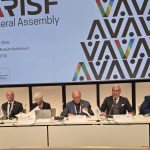
The election of Johanna Talihärm as the new Chair of the Athletes’ Commission of the European Olympic Committees (COE) marks a significant moment for athlete representation across the continent. In a context where the voice of athletes is gaining increasing importance, her appointment — made during the second day of the 8th European Athletes’ Forum and Assembly in London — reinforces the COE’s commitment to strengthening the role of those who experience sport from within. Talihärm, a renowned Estonian biathlete, steps into this role with a career marked by active advocacy for the rights and needs of athletes.
The new Chair assumes her role with responsibility and a clear vision: to convey to the COE Executive Committee — where she will serve with full voting rights — the concerns, challenges and aspirations of European athletes. Her mandate, which will run from 2025 to 2029, will be supported by a diverse team that combines experience, discipline and a deep connection with the continent’s sporting community.
Renewed leadership for stronger representation
The structure of the new Commission reflects a balance between different generations and sporting disciplines. Alongside Talihärm, German athlete Ronald Rauhe will serve as Vice Chair and Serbian athlete Zorana Arunovic as Secretary, forming a core leadership team that aims to provide continuity while bringing new energy to the Commission’s work. They are joined by members from different corners of Europe and a wide range of sports: from Slovakia’s Alexandra Longova and Sweden’s Michelle Coleman, to Portugal’s Emanuel Silva and Hungary’s Bendeguz Petervari-Molnar, as well as Dinos Jr. Lefkaritis, who will represent winter sports.
The diversity of this new composition allows for more inclusive representation that is sensitive to the realities athletes face in their different contexts. During the first meeting in London, Talihärm expressed her gratitude and the depth of the commitment she assumes: representing a collective voice that demands to be heard in every decision-making process. Her words reflected not only emotion, but also a strong belief that the COE must continue placing athletes at the center of its institutional work.
A Forum that sparked new discussions and priorities
The sessions held in London also provided a space for dialogue on key issues for the future of European sport. One of the most relevant points was the funding of Athletes’ Commissions, and the opportunities offered by Olympic Solidarity to strengthen their operations in each country. This discussion, which brought together athletes from different disciplines, highlighted the importance of having sustainable structures that allow athletes to focus both on their competitive development and on their participation in representative bodies.
COE President Spyros Capralos highlighted the value of the discussions held and the insights provided by the participants, noting that the ideas shared during the Forum point to an optimistic future for European sport. His remarks reinforced a message of unity and continuity: a call for all athletes — even those not elected — to remain involved in the processes shaping the Olympic Movement in Europe. With ANOC also celebrating the election of Talihärm and the new team, the 2025–2029 period opens as a phase of strengthening and collaborative work at both the continental and global levels.
 Last related articles