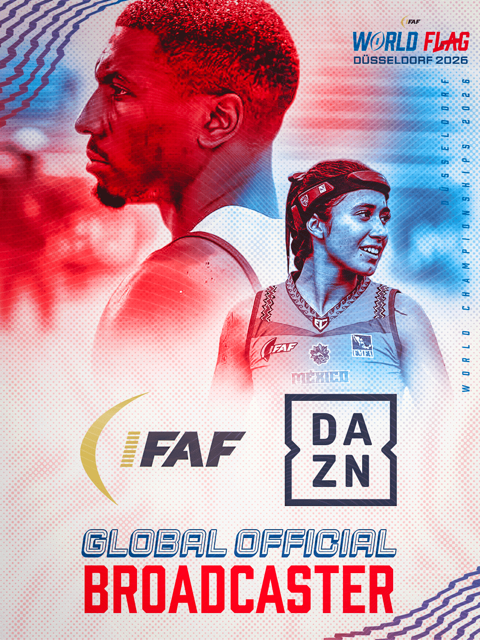
DAZN has acquired the global broadcast rights to the flag football competitions of the International Federation of American Football -IFAF- under a multi-year agreement that will allow a wide selection of events to be streamed free-to-view in more than 200 markets. The partnership comes at a key moment for the discipline, which will make its Olympic debut at Los Angeles 2028 and is seeking to expand its international visibility before entering the Games.
Coverage will begin with the men’s and women’s IFAF Flag Football World Championships, which will take place in Düsseldorf, Germany, from 13 to 16 August 2026. The tournament will also serve as a qualifying event for LA28, with two Olympic places available in each competition, and will be one of the first direct qualification events for the Games in any sport. DAZN will also broadcast the 2027 IFAF Continental Championships and the 2028 Flag Football World Championships.
A global platform for a growing sport
The agreement represents a distribution leap for IFAF, which will have a global partnership of this scale for its flag football competitions for the first time. Free-to-view coverage lowers the barrier of access for new audiences and is supported by a platform already linked internationally to American football through NFL Game Pass, available on DAZN outside the United States and China.
DAZN chief executive Shay Segev said the company’s technology, multi-platform distribution and cross-promotion capacity can accelerate flag football’s global reach. “By delivering IFAF events free-to-view on DAZN, we can introduce new audiences to an exciting sport at a pivotal moment in its global development,” he said. IFAF president Pierre Trochet described the agreement as “a landmark” for the federation as it enters a new stage of commercial maturity before the discipline’s Olympic debut.
The road to Los Angeles 2028
Flag football will arrive at Los Angeles 2028 as the non-contact format of American football, with a proposal based on speed, strategy, skill and accessibility. Its inclusion in the Olympic programme has accelerated interest from federations, leagues, brands and development structures, with a discipline that can broaden the practice of American football beyond the traditional contact model.
That momentum has also activated the National Football League -NFL-. In 2025, clubs approved the participation of league players at LA28, a decision that opened the door for professional stars to be part of the Olympic process with their national teams. The NFL and the NFL Players Association are working with LA28 and IFAF on areas such as injury protection, field standards and player scheduling.
 Growth already measured in national teams and audiences
The agreement comes with signs of sustained growth. IFAF says the number of national teams included in its world ranking system has increased by 48% over the past three years, while audience interest has also grown. At The World Games 2025 in China, flag football led every streaming category among the 60 sports on the programme, with 23% of total watch time across the event.
In the United States, the growth of the discipline is also supported by youth participation and women’s sport. The expansion of school, university and federation programmes has positioned flag football as a more accessible entry point into American football, while USA Football has strengthened its development structures for young players on the pathway towards national teams and international trials.
From emerging sport to international product
The partnership between DAZN and IFAF places that expansion in a new phase of visibility. The Düsseldorf 2026 World Championships will open the first direct route to LA28, the 2027 Continental Championships will extend the qualification process and the 2028 World Championships will arrive in the Olympic year, in a calendar that connects international competition, global distribution and promotion of the sport.
For a discipline that combines an accessible format, youth growth, women’s momentum and NFL support, free distribution in more than 200 markets appears as a central tool to turn pre-Los Angeles interest into a more stable international audience. Flag football therefore enters its Olympic cycle with a reinforced competition structure and a new global platform to reach audiences that are not yet part of the traditional American football ecosystem.
 Last related articles