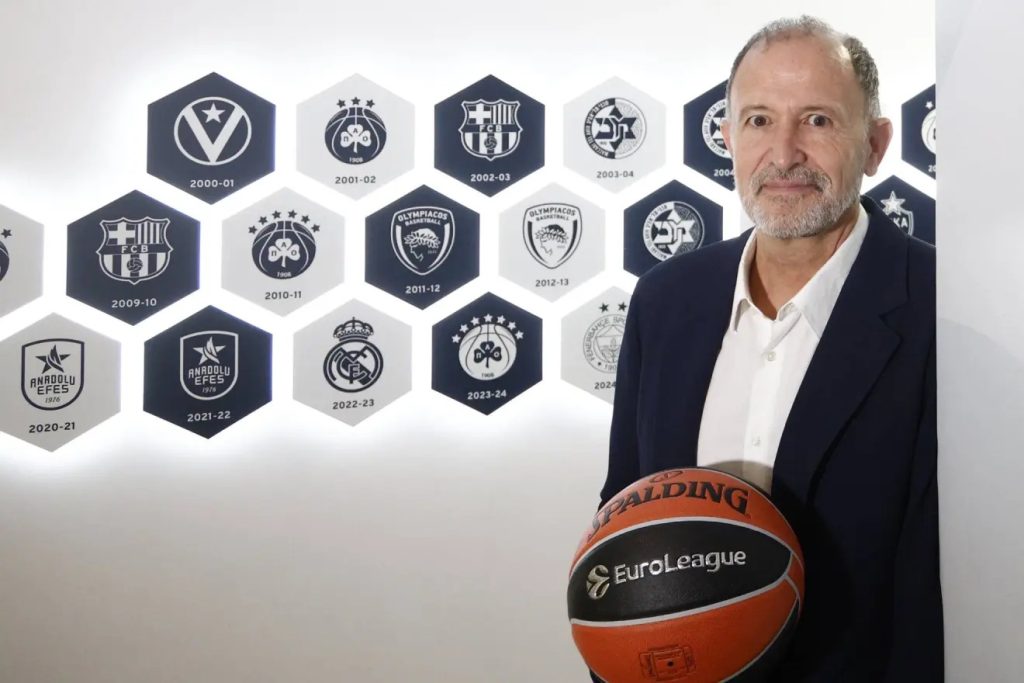
EuroLeague remains open to negotiations with the NBA, but places three conditions at the heart of any agreement: including all thirteen shareholder clubs, preserving their role in decision-making and reducing the investment required to join. Its CEO, Chus Bueno, explained the position in an interview with EFE: “The clubs are open to joining, but they all want to be included and to find the best ways to avoid investing so much.” His comments clarify the European position following the rejection of the initial NBA proposal, as talks with clubs and investors continue towards an NBA Europe launch in October 2027.
The first difficulty lies in the competition’s design. The project developed by the NBA and the International Basketball Federation (FIBA) envisages twelve permanent franchises and four additional places earned through sporting qualification. Giving all thirteen EuroLeague shareholders permanent membership would require changes to that structure, which also aims to accommodate new ventures in major European cities. NBA Deputy Commissioner Mark Tatum has also explained that the model would include a second division offering a route into the top tier. Where European clubs would fit within that structure is one of the issues separating the proposals.
Clubs take different positions
Contacts around the Ballon d’Or ceremony in London have revealed differing levels of willingness to engage with the NBA. Sky News reported that talks with representatives of major European clubs were scheduled for 27 October; Eurohoops subsequently reported that FC Barcelona and FC Bayern Munich would not participate, maintaining the position agreed by EuroLeague owners in Cernobbio on 6 October. That meeting approved further steps towards a franchise system and continued expansion, while the clubs rejected the initial NBA offer.
Real Madrid features in those reports as one of the clubs most willing to continue discussions with the NBA. Bueno, however, emphasised its commitment to EuroLeague in his EFE interview: “It has signed a ten-year contract. It is an ambitious club that wants progress and is always helping to accelerate the process.” He explained that the club had submitted ideas to develop the European project. Exploring an alternative and contributing to the transformation of the existing competition remain parallel activities at this stage of negotiations.
London attracts competing investors
The most substantial new investment development comes from London. According to ‘Sports Business Journal’, Larry Tanenbaum, a former minority owner of the Toronto Raptors, is pursuing a franchise with a bid of around $1 billion. His Kilmer Sports business has recently sold its 25% stake in Maple Leaf Sports & Entertainment for $3.1 billion, providing liquidity and facilitating a move into the European project. London has also attracted bids or interest from groups linked to Daniel Levy and Liberty Global, the Reuben family and technology entrepreneur Nikesh Arora.
In Paris, SBJ identifies Paris Saint-Germain as the leading candidate to establish a new franchise. The NBA’s target markets also include Manchester, Lyon, Madrid, Barcelona, Milan, Rome, Berlin, Munich, Istanbul and Athens. Within those markets, Meridian Sport names Real Madrid, Barça, Fenerbahçe, Bayern, ASVEL and Panathinaikos among the clubs being considered. The approach combines the appeal of established sporting brands with the search for owners able to finance teams, facilities and operations in cities where a new organisation would need to be built.
Entry costs and decision-making power
The required investment is another source of friction. EFE reported that the initial proposal offered more than €500 million to be shared among the owners, while requiring each club interested in joining to invest €440 million. Bueno challenged Tatum’s comparison suggesting that the new model could triple EuroLeague’s projected distributions. His argument is that returns must be assessed alongside the initial outlay. He also insists on a governance condition: “They have created a league that they own, and they want to continue deciding their future.”
While negotiations continue, EuroLeague is maintaining its expansion to 24 teams for the 2027–28 season, with a two-conference system, according to Bueno’s EFE interview. It is also preparing to convert its thirteen shareholders’ licences into franchises. The executive believes Valencia Basket “has everything” needed to secure that status, citing its arena, supporters, track record and backing from Juan Roig, although the decision rests with the owners. Dubai Basketball also wants franchise status. The process envisages up to eight new franchises, potentially awarded gradually depending on each project’s sporting, financial and infrastructure readiness.
The next decisions come in November
Bueno warns that an agreement involving only some clubs could create more competitions. “There are already clubs that have told me: ‘If you reach an agreement with the NBA and leave us out, we will create our own competition,’” he told EFE. The warning extends beyond the thirteen shareholders to teams associated with the EuroCup. For EuroLeague, an alliance must accommodate its wider structure; for the NBA, incorporating existing organisations must fit the model and commitments being negotiated with new investors.
The next concrete step is a EuroLeague meeting during the week beginning 2 November to review its financial rules. Bueno puts the proportion of clubs currently operating sustainably at 40% and wants to balance spending capacity with that objective. He also expects owners to decide on prospective franchises within one or two months. On the NBA side, Tatum maintains October 2027 as the launch target, with successful franchise applicants yet to be announced. The forthcoming decisions must establish both the participants and the financial and governance terms under which they will join.
 Last related articles