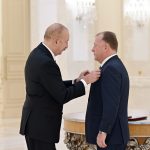
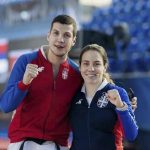
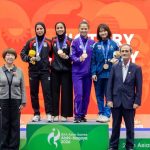
Munich provided an appropriate backdrop as the European Taekwondo Union marked its 50th anniversary with a formal gala, bringing together federation leaders, athletes and officials from across the continent. The presence of World Taekwondo President Chungwon Choue underlined both the significance of the occasion and Europe’s established place within the sport’s global structure.
There is substance behind the celebration. Over five decades, European taekwondo has evolved into one of the sport’s most organised regional systems, regularly hosting major competitions and producing Olympic and world-level athletes. Countries across the continent have helped raise competitive standards while strengthening administrative capacity within the discipline.
ETU President Sakis Pragalos, widely credited with reinforcing ties among national federations, used the anniversary to emphasise unity. “European taekwondo is one great family,” he said, echoing a familiar theme in the sport’s official discourse.
Such language is common in international sport, particularly on ceremonial occasions. It conveys identity and continuity. Yet behind it lies a more complex reality.
Taekwondo today is indisputably global. Practised in more than 200 countries, it has been a consistent presence at the Olympic Games for over two decades. Europe has played a meaningful role in that expansion, not only as a host of major events, but also as a centre for athlete development and high-level competition.
Yet governance presents a less settled picture
Since the founding of World Taekwondo, the presidency has remained in South Korean hands. While this continuity reflects the sport’s origins and Korea’s decisive contribution to its global development and Olympic recognition, it also raises enduring questions about institutional balance and diversity in leadership.
As the sport has expanded worldwide, the absence of leadership rotation contrasts with broader trends across international federations, where greater emphasis is increasingly placed on geographic representation and shared governance. Stability has been a defining feature, but it has also sustained periodic debate about whether the sport’s leadership structure fully reflects its global participation.
This tension is not unique to taekwondo. Many international sports continue to balance historical legacy with evolving expectations of inclusivity and shared authority. Nor does it diminish the achievements celebrated in Munich. But it does prompt a broader question. Have institutional structures evolved at the same pace as the sport itself?
The anniversary event succeeded in honouring the past and reaffirming continuity. It also, perhaps unintentionally, highlighted the distance still to travel.
After 50 years, European taekwondo stands strong, influential and well organised. Its next phase may be defined not only by how far it can expand, but by how widely influence within it is shared.
Because in global sport, unity is measured not only by ceremony, but by who holds a seat at the table.
 Last related articles