When a skier explodes out of the start gate at a World Cup event, every turn, recovery from compression and high-speed adjustment relies on months of work completed away from the snow. The strength to withstand extreme loads, the ability to maintain control, injury prevention and recovery are developed through programmes that begin long before athletes reach the slopes. Dryland training has become a permanent part of performance preparation rather than something confined to the off-season.
An analysis published by the International Ski and Snowboard Federation -FIS- shows how coaches have replaced general strength and endurance plans with systems adapted to each athlete. Alpine skiing combines physical and metabolic blocks; moguls specialists use Pilates to develop control with less impact; and big air and halfpipe athletes practise on dry slopes, in foam pits and on airbags before taking their tricks to the snow. Methods vary between disciplines, but they share four elements: strength, individualisation, recovery and mental preparation.
Two approaches to building an alpine skier’s physical base
Luca Scarian, strength and conditioning coach for the Italian national team who works with skiers including Federica Brignone and Marta Bassino, maintains a clear separation between sporting practice and physical development. “I want to maintain a clear distinction between the areas of training,” he explains. His programme develops strength, oxygen consumption, core stability and efficient movement patterns. Before increasing the load, he ensures that athletes are healthy and able to move efficiently from a biomechanical perspective. Strength is developed through time under muscular tension, appropriate training volume and the rate at which the body can produce force.
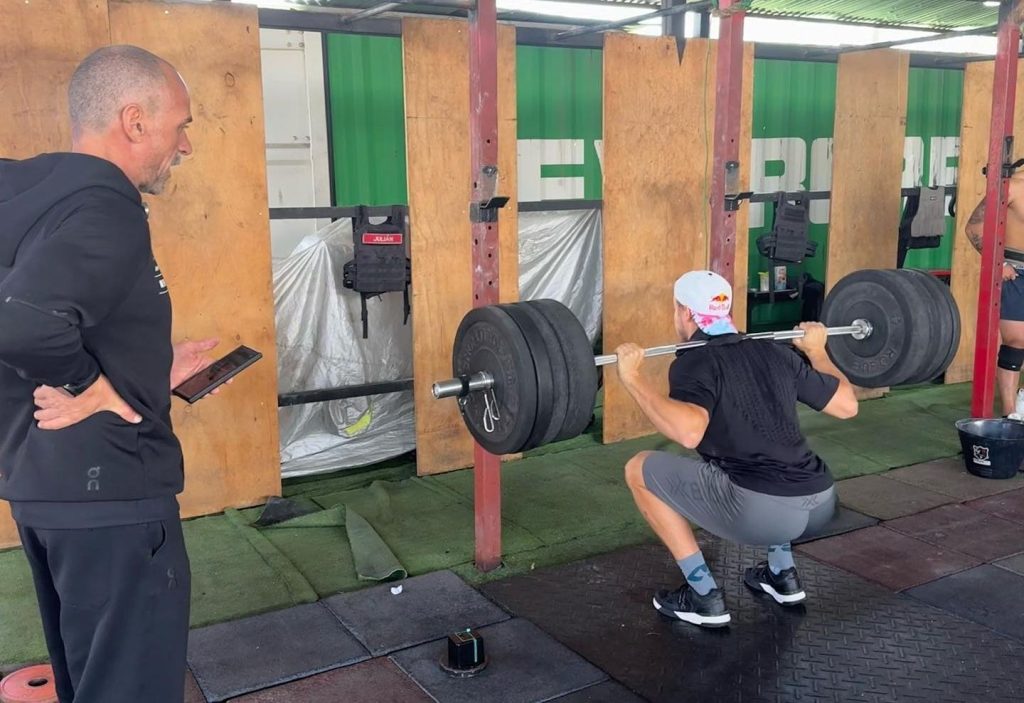
Alejo Hervás, who coaches Marco Odermatt, Gino Caviezel and Justin Murisier, organises his system around two pillars. Structural work focuses on muscles, joints, connective tissue and other soft tissues, while metabolic training develops the aerobic and anaerobic energy systems. During a central 24-week block, the programme begins with aerobic development before progressing to strength phases involving concentric, eccentric and isometric contractions. Volume and intensity rise and fall in waves, with recovery weeks incorporated throughout. Once on-snow camps and competition begin, the focus shifts to preserving the physical qualities already developed.
The group programme adapts to each body
Physical testing provides information about strength, mobility and endurance, but both coaches place equal value on daily observation. They analyse how athletes move, respond to fatigue, communicate their condition and differ from one side of the body to the other. Hervás studies natural asymmetries to determine whether they should be corrected or incorporated into the programme. “Knowing the athlete is fundamental — not only through physical tests, but by understanding them completely,” Scarian says.
Individualisation does not require every member of the team to complete an entirely different session. Coaches adjust repetitions, intensity, rest periods, exercise selection and recovery time within group training. Younger athletes need to establish consistent habits and increase their workloads progressively, while experienced competitors require more precise adjustments. Injuries alter priorities and require coaches to preserve the qualities that can still be trained without interfering with medical treatment. For Hervás, the athlete’s own assessment is decisive: “Athlete feedback is absolutely the most important thing.”
Airbags and Pilates transfer movement to the snow
Acrobatic disciplines use specialised facilities where athletes can rehearse movements without immediately facing the consequences of landing on snow. Skiers and snowboarders practise spins and flips on dry slopes, in foam pits and on large airbags until the movements become embedded in muscle memory. Lily Dhawornvej, a US slopestyle and big air specialist, accelerated her progression after joining the national team in 2025 and increasing her sessions at Woodward Copper in Colorado. In January 2026, she earned her first World Cup podium with a performance that included two 720s and a front flip.
The training completed by Tess Johnson and Olivia Giaccio reflects the specific demands of moguls. Johnson spends approximately 60 per cent of her training time on snow and 40 per cent away from it, while both athletes trained between four and six days a week in the build-up to Milano Cortina 2026. Reformer Pilates allows them to develop core strength, balance and control through low-impact movement. “It helps me focus on core strength, balance and control, all of which directly translate to how I ski on the hill,” Johnson explains. Giaccio uses controlled resistance to remain active during high-volume periods without adding unnecessary strain.
Recovery, data and mental training
Recovery determines how much training an athlete can absorb. Johnson travels with a massage gun, foam roller, yoga mat, mini bands and a lacrosse ball, while Giaccio adjusts her sessions according to her physical and mental needs each day. Paralympic snowboarder Mike Schultz combines mobility work, stretching, compression, rest and sleep with monitoring of his heart rate, heart-rate variability and recovery quality. “Snow time is critical; it’s where feeling, timing and confidence are built. Gym time is where longevity and durability come from,” he says. Hydration and post-training protein intake complete a process in which rest is planned as precisely as the workload.
Psychological preparation incorporates stress management, sleep hygiene, visualisation and goal setting. The United States Olympic and Paralympic Committee -USOPC- employs 15 full-time professionals dedicated to mental health and psychological performance, alongside a confidential support line and meditation and mental-training applications. Giaccio says she has visualised an Olympic final run “thousands upon thousands of times”. Chloe Kim underwent intensive therapy to address pressure and the connection she had created between results and personal value. “Funny enough, now that I’m having fun, I think I’m riding the best I ever have,” she said.
 Last related articles