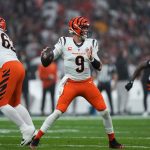
Pablo Maffeo and Joe Burrow provided two contrasting images this weekend that invite football to take a look in the mirror. On Saturday, the Valencia defender greeted a DAZN half-time interview against Real Madrid with a message that soon went viral: “I don’t fucking feel like doing this interview.” On Friday, the Cincinnati Bengals star had appeared before the media at the Ciudad del Fútbol in Las Rozas and given several interviews. On Sunday, he spoke again after the NFL game at the Bernabéu. Before playing, he also found time to pose for a photograph with Ferran Torres. Being a global star and remaining accessible to help ‘sell’ the NFL are two perfectly compatible qualities.
Maffeo was angry, his team was losing and he felt the refereeing had gone against them. After the match, he approached journalist Sergio Quirante to apologise, a gesture that deserves to be acknowledged just as clearly as his outburst. But that does not change the fact that a professional must honour the contracts signed by his club, and spending 30 seconds on an interview should not be a problem. His reaction invites reflection on an issue that goes beyond the individual player: how readily part of the football world treats media duties as a nuisance unrelated to their profession. Clubs are teaching players the wrong habits by overprotecting them.
A star who understands what he represents
The NFL has once again surprised Madrid with its spectacle, but also with the ease with which its leading figures can explain what they do. Burrow, perhaps the most in-form player in the entire NFL right now, was one of the main attractions at Friday’s press conference at the RFEF facilities. He answered questions about the Bengals’ ambitions, his injuries and his visit to Madrid. There was also time to discuss his interests away from the field. That same day, he sat down with El Desmarque, DAZN, AS and others. Each format offered a different perspective on the athlete, providing content for different audiences and giving people reasons to take an interest in someone many Spaniards barely knew before this week. His presence in Madrid had both a sporting and a promotional dimension, and he found time for both.
On Sunday, before the 2026 NFL Madrid Game, Burrow posed for a photograph with Ferran Torres, who was at the Bernabéu to enjoy the game. After competing, he returned to the microphones. The player helps build interest in his team and his sport. His value as a star also grows when the public can get to know him, hear how he analyses a game or discover what interests him away from it. Approachability can coexist with the concentration and demands of elite sport. In Madrid, that availability was part of his professional schedule.
A business comparable to Europe’s five major leagues
The financial scale helps illustrate that this openness coexists with an extraordinarily powerful industry. The NFL surpassed $23 billion in revenue in the financial year ending in 2025, according to Sports Business Journal. The clubs in Europe’s five major leagues—the Premier League, LaLiga, Bundesliga, Serie A and Ligue 1—generated combined revenue equivalent to $24.408 billion in the 2024/25 season, based on Deloitte’s figures. A single American league therefore operates on a financial scale close to that of Europe’s five biggest leagues combined. Attributing that revenue to media access would be an oversimplification; ignoring the fact that its relationship with the public is part of its business would be one too.
Football’s bubble is fuelled by the fear of an ill-judged remark, the pressure of results and the temptation to control every message through clubs’ own channels. That protection can make sense in certain circumstances. Once it becomes a habit, it comes at a cost: stories, personality and opportunities to connect with people who are not yet fans are lost. When access is reduced to a minimum, the space to discuss the game also narrows, along with opportunities to explain a decision or get to know the athlete beyond results and controversy. Clubs want to expand their audiences and attract sponsors; to do so, they need their leading figures to reach people who do not yet follow their accounts or buy their shirts. It is difficult to build new connections when almost every door remains closed.
Learning to speak is also part of the job
Responsibility begins with the clubs and the competitions and federations that shape this relationship. Athletes need training in dealing with the press, and clubs need training in facilitating that work in an organised way. Set schedules, share media duties, agree reasonable durations and prepare players to respond in tense moments. That training should help them express themselves thoughtfully, acknowledge mistakes and handle uncomfortable questions without treating every microphone as a threat. It also requires professionalism on the other side: respecting time limits, preparing interviews and understanding that access has boundaries. A predictable system protects the athlete and allows the journalist to work. The communications department has a fundamental task in maintaining that balance: organising a relationship that works for everyone involved.
The fan who pays for a ticket, a subscription or a shirt supports a substantial part of this industry and wants to hear from its leading figures. The press connects with that audience and also asks questions, checks facts and provides critical scrutiny: its role extends beyond promoting a competition. That is why this relationship should become standard practice, from youth development through to the boardroom. A brief interview can fit into a demanding day. A polite answer can be given even in anger. Dealing with the media is part of a sports star’s job. Clubs should incorporate it into their players’ preparation with the same seriousness they apply to organising the rest of their professional obligations. Setting aside a few minutes, explaining the conditions and honouring what has been agreed would be a good start.
 Last related articles