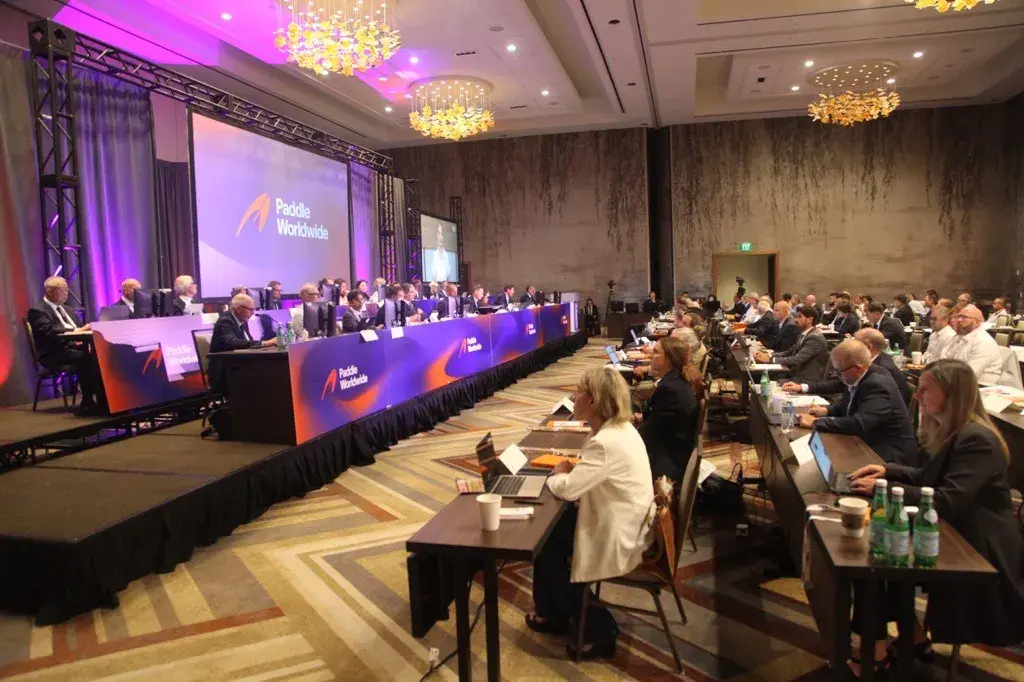
The International Canoe Federation -ICF- has adopted the Paddle Worldwide identity and accompanied its rebrand with 24 governance reforms, new gender equality requirements and a strategy to reduce its reliance on Olympic funding. The measures, approved at the Congress held in Oklahoma City, United States, change the composition of its governing bodies, increase athlete representation, create independent integrity structures and prepare greater investment in National Federations, Continental Associations, technology and development.
The name places paddlesport within the trend followed by organisations such as World Athletics, World Aquatics, World Sailing and World Triathlon, which replaced technical names or historic acronyms with identities that are more recognisable across different markets. Paddle Worldwide is designed to cover the 10 disciplines it governs and connect elite competition with clubs, coaches, volunteers and recreational paddlers. The reforms strengthen areas of growing importance within the Olympic Movement: equality, athlete representation, integrity, financial sustainability, international reach and the ability to maintain complete men’s and women’s programmes.
A shared identity for 10 disciplines
Paddle Worldwide President Thomas Konietzko explained that the new brand expands the federation’s traditional role. “Our responsibility extends beyond governing international competition. We want to inspire more people to experience our sport, strengthen our clubs and communities, and provide a home for everyone who shares a passion for life on the water,” he said. The word ‘Paddle’ identifies the element shared across different craft and disciplines, while ‘Worldwide’ expresses an ambition to cross sporting, cultural and geographical boundaries.
The identity will not replace the names of National Federations or domestic competitions. Instead, it will operate as a platform that each Continental Association, member federation, club or event organiser can adapt. Secretary General Richard Pettit said the aim was not to ask everyone “to communicate in the same way”, but to share resources, knowledge and opportunities within a common structure. The reform completes the Fit for Future strategy, developed to review how the organisation should operate after marking a century since its foundation in 1924.
Athletes move into the centre of decision-making
The institutional review began in 2024 and involved five working groups and a Steering Committee. More than 100 National Federations participated in town hall meetings, while Continental Associations, Board members and other stakeholders submitted proposals. “Every piece of feedback was carefully considered throughout the process,” Konietzko said. The resulting structure establishes an Executive Committee comprising the President, four Vice-Presidents — including an athlete representative — and the Presidents of the five Continental Associations. The Secretary General will participate as a non-voting member.
A broader Council will include the Executive Committee, the Athletes’ Committee Co-Chair and the Chairs of the 10 paddlesport disciplines. The Chairs of the Medical and Anti-Doping Commission and the Finance, Audit and Risk Commission will also participate without voting rights, providing specialist expertise. Four separate Boards will cover sport, athletes, development and Continental Associations. This structure is intended to define responsibilities and prevent operational, technical and strategic decisions from being concentrated within a single body.
Independent structures for integrity and disciplinary matters
Congress also approved the creation of an Independent Integrity Unit, chaired by Canada’s Mike Chambers and including Mario Santos of Portugal and Brianna Quinn of Australia. The new structure will strengthen independent oversight, transparency and ethical governance. An independent Adjudicatory Panel, comprising six specialists from Canada, Hungary, Mexico, Argentina, the United States and Australia, will help ensure due process in disciplinary cases.
These structures will be supported by greater medical, anti-doping, financial and risk oversight. Their introduction responds to standards now expected of international federations: independent mechanisms, predictable rules and clear appeal procedures. Demonstrating that capacity is important for Paddle Worldwide both to retain the confidence of its members and athletes and to reinforce its position within the Olympic and Paralympic programmes.
Gender parity becomes a phased requirement
The proposal submitted by the Argentine Canoe Federation introduces specific changes to representation. National Federations sending two delegates to Congress must appoint one man and one woman, while a third delegate may be of either gender. Technical Committees will maintain their current minimum representation requirements until the end of the 2028 Congress. After that, their four members must be divided equally between men and women. Commissions will also move to equal gender representation across their Chair and up to five additional members.
Vice-President Cecilia Farias argued that increasing women’s participation should extend beyond an institutional commitment. “The aim is to ensure that everyone enjoys equal rights, resources and opportunities, without discrimination,” she said. An analysis of participation during the 2023-2025 World Championship cycle showed that imbalances remain. Farias also warned that women’s events have been cancelled at Regional Games after failing to reach minimum participation levels, even when Olympic champions or world medallists were entered. The federation intends to use leadership representation, scholarships and cooperation with its members to maintain complete programmes for both men and women.
Reducing dependence on Olympic funding
The institutional transformation is supported by a new financial model. According to figures presented to Congress, the proportion of income received from the International Olympic Committee -IOC- has fallen from approximately 93% to less than 50% since the end of 2021. Paddle Worldwide attributes that reduction to agreements with the Hungarian Government and the Hangzhou Sports Bureau, together with a new approach to broadcasting, marketing and event allocation. The funding agreements run until 2035 in Hungary and 2034 in Hangzhou.
The federation opened its headquarters in Budapest in December 2025, adding to its offices in Lausanne, Switzerland, and Hangzhou, China. Its workforce includes staff from 14 countries across five continents, with dedicated managers assigned to work with each Continental Association. An integrated financial and operational management system has been accompanied by stronger procurement controls and a reduction of more than 70% in certain annual software licensing costs. The provisional 2027-2028 budget projects reserves of approximately €10 million by the end of the cycle. Paddle Worldwide plans to use its increased revenue to double financial support for Continental Associations and invest further in technology, events, development programmes and services for its members. “Future revenues will now be invested entirely in the development of our sport,” Konietzko said.
 Last related articles