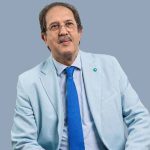
Pyrros Dimas added another recognition of major symbolic value on Tuesday to one of the greatest careers in world weightlifting by signing the Olympians’ Wall at the Olympic House in Lausanne, headquarters of the International Olympic Committee -IOC-. The ceremony brought together the organisation’s president, Kirsty Coventry; the president of the International Weightlifting Federation -IWF-, Mohammed Jalood; the federation’s secretary general, José Quiñones; and the ambassador of Greece to Switzerland, Ekaterini Simopoulou, in an event that once again placed the former champion at the centre of Olympic memory.
The tribute went beyond a formal photo opportunity. In Lausanne, Dimas experienced the occasion as a celebration of both career and legacy, with a visit to the Olympic Museum and the signing of the institution’s Golden Book. The former weightlifter described his journey as “a great path, full of beautiful and rewarding memories”, and added that weightlifting has been “an essential part” of his life, to the point that he still becomes emotional when receiving tributes of this kind. He also thanked the IOC, Kirsty Coventry and the IWF for the recognition.
Lausanne honours a central figure in Olympic weightlifting
The significance of the tribute is explained by the historical weight of its subject. According to the IWF itself, Pyrros Dimas is the most Olympic-medalled weightlifter in the federation’s history and, at the same time, the most successful Greek athlete in the Games across all sports. His Olympic record includes three gold medals in Barcelona 1992, Atlanta 1996 and Sydney 2000, as well as the bronze he won in Athens 2004, in front of his home crowd.
That career produced several moments of enormous competitive and symbolic value. In Barcelona 1992, in the 82.5kg category, he lifted a total of 370kg and won gold thanks to a tiebreak rule that rewarded the lifter who had reached the final total first. In Sydney 2000, after another tie at 390kg, he secured his third title because he weighed 16 grams less than Marc Huster and 64 grams less than Georgi Asanidze. Between those two milestones, in Atlanta 1996, he arrived as the world record holder, broke the world record in both the snatch and the clean and jerk, and finished 9kg ahead of Huster.

From Barcelona to Athens: four Games in an unmatched career
His Olympic farewell is also part of the legend. In Athens 2004, Dimas ended his Olympic journey with a bronze medal that the IWF still describes as one of the most inspiring moments of his career, because of the reaction of the Greek crowd during the medal ceremony and the image that followed, when he signalled his retirement by leaving his shoes on the platform. That podium finish completed a sequence of four consecutive Olympic Games with a medal and cemented a figure who went far beyond the limits of weightlifting in Greece.
His personal story also adds context to the tribute in Lausanne. Dimas was born in 1971 in Himara, in Albania, into a Greek family, and moved to Athens in the early 1990s. In addition to his four Olympic medals, he was world champion in 1993, 1995 and 1998, posted personal bests of 180.5kg in the snatch, 215kg in the clean and jerk and 392.5kg in total, was inducted into weightlifting’s Hall of Fame in 2009 and served as a member of the Hellenic Parliament between 2012 and 2015.
Dimas still plays an active role within the IWF
The recognition at IOC headquarters also connects with his current place in the governance of the sport. Dimas is a member of the IWF executive board and leads its innovation committee, a role from which he says he can still contribute “experience and knowledge” for the benefit of athletes and events. In his remarks in Lausanne, he argued that weightlifting has undergone many changes in recent years and said that it is now “a valuable and respected partner within the Olympic Movement”.
At the end of the ceremony, Dimas offered one of the lines that best captured the meaning of the tribute. He said it was “a beautiful feeling” to share that space with so many other champions and Olympians, whom he described as examples of determination, passion and dedication, and stressed that he felt “very honoured” to see his name on such a prestigious wall. In Lausanne, he also had a special witness at the ceremony: his 16-year-old son Nicolas, who accompanied him in a day that felt less like a farewell than the confirmation of a place already secured in the history of Olympism.
 Last related articles