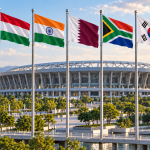
The paradisiacal city of Panama is experiencing a true sporting celebration these days: it reunites, after fifty years, with the organisation of a mega sporting event such as the South American Youth Games, a competition that brings together 15 countries and more than 2,000 athletes aged between 14 and 18, competing in more than 22 sports.
In this place, where every young person has the dream of building their own future through sport, a Chilean official focuses on these categories and age groups to reaffirm Santiago de Chile’s bid for the next Youth Olympic Games. He is clear that the path they have taken shows hope to lay the foundations of a country that seeks, through sport, to grow and leave a legacy for new generations. This is a one-on-one with Miguel Ángel Mujica Brain, president of the Chilean Olympic Committee, who conveys confidence within the restraint required in elections where IOC Members vote and where lobbying or approaching members of the International Olympic Committee is prohibited.
President Mujica Brain, Chile has had a strong performance in these South American Games here in Panama, results that go hand in hand with the work carried out through the Olympic Plan and its federations. Does this go hand in hand or align with Santiago’s bid for the next Youth Olympic Games?
“Our bid goes hand in hand with understanding and assuming that the real focus is on young people, at early ages, in order to identify them at the right moment and follow their development over the long term. The creation of Chile’s Olympic Plan, where the State, the Olympic Committee and the federations take part, has that ultimate goal: to find new talent, without forgetting that they are adolescents who must evolve and mature over time.
All -or the vast majority of athletes at these ages- are monitored by Paris Inostroza, a distinguished Chilean fencer who competed in four Olympic Games, and that experience is vital to pass on to those who are starting out in these sporting disciplines. Just as an example, here in Panama, in the cycling time trial, Luciano Carrizo is a cyclist, a young athlete with tremendous potential; I have no doubt he will be on the radar of the national cycling coaches. The same applies to Alexandra Osorio, also South American gold medallist in the women’s event. And there are many more who have shown a high level: I recall gymnasts Arturo Rossel and Matías Martínez, as well as the surfer Antonia Gutiérrez, to name a few. These examples show that there is raw talent and opportunities to continue growing with these young athletes.”
President Mujica, you are in the countdown, with visits to Santiago de Chile and the other candidate cities. How do things look between now and June 25, when the elections take place in Lausanne, Switzerland?
“From May 13 to 17, the IOC Evaluation Commission will arrive in Santiago, carrying out the final inspection of sports venues, hotels, transport and connectivity from the Olympic Village to the competition sites. They will then meet with all national authorities to explain the scope of hosting a Youth Olympic Games and to make it very clear that this bid is led by the Chilean Olympic Committee, with the support of the State, and that it goes beyond the current government. In fact, if Chile is awarded the 2030 Games, they will not be inaugurated by President Kast’s government, but they must be part of a State policy, as was the case with the Santiago 2023 Pan American Games.”
Mr Mujica Brain, I sense a lot of optimism from you, is it due to the experience gained from organising the 2023 Pan American Games in Santiago?
“Look, I want to be very honest with you, since you have known me for years and you also understand how the Olympic world works. First of all, you cannot campaign with IOC Members; they are the ones who vote and choose the host city. But it is also true that, in the decision-making process for these Youth Games, the IOC Evaluation Commission has a high level of influence in the report submitted to the Executive Committee and the IOC Members themselves. With this information, with the strengths and weaknesses of each bidder, they must weigh everything and decide what is best for the Olympic Movement.
From that analysis, based on objective criteria, our country, and Santiago in particular, has comparative advantages, not only in organising large mega-events; its economic and political stability is also relevant, as well as the legacy left by the 2023 Pan American Games, the level of transport connectivity, and the fact that the vast majority of sports -more than 80%- will be held in the National Stadium Park. Another key factor: from the Olympic Village to the National Stadium Park, athletes can travel in 15 minutes by metro, a top-level transport system.
All of this increases my optimism, along with the experience accumulated as a national and international sports official, where one hopes that smaller countries like ours can organise, with high standards, Games for the youth of the world and, at the same time, give us the opportunity to develop internally as a sporting nation, where physical activity is essential for young people’s health and brings them closer to their families.”
On June 25, in Lausanne, Switzerland, the host city of the 2030 Youth Olympic Games will be decided. Asunción, Bangkok and Santiago dream of hosting the event for the first time; their leaders are working to secure the bid, while young athletes aspire to compete at home. The Olympic dream is just around the corner.
 Last related articles