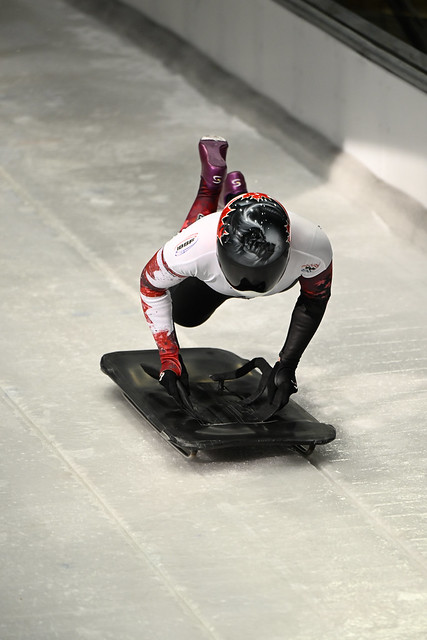
Jane Channell has announced her retirement from skeleton after 15 years in a sport that demands throwing yourself head-first down the ice at speeds close to 140 kilometres per hour. The Canadian, an Olympian at PyeongChang, Beijing and Milano Cortina, steps away at the age of 37 with four World Cup medals, a bronze Crystal Globe, a world silver medal in the team event and an influence that went far beyond results within Canada’s national programme.
“To be inside a highly physically demanding sport for 15 years is a long time and I feel like now is the right time to move on,” Channell said in a statement released by Bobsleigh Canada Skeleton. The decision, like many retirements, was complex and carefully considered. “Skeleton is my family. That is why it is so difficult to step away and why it has taken me so long to come to terms with this decision. The community that the Canadian programme has right now is unique. Through all the ups and downs, and with all the support I have received, both loud and quiet, it has been an unforgettable ride,” she added.
“Help me fly”: turning loss into momentum
Channell was born and raised in North Vancouver, British Columbia, and described herself during childhood as “the shy one”. Sport soon became a natural space for her: she played basketball, football, softball and ran track. Later, at Simon Fraser University, she established herself as a sprinter and also competed with the university softball team. “I live in the moment. I leave nothing undone. I have no regrets. I live out loud,” she wrote in her own biography, a line that helps explain the way she would go on to build her career.
In her fourth year at university, her boyfriend passed away suddenly and Channell found in track a way to move through that loss. “It was when I was training and racing at top speeds that I felt free. This feeling is what saved me and brought me back from devastation,” she said. The idea of “Help me fly” captures that part of her story: running, pushing, sliding and competing were not only sporting gestures, but a way of continuing forward after a personal blow.
 From the track to the ice
Skeleton entered her life before she knew she would one day become an Olympian. She watched the Salt Lake City competition on television with her grandfather, who told her the athletes doing it were “crazy”. She had the opposite reaction: she knew it was something she wanted to try. Years later, Jon Montgomery’s gold medal in Vancouver deepened that attraction to a sport built on precision, risk and adrenaline.
After graduating in 2011 with a Bachelor of Science in Physical Geography from Simon Fraser University, she moved to Whistler almost on impulse to fully immerse herself in skeleton. She worked and trained full time for two winters, made Canada’s development team in her second year and then moved to Calgary to continue the journey with the rest of the squad. Her sprinting background fitted naturally with a discipline in which an explosive start can shape a race before the sled reaches the most technical part of the track.
Podiums, Olympic Games and a 15-year career
Her international progression was quick. She won the overall North American Cup title in the 2012-13 season, moved through the Intercontinental Cup and reached the World Cup. In 2015, she delivered one of her first major statements by finishing fourth at the World Championships, just 0.06 seconds off the podium on her debut at the event. In the 2015-16 season, she earned her first World Cup podiums, finished third overall and received a bronze Crystal Globe as one of the leading athletes on the circuit.
Across her career, Channell collected four World Cup medals, with silvers in Park City and Whistler and bronzes in Königssee and Winterberg. Her best Olympic result came at PyeongChang 2018, where she finished 10th and stood out for her push times. At Beijing 2022 she placed 17th, and at Milano Cortina 2026 she represented Canada again, finishing 18th individually and 15th in the mixed team event. She also won silver at the 2020 World Championships in the mixed team event alongside Dave Greszczyszyn, a medal she remembers as one of her favourite moments because they arrived as clear underdogs and finished just 0.01 seconds from victory.
 Beyond the finish line
Her farewell also speaks to leadership. Channell thought 2022 might be her final year, but decided to continue because she did not want to leave Canadian skeleton in the state it was in at the time. “There was so much change, but it was very rewarding to be part of it all,” she explained. In the cycle leading to Milano Cortina 2026, she helped guide younger athletes, bring order to development standards and build a culture of accountability, responsibility and team success within the national programme.
Joe Cecchini, high performance director and head coach of the national skeleton programme, described her as “the heartbeat of our programme for many years”. Channell also explained it from another angle: “I could have stayed around longer, and I would have been more than capable of sliding, but if I did that, I feel like I’d be blocking that next step for athletes coming up the pipeline who now deserve the opportunity. I don’t want to do that.” Her retirement closes a career with three Olympic Games and international podiums, but also a story that began with speed on a track and found in the ice a way to fly.
 Last related articles