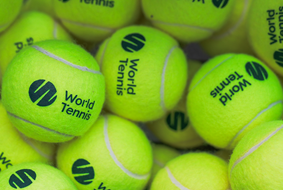
The International Tennis Federation -ITF-, the global governing body of tennis since 1913, has become World Tennis. The name change opens a new stage for a federation that governs the sport at global level, brings together 214 national associations and is seeking to strengthen its role in an ecosystem that is increasingly competitive, fragmented and shaped by the ability to attract participation, investment and audiences.
The official version speaks of transformation, growth and the future. World Tennis presents its new identity as a way to better reflect its global reach and mandate within tennis. The organisation has set a target of increasing the number of players worldwide from 106 million to 140 million by 2035, growth of more than 30%, and has committed to reinvesting at least 85% of all annual income over the next decade into the development of the sport.
A new identity for a global ambition
The change is accompanied by an open letter signed by World Tennis president David Haggerty and chief executive Ross Hutchins. In it, the organisation defends the idea of opening a “world of opportunities” for people of all ages, abilities and backgrounds, both on and off the court. The message seeks to position the former ITF not only as a regulator, but also as a driver of growth, access and development for tennis worldwide.
World Tennis has defined five strategic priorities for the coming years: increasing participation, strengthening the pathway for future stars, elevating official nations competitions, preparing tennis for new audiences and attracting more investment to grow the sport. That roadmap brings together grassroots participation, high performance, innovation, governance, integrity, player wellbeing and the search for new revenue streams.
 More than a change of image
The transformation also has a broader reading within international sport. The ITF acronym retains historical and institutional value, but World Tennis is a more direct brand, easier for global fans to understand and more useful when speaking to sponsors, governments, commercial partners and new markets. At a time when many international federations are simplifying their identities towards clearer World ‘X’ formulas, tennis is adopting a language that no longer belongs only to governing bodies, but also to the market.
It is not a strange move, nor necessarily a cosmetic one. International federations compete for attention, investment and cultural relevance in an environment saturated with competitions, platforms and content. A simpler global brand can make it easier to connect with audiences who may not know the institutional structure of tennis, but can understand a direct identity such as World Tennis. The operation therefore combines official narrative and economic necessity: growth also requires being recognisable.
Tennis as a fragmented ecosystem
The change is especially significant in a sport whose governance is shared among different actors. World Tennis is responsible for the rules of tennis, global development, the Davis Cup, the Billie Jean King Cup by Gainbridge, tennis and wheelchair tennis at the Olympic Games and Paralympic Games, and circuits such as the World Tennis Tour, the Uniqlo Wheelchair Tennis Tour and the Beach Tennis World Tour. It also manages a pathway into professional tennis through almost 2,000 tournaments each year.
However, World Tennis does not directly organise the four Grand Slam tournaments. The Australian Open, Roland Garros, Wimbledon and the US Open depend on their respective national and organisational structures, although the federation works with them through the Grand Slam Board and provides support in governance, administration, officiating and communications. Nor does it control the ATP or the WTA, which forces the organisation to find its own space within a tennis ecosystem that needs coordination, but does not answer to a single commercial authority.
The economic reading of the change
That fragmentation helps explain why the name change can make sense beyond image. World Tennis has not presented the transformation as a search for external investment, but as a way to diversify revenue, strengthen long-term partnerships and make it easier for those who want to invest in tennis to find fewer points of friction. Hutchins has argued that the sport needs to speak more specifically to each part of its pyramid: the elite, professionals, competitive players and the grassroots.
The debate coincides with a broader conversation about the economic potential of tennis. Andrea Gaudenzi, president of the Association of Tennis Professionals -ATP-, has argued that the professional ecosystem could multiply its revenues if its organisations integrated their commercial forces more effectively. In that context, World Tennis is trying to position itself as a brand capable of ordering its part of the system, strengthening the value of nations competitions and connecting development, participation and investment.
A gradual transition
The new identity will not be adopted across all products at once. Most events will start using the World Tennis brand from 25 June 2026, but the World Tennis Tour and World Tennis Tour Juniors will complete the transition on 1 January 2027 because of the scale of their calendars. The World Tennis Number will also adopt the new identity later, due to the complexity of a platform with more than 2.3 million players and systems connected across different federations.
The former ITF retains its historical functions, but changes the way it presents them. World Tennis does not solve tennis’s fragmentation by itself, although it does try to place the federation in a clearer position within that ecosystem. In a sport that wants to grow from 106 million to 140 million players, strengthen its nations competitions and attract more investment, the name change looks less like an aesthetic gesture than an adaptation to the new economic and institutional language of global sport.
 Last related articles