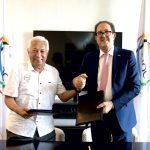
The Association of National Olympic Committees of Africa -ANOCA- held a high-level strategic meeting with RISE World, a European company specialising in critical digital infrastructure, at its headquarters in Abuja on 16 May 2026. The meeting, organised as part of the digital transformation process of the African Olympic and Sports Movement, marks a relevant step in the ambition to equip the continent with a sovereign, unified digital infrastructure adapted to the needs of its 54 National Olympic Committees.
The meeting was supervised by ANOCA president Mustapha Berraf, who was represented at the opening by first vice-president Joao Da Costa Alegre Afonso, who delivered the official address. Also present were treasurer general Habu Ahmed Gumel; the president of the Marketing Commission, Alfred Foloko; representatives of Sport Data; and the RISE World team, led by Ronald Breiteneder, the company’s representative and head of the RISE team in this strategic dialogue process.
A digital infrastructure for 54 Olympic committees
The aim of the meeting was to examine RISE World’s technological and operational capabilities and to study the prospects for a continent-wide programme. Following the presentations and exchanges, a shared vision emerged around the “digital and security transformation of the African Olympic Movement”, with the ambition of creating the first pan-African digital infrastructure dedicated to Olympic sport.
The programme would include a unified digital platform for the 54 African National Olympic Committees, a digital identity for athletes, secure accreditation systems, competition management platforms, an African sports cloud, data intelligence tools, media platforms and an institutional cybersecurity architecture. The proposal seeks to move from fragmented solutions to a common system capable of organising data, processes, competitions, communication and institutional protection across the African Olympic ecosystem.
Digital sovereignty as a non-negotiable condition
ANOCA has set clear strategic requirements for any large-scale technology partnership. These include full ownership of data by the organisation, secure administrator access, an independent cybersecurity audit, defined governance and data protection contracts, skills transfer to African teams and the ability to recover all information at any time. Digitalisation is therefore linked to operational autonomy, institutional control and the protection of African Olympic sport’s strategic assets.
The vision also connects with the role of the Marketing Commission within the continental strategy. In his speech, Berraf argued that the commission works on “the means of our ambition” and recalled that no sports project can be carried out without resources and no champion can be prepared without a budget. His message positioned African sports marketing as a lever to transform the continent’s potential into economic, institutional and sporting value.
Dakar 2026 and the African Olympic brand
Berraf also underlined the need to move beyond a model in which African sport has too long been seen as a recipient of aid, subsidies or international solidarity. “African sport must no longer be a recipient: it is an actor, a producer of value, a market,” he said. The idea summarises the political and economic substance of the project: Africa does not want to limit itself to receiving external solutions, but to build its own capabilities, protect its assets and negotiate from a stronger position.
The immediate horizon of Dakar 2026 reinforces that reading. Berraf recalled that the Youth Olympic Games will be the first major commercial showcase for the African Olympic Movement on a global scale, with worldwide audiences, brands, media, broadcasters and thousands of journalists focused on the continent. The event represents not only a sporting and organisational challenge, but also a test of brand positioning, data management, digital security and the ability to turn international attention into lasting relationships.
RISE World and the next phases
The roadmap outlined after the meeting includes three phases. First, RISE World will prepare a complete institutional proposal including the technological architecture, the governance model, the cybersecurity framework and the data sovereignty strategy. Then, an institutional and financial dossier will be prepared for international funders and African and international financial institutions. Finally, the mobilisation of resources and the progressive launch of the programme will begin.
The project has been identified as compatible with development priorities such as youth, innovation, digital transformation, African integration, cybersecurity, digital sovereignty and the sports economy. With this initiative, ANOCA is seeking to position itself as an actor in the digital transformation of African sport, rather than only as a beneficiary of external solutions. The commitment to common infrastructure, owned data and skills transfer marks a change of scale: modernising processes, strengthening operational independence and building a foundation from which Africa can better protect, manage and enhance the value of its own Olympic ecosystem.
 Last related articles