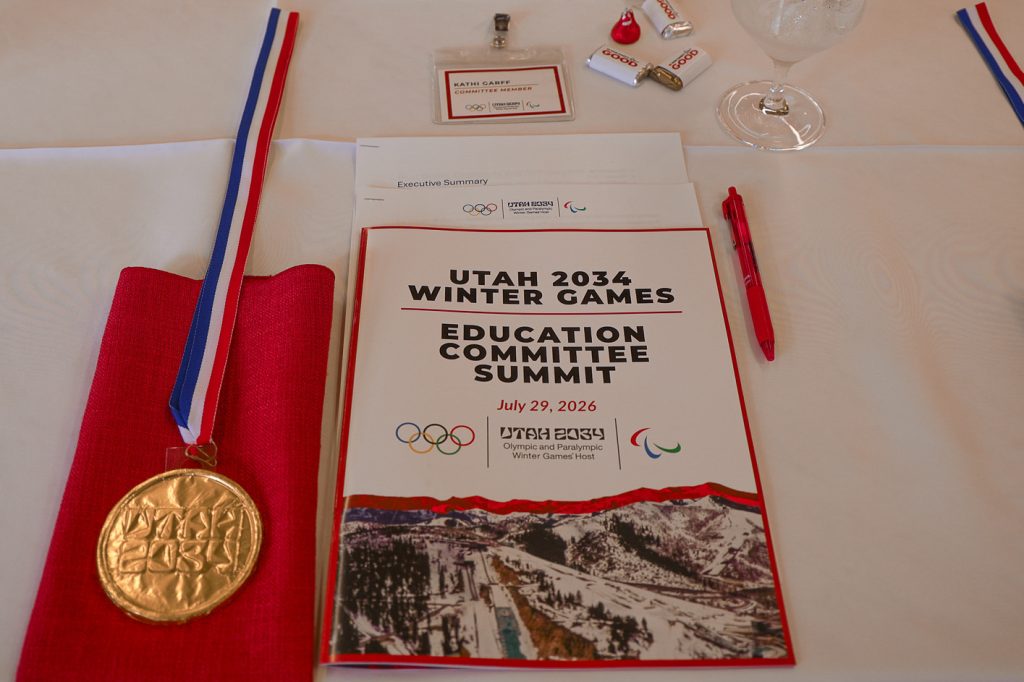
The Organising Committee for the 2034 Olympic and Paralympic Winter Games has established the Utah 2034 Education Committee, an advisory body responsible for developing a statewide school programme. The initiative will use Olympic and Paralympic values to improve literacy, increase school attendance and establish indicators to measure its results. Its inaugural meeting took place on 29 July at Utah Olympic Park in Park City, bringing together education officials, sports leaders and representatives from school districts.
The committee will be chaired by Amy Garff, president of Ken Garff Philanthropies, with former state superintendent of public instruction Syd Dickson serving as vice-chair. Utah-born Olympic champion Nathan Chen will provide an athlete perspective. The Robert H. and Katharine B. Garff Foundation is also a founding member of Podium34, the philanthropic programme created to finance the early stages of the Games and community projects. “We’re creating opportunities for students to engage with the values of the Olympic and Paralympic Movement in meaningful ways that will extend well beyond the Games,” Garff said.
From education to Games planning
Utah was officially awarded the Games in July 2024 and established its Organising Committee in February 2025. The Olympic Games will take place from 10 to 26 February 2034, followed by the Paralympic Games from 10 to 19 March, with more than 90 countries expected to participate. Since November 2025, the official name has been Utah 2034 rather than Salt Lake City-Utah 2034, reflecting the project’s statewide reach, although Salt Lake City will remain its main urban and operational hub. Fraser Bullock, who served as chief operating and financial officer for Salt Lake 2002, is executive chair and president, while Brad Wilson is chief executive. The 26-member board reserves approximately one-third of its positions for Olympic and Paralympic athletes.
The organisation currently has a workforce of around 12 employees, supported by advisers, contractors and volunteers. Its first Games Plan, published in June 2026 and intended to be updated annually, divides preparations into two stages. Until 2030, the focus will be on establishing the organisational, financial, commercial and strategic foundations. Operational planning, testing and final preparations will intensify from that point. During Milano Cortina 2026, Utah made its first formal presentation to the International Olympic Committee -IOC- since being awarded the Games and joined the observer programme to examine transport, security, volunteering, ticketing, sustainability and the experience provided to athletes and spectators.
Thirteen existing venues, but work still to be done
The provisional plan is based on 13 facilities, many inherited from the 2002 Games, and does not require the construction of new permanent competition venues. The Olympic and Paralympic Village will be located at the University of Utah, with every venue expected by the organisers to be no more than an hour away. Rice-Eccles Stadium will host the ceremonies, while the Utah Olympic Oval will stage speed skating. Deer Valley, Park City Mountain, Snowbasin and Soldier Hollow will accommodate the snow events, while the Delta Center, Maverik Center and other arenas will host the ice sports. The Salt Palace will stage curling in a temporary facility.
Having these venues already in place reduces construction requirements, but does not mean they are all ready for 2034. Facilities will need to be modernised, arenas adapted, technical systems renewed and temporary structures installed, including the curling venue and an urban big air ramp. Bid planning estimated around $31.2 million in permanent investment and more than $206 million for temporary infrastructure, signage and wayfinding. The state legislature has allocated around $53 million to upgrading publicly owned facilities, of which approximately $46 million has already been spent. The Utah Olympic Legacy Foundation estimates that another $50 million could be required for maintenance and improvements before the Games.
A privately funded budget with public commitments
The initial budget sets aside approximately $2.84 billion for operations, with the overall cost projected at close to $4 billion once contingencies, legacy programmes and other items are included. These figures originated in the bid, are expressed in 2023 dollars and will need to be updated over the coming years. Utah 2034 intends to finance its operations through sponsorship, ticket sales, hospitality, IOC contributions from broadcasting rights and worldwide partners, and private donations. Podium34 has already secured commitments worth $250 million towards a $300 million target. This early funding is particularly important because the committee must wait until after Los Angeles 2028 before fully exploiting certain domestic sponsorship opportunities.
The pledge not to use state or municipal funding mainly applies to the operating budget and does not remove all public involvement. The state is contractually responsible for guaranteeing any deficit, while public authorities will finance improvements to publicly owned venues, security, transport and urban services. Some of these projects would proceed even without the Games. A study by the Kem C. Gardner Policy Institute estimates that the project could generate $6.6 billion in cumulative economic activity, add nearly $3.9 billion to state gross domestic product, support more than 42,000 job-years and produce $2.5 billion in personal income between 2024 and 2035. These are projected economic impacts rather than direct Organising Committee revenue or guaranteed returns.
Transport, security and decisions still to be made
The compact model simplifies travel from a single Village but also concentrates the risk of congestion across the Wasatch Front. The regional FrontRunner 2X programme, which is not exclusively an Olympic project, includes 11 new sections of double track, ten additional trains and services every 15 minutes during peak periods. Its estimated cost is around $966 million, it depends partly on federal funding and substantial completion is targeted for 2030. A dedicated Games public safety command will also begin taking shape during 2026 to coordinate federal, state and municipal authorities, although a detailed security budget has yet to be published.
The Church of Jesus Christ of Latter-day Saints has committed an as-yet undisclosed financial contribution, together with Block 85 and additional land for parking and operational requirements. The downtown site is expected to accommodate the medals plaza and potentially the big air competition. Utah 2034 has also announced that 34,000 tickets will be available for $34, indirectly subsidised through premium seats and hospitality packages, although the wider sales system and pricing structure remain undecided. The final sports programme, allocation of every discipline, temporary venue designs and individual renovation projects also remain open. Organisers are considering disciplines such as freeride, although no decision has been taken for 2034, and are testing snowmaking, storage and protection systems to reduce climate-related risks, particularly during the Paralympic Games in March.
 Last related articles