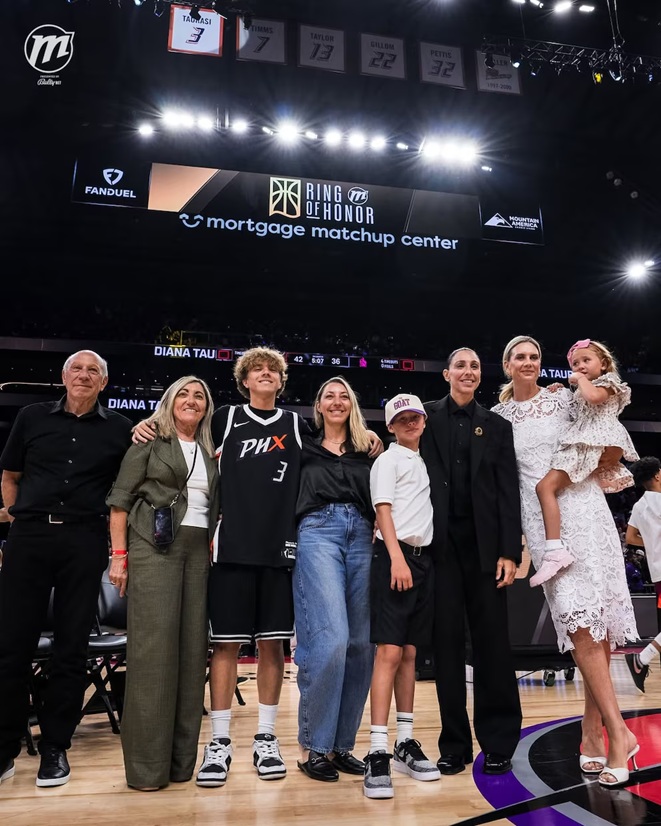
“He did it every day for 50 years, over and over again. So don’t tell me this country wasn’t built on the effort of hard-working people, regardless of where they were born.” Diana Taurasi was speaking about her father, Mario Taurasi, but her words extended far beyond her family’s story. She delivered them on Sunday, when Phoenix Mercury retired her number 3 jersey and inducted her into the franchise’s Ring of Honor. The Taurasi name was raised to the rafters in front of 16,513 spectators during the Women’s National Basketball Association -WNBA- game against the Portland Fire.
Taurasi was one of the WNBA’s first major stars, a pioneer and one of the greatest players in basketball history. She won three championships with Phoenix, was named the league’s Most Valuable Player in 2009, claimed six Olympic gold medals and remains its all-time leading scorer with 10,646 points. She also represented the United States throughout her career, but never forgot her roots: Mario was born in Italy and raised in Argentina, while her mother, Liliana, is Argentine. Both emigrated to the United States, and their daughter has always praised their sacrifices whenever she has had the opportunity. Amid the current political climate surrounding immigration, and without mentioning any political leader, Taurasi used her night to underline the contribution immigrant families make to the country. What would US basketball be without Diana Taurasi? How many stories like hers can be found in sport or in the country’s everyday life?
The work behind the family name
“I know this story can connect with a lot of people in many different ways. When your parents do everything for you — and I mean absolutely everything… My parents did everything for my sister and me. They changed countries. They arrived in a place where they didn’t know the language,” Taurasi said. She then explained what showing up for one’s family every day meant to her. She remembered her father getting into his car at four in the morning and driving for an hour and a half to the sheet-metal factory where he worked. He left so early to avoid the traffic that he would sleep in the car park before beginning his shift.
After recalling that routine, Taurasi broadened the meaning of her story: “My parents didn’t just come to this country. They came to contribute, to make it better. And it doesn’t matter where you come from. It doesn’t matter where you come from.” She also used a metaphor to address inequality of opportunity: “Life isn’t fair. People always say life is like a game of chess. No, it isn’t. We aren’t all given the same pieces.” Finally, she pointed towards the jersey already hanging from the rafters: “But don’t let those disadvantages bring you down because, like my parents, who came to this country… look at their name now.” The tribute therefore acquired another meaning: the individual recognition of an athlete also gave physical form to the journey of an immigrant family.
 Argentina at home
The story began before Taurasi was born. Mario moved to Argentina at the age of five, played football and met Liliana, who is from Rosario. After marrying and having their first daughter, Jessica, the family considered remaining in the country, but a job opportunity arose in California and they eventually settled in the United States. Diana was born on 11 June 1982 and grew up in Chino, in San Bernardino County. Outside the family home, she developed as a US athlete; inside it, she found an Argentine household shaped by the language, food and customs her parents had brought with them.
“I feel just as Argentine as I do from the United States. You can ask my national team-mates how I behave when we are at an Olympic Games or a World Cup. At home, we speak Spanish, drink mate and eat pastries, milanesas, empanadas, asado, tripe and chicken al galeto. We talk about football all day… I have lived almost all my life in the United States, but arriving at my home in Los Angeles was like arriving in Argentina,” she explained in a 2019 interview with ‘Infobae’. At the age of 12, she returned to Rosario for a little over a year and spent much of that period at Club Atlético Villa Diego, now known as Club Atlético Talleres Rosario Puerto Belgrano. “I treasure some wonderful memories. I was there all day, from eight in the morning until eight at night. I still miss that club life because it doesn’t exist in the United States. I played everything there: football, tennis, hockey…,” she recalled.
A first-generation American
Taurasi had already explored this part of her identity in ‘Just a Kid from Chino’, an article she wrote for ‘The Players’ Tribune’ in 2015. “I’m a first-generation American” and “I am very much the daughter of immigrants,” she wrote. Her family spoke Spanish at home, watched Spanish-language television, listened to music in the language and mainly ate Italian and Argentine food. That upbringing taught her to understand the United States as “a myriad of cultures coexisting all at once”, a view that resurfaced 11 years later in the speech delivered beneath her jersey.
The article also described how her time in Argentina allowed her to witness the difficulties experienced by some members of her family and better understand the opportunities available to her upon returning to California. Her father got up every morning to travel to the factory, while her mother moved between different jobs, from childcare to working in a restaurant. Taurasi needed years to understand the scale of that effort, but eventually made it a central part of her identity: “That’s the duality of the American immigrant experience in a nutshell: the insider’s feeling of opportunity but the outsider’s understanding of privilege.”
 Last related articles