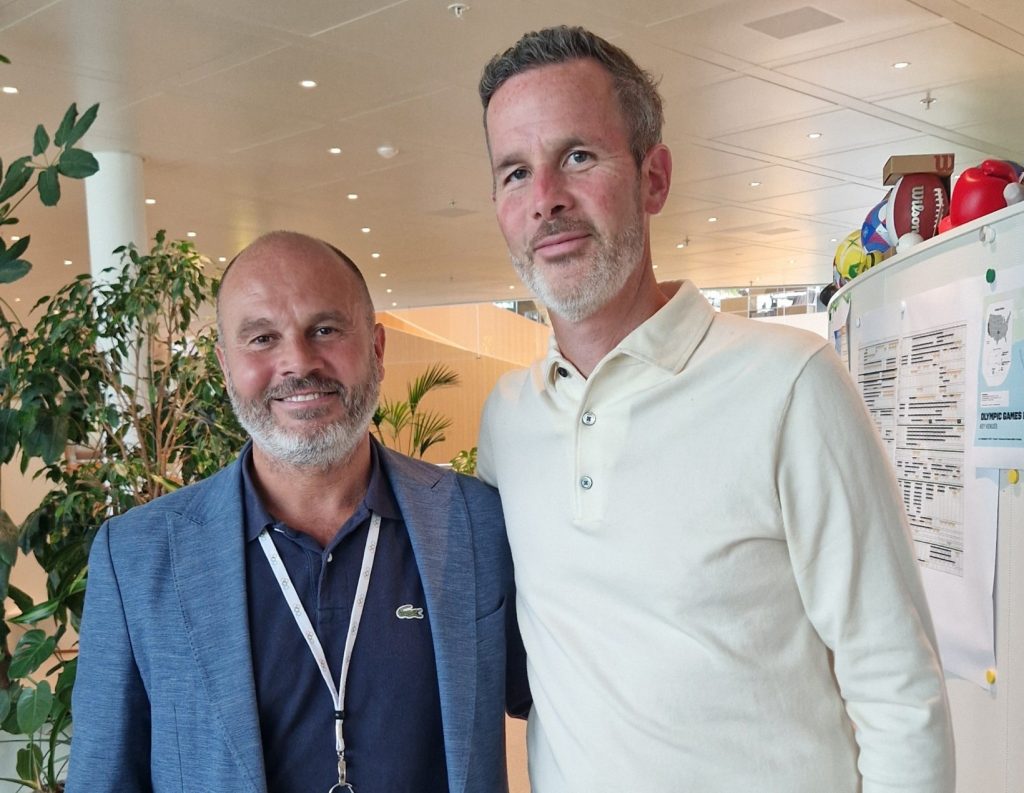
The Federation of International Bandy -FIB- has presented the International Olympic Committee -IOC- with the changes through which it intends to broaden bandy’s reach and work towards future inclusion in the Olympic Winter Games programme. Its General Secretary, Attila Adamfi, met IOC Sports Director Pierre Ducrey and Head of Recognised International Federations Tania Tchea at the organisation’s headquarters in Lausanne. The discussions included a specific horizon: the possibility of directing the federation’s Olympic ambitions towards the 2034 Games.
The meeting followed several changes to the structure of international bandy. Since 2022, the FIB has reformed its governance and integrity rules; in 2025, it held the first direct election of its Athletes Committee and improved its position in ARISF’s independent assessment; and in January 2026, it approved Short Bandy as its third official discipline. It has also introduced post-championship athlete surveys, is preparing to adapt its anti-doping rules to the World Code that will take effect on 1 January 2027, has been recognised as a Committee Member of the International Sport for All Federation and has opened a review of its competition model. These measures formed the wider picture presented to the IOC alongside the objective of reaching new countries and athletes.
An ambition, not a bid
The discussion about 2034 does not mean that bandy has been added to the programme or that a formal bid currently exists. The Games have already been awarded to Utah, in the United States, but the sports programme will still have to pass through the corresponding evaluation and approval processes. The meeting allowed the FIB to understand the criteria within the new methodology for determining the Olympic programme approved under ‘Fit for the Future’, which will begin to apply from Brisbane 2032, and to explain how bandy’s characteristics could fit within it. The federation’s arguments include its ability to share facilities, its development potential and the possibility of limiting the construction of new infrastructure.
Bandy’s relationship with the Olympic Movement began much earlier. It was a demonstration sport at Oslo 1952, where Norway, Sweden and Finland contested a three-match tournament, although it never became part of the official medal programme. The FIB received full IOC recognition in 2004 and belongs to the Association of IOC Recognised International Sports Federations -ARISF-, but recognition identifies the federation as the sport’s international governing body and does not automatically provide a place at the Games. Any new team sport must also fit within the Olympic programme’s limits on athlete numbers, events, costs and operational complexity.
 A smaller rink for wider growth
Short Bandy occupies a central position in that strategy because it addresses one of the main barriers to the sport’s expansion. Traditional bandy is played by two teams of 11 on an ice surface with dimensions similar to a football pitch, a facility rarely available outside its principal markets. The new discipline uses a conventional ice hockey rink and teams of four outfield players plus a goalkeeper. It retains the ball, larger goals and corners associated with bandy, while reducing the playing area, number of participants and organisational requirements.
The FIB approved the format at its January Congress as a third official discipline alongside traditional bandy and rink bandy, and is preparing an international club tournament in Switzerland for September 2026. Its compatibility with ice hockey rinks creates opportunities to stage competitions and establish programmes in countries where those facilities already exist. The federation has also supported Short Bandy projects in northern Italy by providing equipment, sticks and balls. This work coincides with its recognition in July as a Committee Member of the International Sport for All Federation -FISpT-, a relationship focused on knowledge exchange, joint initiatives and participation programmes. With Italy’s admission in 2024, the FIB reached 28 national member associations across five continents.
Reforms and calendar constraints
The ARISF governance review provided another institutional argument presented in Lausanne. The FIB moved from Group C in the 2019 assessment to the upper end of Group B in 2025 and recorded one of the largest increases among the federations included in both studies. The review highlighted progress in transparency, accountability, athlete representation, gender balance and term limits. The Athletes Committee was directly elected by World Championship participants for the first time in 2025, and its Chair gained a full seat on the Executive Committee. Surveys conducted after the championships in Pori and Uppsala assessed transport, hotels, warm-up areas and recovery facilities, while also identifying the need for more preparation time on the ice and equivalent changing-room conditions for teams and genders. In parallel, the Anti-Doping Committee is working on the adoption of the World Anti-Doping Agency -WADA- Code for 2027 and on updates to the federation’s rules and testing plan.
Development continues to face financial and competitive constraints. The 2026-2027 season will not include the senior Group A World Championships after Finland, Norway and Sweden decided not to participate for financial reasons, preventing both the men’s and women’s tournaments from being staged. The FIB is considering friendly competitions in Norway or Sweden, probably involving three or four national teams, and has established a working group to review the frequency, dates, venues, formats and use of indoor or outdoor rinks from the 2027-2028 season onwards. The IOC meeting also addressed the implementation of its recommendations concerning athletes from Russia and Belarus. The federation has created a separate group to examine the sporting and practical aspects of possible reintegration, while acknowledging that different positions remain within the international bandy community.
 Last related articles