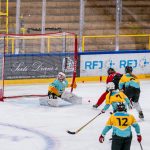
The Federation of International Bandy –FIB– approved Short Bandy as a new discipline on 17 January during its Annual Congress in Pori, Finland. Eight months later, its first international test has arrived: six clubs will compete in Porrentruy, Switzerland, on 12 and 13 September in a pilot tournament designed to assess the format, logistics and competitive structure. The federation intends to use the findings to develop future European competitions and turn a discipline created five years ago into a new route for the international expansion of bandy.
Traditional bandy is played by teams of 11 on an ice surface measuring approximately 100 by 60 metres, similar in size to a football pitch. The need for such a large facility restricts its development beyond its main markets. Short Bandy transfers the sport’s essential features to a conventional ice hockey rink and reduces each team to four outfield players and one goalkeeper. The FIB believes it retains a closer connection to the original sport than rink bandy and could help federations that currently compete in the B division of the World Championships but lack full-size rinks on which to train regularly.
From full-size ice to a hockey rink
The discipline was created in Czechia in 2021 in response to that shortage. Its inventor and the General Secretary of the Czech Bandy Association, Miroslav Samec, recalls the question that started the project: “How can we transfer elements of full-size bandy to a hockey rink?” He explained: “We were forced to train on hockey rinks because many European countries do not have access to large ice surfaces. We tried to identify which bandy conditions could be transferred to Short Bandy. In June 2021, we played the first competition.”
The lack of facilities turned that experiment into a solution for the domestic calendar. “Because we did not have a large ice surface, we played Short Bandy in Czechia’s top competition,” Samec said. “We proposed the name because we could see the potential for expansion around the world.” Its rules retain long-range shooting, corner shots and a penalty stroke similar to the one used in bandy, but do not allow play behind the goal. The goals measure 2.5 by 2.1 metres, placing them between those used in rink bandy and traditional bandy. Portable boards and collapsible goals also make it possible to set up a playing area on a hockey rink or even a frozen pond or lake.
 An entry point for countries without full-size rinks
Five national federations already play the discipline: Czechia, Germany, Hungary, Switzerland and the Netherlands. The Chair of the FIB Technical Committee, Frank Peters, says their experience has demonstrated its similarities to full-size bandy. “There are already five national federations playing Short Bandy: Czechia, Germany, Hungary, Switzerland and the Netherlands. We have seen many positive experiences there and many similarities to bandy, but on hockey rinks,” he said.
Peters believes its official recognition can support both player development and the involvement of new countries. “There is a major opportunity to improve as a bandy player because Short Bandy is much closer to bandy than rink bandy. It also gives new countries an opportunity to start developing the sport, even on an ice hockey rink,” he explained. He is already aware of an initiative to create a Champions League for national champions and has not ruled out a World Championship: “That could also be an option, especially if the Bandy World Championships are not held every year.” His comments follow the cancellation of the 2027 senior championships after Sweden, Finland and Norway declined to host them for financial reasons and proposed moving to a biennial calendar. The FIB also appointed Sportfive to distribute the international media rights for the 2026 World Championship as it seeks to expand the sport’s audience and commercial value.
A discipline designed to share Olympic venues
FIB General Secretary Attila Adamfi recently presented Short Bandy to the International Olympic Committee –IOC– as part of the federation’s attempt to move closer to the Winter Games. “Short Bandy was recently presented to the IOC as FIB’s newest discipline, meeting many of the requirements of the modern era of the Olympic Winter Games,” he explained. “The IOC’s latest strategy, ‘Fit for the Future’, is supported by Short Bandy’s characteristics, such as the possibility of sharing venues and requiring fewer athletes while still retaining bandy’s DNA.” The FIB views 2034 as a possible target for its Olympic ambitions, although no inclusion process is currently open. Bandy has previously appeared at the Games only as a demonstration sport, at Oslo 1952.
The first assessment will begin in Porrentruy with Noviomagus Lions and Nijmegen Capitals of the Netherlands, EC Mainzer Wolf of Germany, and Switzerland’s Rinkball Dübendorf, Bandy Club Grand Chasseral and Bandy Club Val-de-Travers. If the pilot succeeds, its organisers intend to welcome more European clubs, officially crown a continental champion and introduce a recreational category for players of different levels within an international setting. The tournament will test whether the format can create new competitions without requiring a full-size rink or such large delegations—and whether a version played on less ice can give bandy a greater reach.
 Last related articles