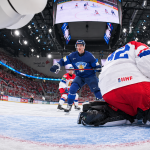
Finland has decided to move its opposition to Russia’s return from statements to competition. Its ice hockey federation announced on November 2 that its national teams would not face Russian teams while the war in Ukraine continues and is seeking to bring other countries together in a united front. The city of Turku has added a second source of pressure: it will relinquish its role as a host of the 2028 World Junior Championship if Russia participates. The dispute opens a gap between reinstatement through sports arbitration and the conditions needed to put it into effect.
The board of the Finnish Ice Hockey Association agreed to keep all available means open to prevent that reinstatement. Its president, Heikki Hietanen, confirmed contacts with other member federations of the International Ice Hockey Federation (IIHF) to coordinate a response carrying greater weight than an individual refusal. The aim is to turn Finland’s position into a shared stance, although no collective boycott agreement has yet been confirmed, nor has a definitive list of countries committed to the initiative.
Turku makes its hosting commitment conditional
Turku’s warning concerns the championship it is due to host alongside Tampere between late 2027 and early 2028. In its November 2 statement, the city authorities said they would withdraw from hosting if the Russian national team’s absence could not be guaranteed. Mayor Piia Elo maintains that accepting its participation while the war of aggression against Ukraine continues would be incompatible with the city’s values and ethical principles. The municipality is calling on the IIHF and the Finnish state to find a solution that avoids that scenario.
Turku has not completed its withdrawal or announced the cancellation of the championship. It remains willing to host the event without Russia but has introduced a condition affecting tournament planning and the certainty of existing commitments. The distinction matters: the 2028 World Junior Championship is not among the five 2027 competitions listed by the IIHF as affected by the recent ruling. The city’s position therefore anticipates the consequences of potential Russian participation in its own edition and extends the dispute beyond the immediate calendar.
The CAS ruling and the difficulties of implementing it
The starting point is the ruling by the Court of Arbitration for Sport (CAS) announced on October 30, which allows Russia to return to five championships: the 2027 Men’s, World Junior, Women’s, U18 Men’s and U18 Women’s World Championships. The IIHF expressed its disagreement and maintained that its restrictions were intended to protect participants’ safety and the integrity of its competitions. At the same time, it said it would respect the tribunal’s authority and act in accordance with its decision. Opposition from a national federation or a host city does not overturn that ruling.
Its implementation, however, requires a review of formats, schedules, travel, accommodation and security arrangements for tournaments whose preparations are already well advanced. The IIHF itself has warned that these changes require coordination with national federations, organising committees and host authorities and cannot be implemented immediately. This is where the institutional problem lies: reinstatement settles the question of participation, but staging the games requires cooperation from parties that may reject its consequences. Finland’s refusal and Turku’s announcement turn that difficulty into a concrete obstacle.
Pressure reaches organisers and sponsors
The difficulties also affect Germany, host of the 2027 Men’s World Championship. Its federation has expressed doubts about whether it can continue hosting the event given the additional costs and security requirements associated with Russia’s return. Adding to that uncertainty is the decision by AJ Products, a championship sponsor since 1989, to withdraw its commercial presence from the next edition. The Swedish company has said it does not want its logo associated with the tournament under these circumstances, adding an economic consequence to the sporting and institutional dispute.
The IIHF’s governing board began a two-day meeting on November 2 with Russian participation as its central issue. Hietanen, who also sits on that body, said he had clearly conveyed Finland’s position and left it to the international federation to communicate its decisions. At the end of the first day, the arrangements for implementing the ruling and possible subsequent steps remained unresolved. Finland, meanwhile, continued its contacts to expand the number of federations willing to refuse to face Russia.
 Last related articles