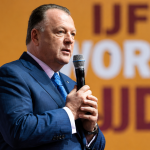
Alireza Dabir, president of the Iranian Wrestling Federation, has accused referees at the World Championships in Astana of favouritism and attempting to distribute medals among countries. The allegations have yet to receive a clear public response from United World Wrestling.
The championships, held from 24 October to 1 November, saw a heated confrontation between Dabir and competition officials following Mohammad Hadi Saravi’s semi-final defeat to Russian wrestler Sargsyan in the 97kg Greco-Roman category.
After the bout, Dabir approached the referees’ table and competition officials, shouting his objections. Security personnel intervened to prevent the confrontation from escalating.
Dabir’s complaints also concerned the officiating in Ali Esko’s match. Speaking to Iranian media after the competition, he claimed that referees had made unusual efforts to distribute medals among different countries.
He defended his conduct, saying that if he had not confronted the officials, they would have cut off the heads of the Iranian team.
To explain his reaction, Dabir referred to events on the opening day of the championships. He claimed that when four Iranian wrestlers reached the semi-finals during the morning session, congratulations from numerous coaches and federation presidents made him suspect that a plan was already in place for the afternoon session.
He also alleged that two members of the UWW Bureau had told him at Zagreb Airport last year that they could not allow Iran to win all the gold medals at the World Championships.
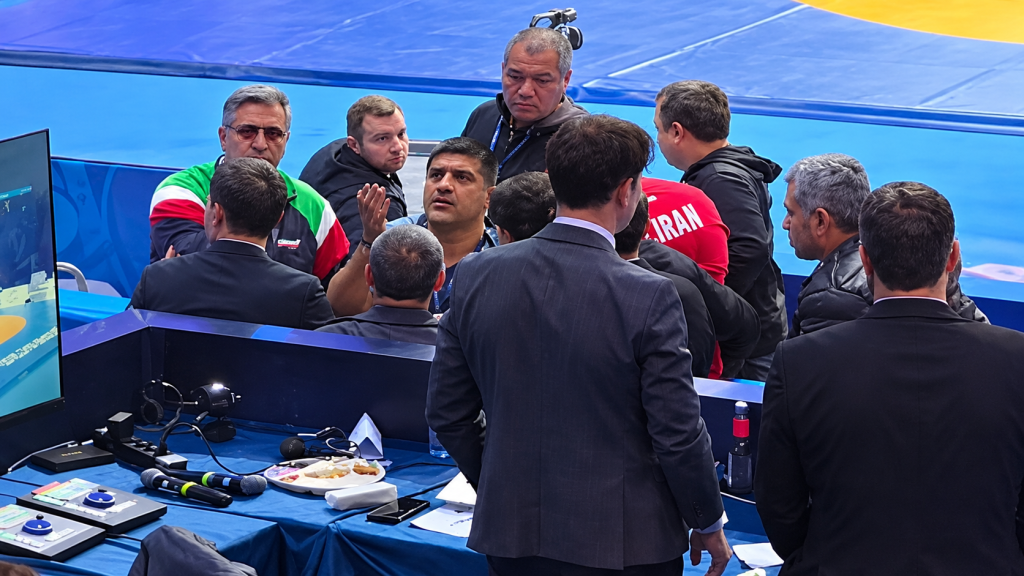
Dabir’s protest refereeing decisions
Dabir’s remarks have raised questions about the officiating at the championships and the procedures through which national federations can challenge refereeing decisions. Formal complaints are generally handled through established competition and disciplinary procedures.
The Iranian federation president is also a controversial figure in his home country. His critics have accused him of maintaining close ties with the political establishment of the Islamic Republic and repeatedly defending government policies in public.
During public protests, Dabir described opponents of the government as people deceived by the West. Following the World Championships, he also publicly thanked Gholamhossein Mohseni Ejei, head of Iran’s judiciary, prompting further criticism over the judiciary’s role in the repression of government opponents and the issuing of death sentences.
Dabir described Iran’s six gold medals in Astana as a major achievement. However, the country’s record in wrestling has also drawn attention to the restrictions facing women in Iranian sport.
UWW under pressure
Since the establishment of the Islamic Republic in 1979, women have faced extensive restrictions on participation in many sports. Wrestling has also been affected. UWW has faced criticism over its efforts to support the development of women’s wrestling and defend equal opportunities for Iranian women athletes.
The allegations made by Dabir now place the Iranian federation and UWW under pressure to address the controversy. The Iranian federation has yet to present publicly verifiable technical evidence supporting its claims against the referees.
UWW has also yet to provide a clear public explanation of whether it intends to examine Dabir’s allegations or how it will address the complaints.
The dispute raises questions about accountability on both sides. The Iranian federation is responsible for substantiating its accusations, while UWW faces questions over its handling of complaints concerning the integrity of officiating at international competitions.
 Last related articles