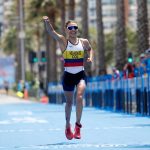
Carolina Velásquez won the Iquique World Triathlon Cup in Chile on 8 November after a sprint finish in which the top two athletes recorded identical times of 55:47. The Colombian, who competed at Paris 2024, had spent around four years away from high-performance sport before beginning the journey that took her to those stages. During that break, she studied psychology, worked as a swimming instructor and remained active, with priorities different from those of a professional athlete.
She decided to step back after the 2015 National Games. The opportunity to return came through a phone call from her former coach in late 2019. Between those moments, she found something she felt she needed to handle the demands of competition. “Back then, I wasn’t physically or psychologically mature enough to take on the commitments of high-performance sport,” she told the Colombian Olympic Committee. With her university degree completed and a sporting career that eventually took her to the Olympic Games, her assessment of those years is clear: “The break was necessary.”
A girl on the shore and a borrowed bike
Born in Marinilla, in Antioquia, Velásquez grew up with her parents, Wilman and Nancy, and her two older sisters. One childhood memory comes from a family seaside holiday: while everyone else went swimming, she stayed on the shore because she did not know how to swim. She asked for lessons so she could join them on their next trip. At six, she entered her local swimming programme before progressing at Club Nativos, where backstroke and butterfly became her specialities.
Triathlon entered her life through friends who began taking up a sport that also involved cycling and running. She was not particularly convinced. “Initially, neither cycling nor running appealed to me, and at first I just saw it as a way to pass the time,” she told ‘La Veintitrés’. Her mother greeted the idea with humour: “If you’re this skinny doing one sport, you’re going to disappear doing three.” With hardly any cycling preparation and a borrowed bike, Carolina entered her first race at Lake Calima. After losing places on the bike, she made up ground on the run and won.
University and work as a swimming instructor
That almost accidental introduction soon led to international competition. In 2014, she represented Colombia at the Nanjing Youth Olympic Games, an experience whose scale only began to sink in as she travelled to China. The following year, she won relay bronze for Antioquia at the National Games. She then decided to prioritise her education. Her father wanted her to gain a professional qualification, and she began studying psychology at the Universidad Católica de Oriente, while teaching swimming to cover her university expenses.
Stepping away from elite competition changed her schedule and her goals, although she continued swimming and cycling with friends. University and work filled the time previously devoted to competitive preparation. In an interview before Paris 2024, she explained what completing that stage meant to her: “I’m grateful it happened this way, because I finished my degree, which was important to my father. I prioritised my studies so that now I can feel at ease and dedicate myself fully to being an athlete.” She could build her return with that concern already resolved.
The phone call before a work placement
In late 2019, she was about to begin a psychology placement at Atlético Nacional when José Said Bustamante, the coach who had accompanied her on the road to Nanjing, called. He invited her to join Caldas’ programme for the 2023 National Games in the Eje Cafetero region, a project that also included triathlete Mayra Vargas. Carolina wanted to accept, provided she could finish her degree. She also had to explain the decision at home. “I told my father: the worst that can happen is that I have to come back. Let me give it a try,” she recalled in the interview with ‘La Veintitrés’.
She joined the programme in Manizales in 2020. With part of her degree still to complete, she travelled to Marinilla every fortnight to meet her academic commitments. Then the pandemic moved classes online and forced her training to change too. Her body needed time to readjust to the demands of professional sport. She described it as “starting the process from scratch because my body was completely out of condition, nothing like a professional athlete’s”. She had made the decision to return; rebuilding her competitive fitness would take much longer.
The team behind her return
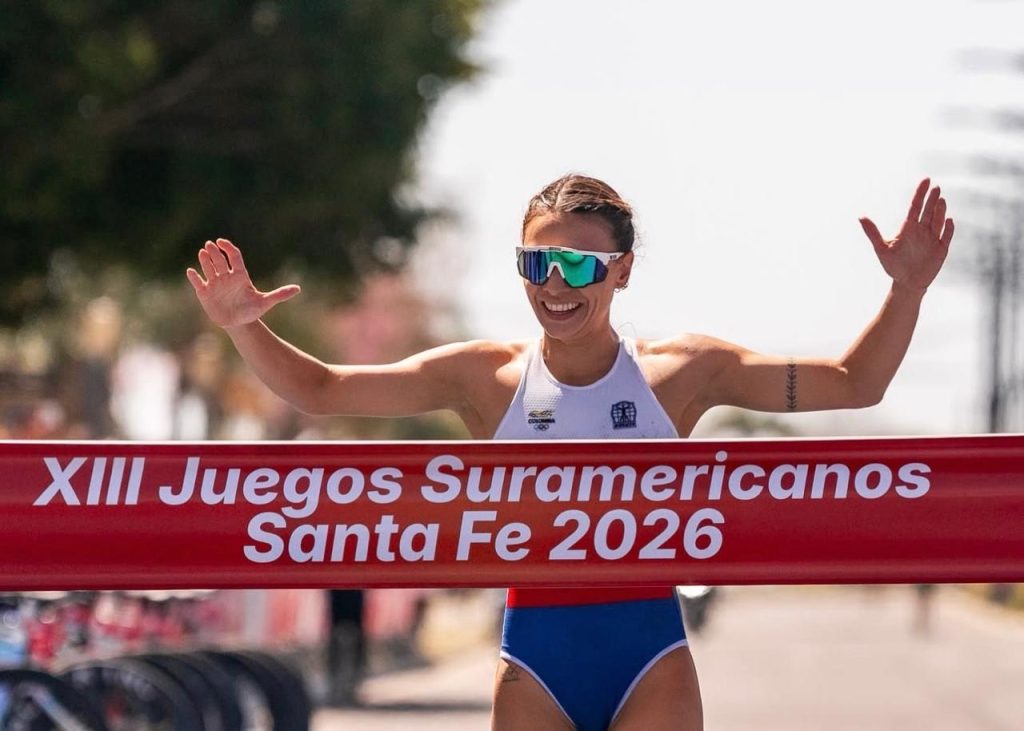
Velásquez credits much of that rebuilding process to the people who worked with her in Caldas. “We had the doctor, the nutritionist, the psychologist and a whole group of people who were involved in the process and began to see the change,” she explained. A national title and World Cup bronze in Viña del Mar followed in 2022, then two gold medals at the 2023 National Games that had prompted her return. She subsequently qualified for Paris 2024. After her time with Caldas, she returned to representing Antioquia, and this season won individual gold at the Santa Fe South American Games before her victory in Iquique.
“I’m very happy. The standard was very high, and fortunately we had the legs for a finishing sprint,” she said after winning in Chile, in comments published by Indeportes Antioquia. Years earlier, as the results of her second career began to arrive, she had explained that her initial expectations were far more modest: “I never imagined any of this. I dreamed of returning to the National Games in good physical shape, but imagining international races was difficult because of the financial support needed.” Her first decision had simply been to accept that phone call and try living in Manizales, with university work still to finish and the possibility that she might have to return home.
 Last related articles